
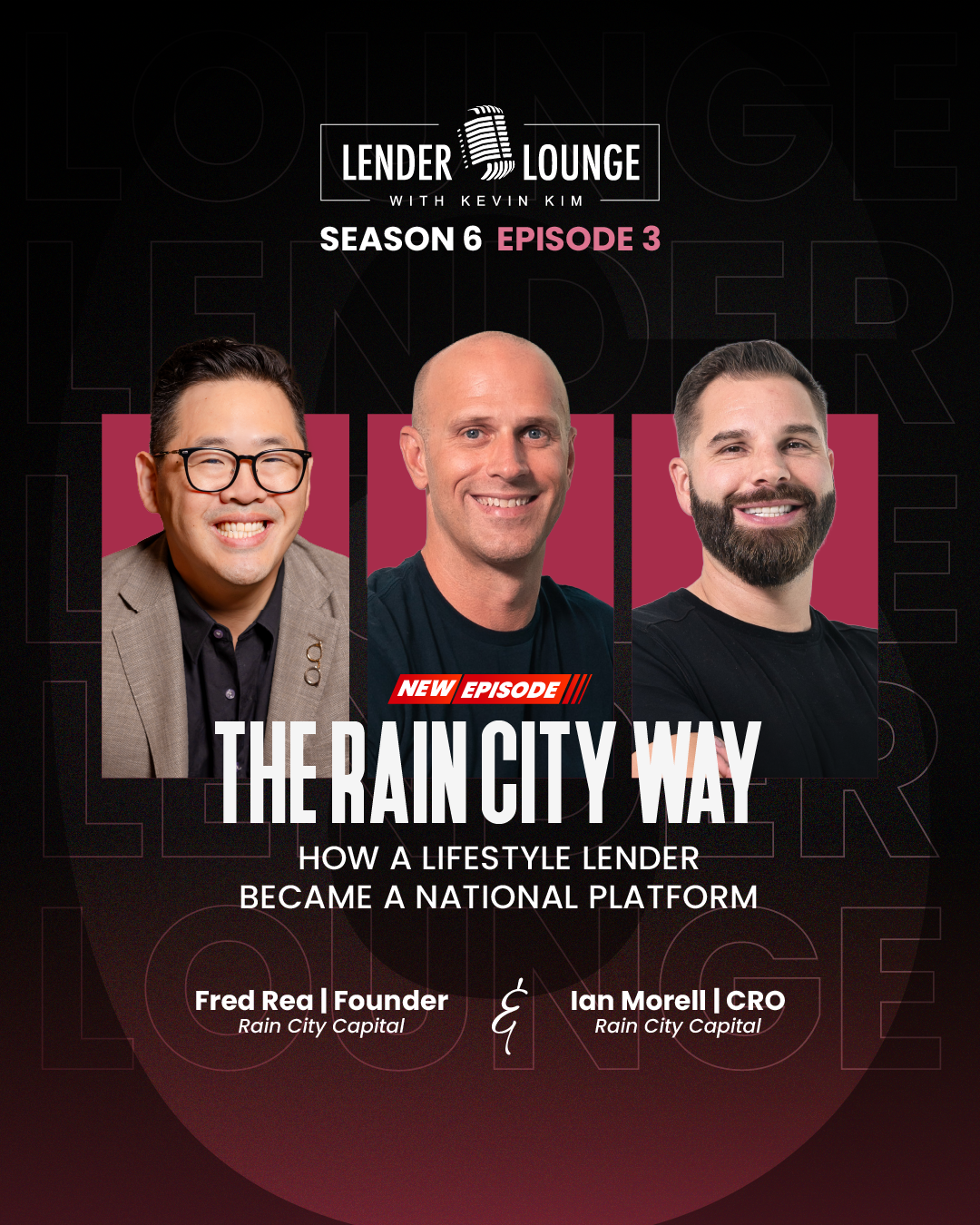


Kevin Kim:
You’re listening to Lender Lounge with Kevin Kim, a podcast dedicated to helping our listeners in the private lending industry grow, improve, and streamline their business. I’m Kevin Kim, partner at Fortra Law, the nation’s largest private lending law firm. Join me as we chat with the best and brightest in private lending.
They’re eager to share their years of wisdom and best practices for lenders, brokers, borrowers, investors, and more. Subscribe to Lender Lounge on your favorite podcast platform and visit our website, fortralaw.com, to learn more about how we can help you scale. Check out the episode summary below for other valuable resources.
Welcome, everyone, to another episode of Lender Lounge with yours, truly Kevin Kim. We are in full swing in season six. Today, we are recording in my home studio.
I never record from home, but, you know, life happens. Today, we are honored to have a guest on the show, a company. I think you guys have been a client, the longest, most of our guests are all our guests.
I don’t know, Fred, we go back a while. Please introduce yourselves to our audience and let’s get started.
Fred Rea:
Hi there, Fred Rea, founder of Rain City Capital.
I think we got 17 years this year in June. It’s been a long road. I’m not sure how long we’ve been gibber-jabbing, but it’s definitely been a while.
I think I remember the first time I met you was at the AAPL when there was like eight booths and like five people tops. So yeah, a lot of the business for sure.
Ian Morell:
Ian Morell, I’ve been a partner of Fred since 2013, I believe. Fred and I started as competitors. Funny story behind like our origin stories on how we met, but essentially 2013, we joined forces.
Yeah, been running ever since, putting up with this guy for a long time.
Kevin Kim:
I love it. And very rarely do we get to have partners on the show. And so, I’m glad you guys are both here.
The main topic of this show is to really give you guys a platform and learn more about the history of the company and your partnership and all that fun stuff, right? And then take us back. I mean, Fred, you said 17 years.
So, I mean, what is that like, 2009, I think? Oh my goodness. Yeah, I mean, hard hard money, right?
Fred Rea:
Different.
Kevin Kim:
Give us the background. I mean, you guys are not partners back then. So what were you guys take us back in time and let’s talk about your backgrounds, how we got to this crazy place called Rain City?
Fred Rea:
Well, Ian when did you start at the other company?
Ian Morell:
I think it’s 2008. It was 2008 or 2009. It was right before, right?
Because it kind of like at the end of the crash when things started. So it was like eight to the eight, nine.
Fred Rea:
So I started in the hard money biz in 2003. My first networking event that after I learned what a mortgage was and started as a mortgage broker or whatever you want to call them was the foreclosure auction. I never left.
I loved it. I loved every second of it. I attended the foreclosure auction in Washington.
It’s weekly. And I finally got to make the full time jump to hard money in 2005. So really, last year I celebrated 20 years in the hard money business.
So I watched it go from, wow, you have 50 million under management and like, holy shit, you guys are big to 50 million. Like that’s not even a month of originations go away. It’s been a while.
Kevin Kim:
Right. Right. Yeah.
Ian, how about you, get back to your origin in our industry and then we’ll move on to how y’all connected?
Ian Morell:
Yeah. So we, when we first started, both Fred and I, we were lending at the foreclosure auction. Anything which is funny to say, but anything outside of the auction scared us.
Like I still remember wanting our first like escrow deal. And I was like, what’s this all about? How’s this work?
But I mean, we would go down to the courthouse steps with cashier’s checks for a million bucks, a couple million bucks every Friday. And I was going down there. I mean, there was not probably a 10 year period in Seattle at the courthouse that I wasn’t standing there with envelope full of checks and Fred would show up every once in a while.
And I’ve told the story of this, this nerd that would show up in oversized jeans and glasses and kind of stand in the corner and wouldn’t talk to anyone. And, you know, I talked to him a few times, got to know him a little bit and realized he’s pretty good dude. And he would show up and, you know, when he showed up usually, because he wasn’t there every week, but when he showed up, usually he was there to buy something and he was representing someone on a property.
And typically, what was your average loan size back then, Fred?
Fred Rea:
60,000, baby. Yeah.
Ian Morell:
You could almost see Fred showing up and know, okay, he’s on, he’s on that property, right? That was like the Fred Rea special. And I was with a pretty large firm at the time, I didn’t have any equity, but at the time I was the originator, the underwriter, everything, I basically looked at all the deals as they came in.
And I like to, you know, tell the story of how Fred’s cute little fund back then, what he’d run out of money. And I’d kind of go and scoop up as many of his clients as I possibly could. And then when we had seasoned loans, I’d call Fred and be like, hey, dude, you want to buy this loan back or buy this loan and I would sell it.
Like it’s a great loan. And we had to get it off our books at that time. Like we didn’t really have a whole lot of flexibility after the nine month period we had with our bank.
And Fred claimed he never bought any loans from us. But I swear we did some I swear we did something back then. I don’t know, it was a long time to go.
Kevin Kim:
That’s great though. It’s great to see competitors partner up. So I mean, was it called Rain City back then?
Fred Rea:
Yeah.
Kevin Kim:
It’s been the same company ever since.
Fred Rea:
Ever since.
Yeah. Since the very beginning.
Kevin Kim:
So Ian’s mentioning, so just kind of give us the picture of the company back then.
It was auction house steps, foreclosure loans, the old school hard money method. Was it still, you know, you had your fund back then already. So you opened, you went to the end of this business with a fund ready to go.
Ian Morell:
When I first started with the company I was with, I was super green. I was a conventional loan officer that was interested. I had no clue what I was doing.
I was at the bottom of the totem pole for a pretty large fund and and worked my way up over five or six years with them. But again, like I just went down. I was the guy that would run money to the auction at the very beginning.
And Fred, Fred actually had, I’ll let Fred tell the story, but Fred actually had a fund and was showing down there was some investor capital early on.
Fred Rea:
I started with a fund. I didn’t know any different. And I really, I’m not the best salesperson.
I’m not Ian over here. So I knew how to make a good loan. And, you know, through 2008, I lost all my money.
I got a crash course on what was a good loan and what wasn’t. And I didn’t want anybody else telling me what to do. So yeah, I started my own fund, started it with 90 grand in 2009. I mean, you you’ve helped me kind of change it over the years.
I think the first fund I set up isn’t even like we didn’t even run with those docs. I think we ended up doing something in like 2012 or 2013 kind of reiterated over time as the company running got larger and, you know, done all the crazy stuff we’ve done.
Kevin Kim:
The fascinating part is there’s very few shops that are still around from that era.
Most of them have either been bought, shuttered, you know, I mean broken up, you know, it’s just very rare to see operations continue for that lengthy period of time. I mean, nearly 20 years. What do you think, you know, kind of took it from the first, like the first big moment for you guys where, okay, now we’re cooking with gas kind of what I call it, right?
Like you’re going from a local small operation and then you really start. Oh, man, this is a real thing. We’re really killing out there.
We’re starting to grow. What was that first moment for you guys?
Fred Rea:
COVID.
Kevin Kim:
Really? All that entire time? 09 to 2020?
Fred Rea: Yeah.
So Ian wasn’t an active partner in the business, even though I begged him to, because again, I’m not the sales guy, right? So he was, you know, giving us loans from his other business. And in 2020, it was really, you know, I got a lot of time to sit around in my house, probably drink a little bit too much alcohol, but, you know, I had a lot of time to think.
And it was, it was really interesting because we still had a small balance sheet. It wasn’t giant, but we still made loans throughout that time. When everybody else just shut down, they were done.
Now we were funding a fraction of what we were doing before and being super careful, but it was then where I really, I got eye opening from a lot. I talked to a lot of different people, a lot of competitors, and I was watching and hearing the deals that were coming out and securizations where they were going at, you know, 1.9% all in and a 95 advance. And I’m sitting here at like a three and a half and a 75 advance.
I’m like, holy shit. I think there was like 25 or 30 employees.
Very manageable, didn’t work that hard, made a lot of money. That was awesome. But I was just like, holy crap, we are going to get our lunch eaten if we don’t pivot.
So during COVID, when COVID started, we were Washington, Oregon only. And I think, you know, our first expansion state was Texas. You know, that was the time where I was like, okay, we consciously made the decision we’re going to grow.
And true Rain City style, we had been doing this a long time, it wasn’t one of those things where I just wanted to go and blow it up.
Kevin Kim: Yeah.
Fred Rea:
You know, and when I saw in 22, that interest rates started going bananas.
That was another time we made another leap ahead, when everyone else was kind of like sucking wind and eating shit. But yeah, it was COVID when we decided to really go for it.
Kevin Kim:
So I noticed the difference in the company as, as your account, wait a minute, what’s going on over here?
Like, and I’m watching the different loans that you’re doing, I’m hearing stuff, but I didn’t actually get that pivotal moment from you. So that’s really important to the audience. But that means that that’s 13 years of just like, or 11 years, just sitting there, just operating locally.
Ian Morell:
Yeah, I think what Fred said about the lifestyle businesses, you know, back in the day, when we were just in the Pacific Northwest, not only do we know every competitor that we were up against, but we knew the name of every loan officer that we were up against. It was such a, there was no institutional money in the game back then. It was, at least there wasn’t in the Pacific Northwest, there was us and a few other lenders that we were battling it out for.
And again, we knew, we knew our competition. And I mean, Fred and I were the only two originators originally, and then slowly, there were a couple more. But I don’t know, Fred, what are you saying, like that 10 period, 10 year period?
Maybe we had four loan officers?
Fred Rea:
Yeah, I think we started hiring really in like 2017. That’s when I stopped originating, it was 2017.
Kevin Kim:
Was that when was the shift in the Washington market away from the courthouse steps?
Fred Rea:
Yeah, it kind of happened over time.
Ian Morell: Yeah. And different operations.
Fred Rea:
So foreclosure auction really ebbs and flows too. So like, you know, when 2012, obviously, it’s humming, right? There’s like 150, whatever.
I remember at the beginning, like, there’s peak weeks on a Monday, you look at the auction, there’d be like 350 to 500 properties scheduled for Friday. Now if you look at it, it’s like 75 to 100. And such a small fraction goes to the auction.
So over time, the market picks back up again, 2015, 2016 rolls around. The auction isn’t really, I mean, there’s only a finite number of properties that were going. So for us, we are always kind of trying to figure out ways to grow the business and do more.
Kevin Kim:
And it seemed like that you’re kind of insulated from a lot of the other guys out there. Because what I started seeing and when I first joined the industry in 2014 was right around 16 was what was when everyone started going, quote unquote, national, right? Like everyone’s like, all right, we’re going and then Texas was the first state for a lot of us West Coasters.
But like, we started seeing New Yorkers making loans in California and all this kind of interesting stuff happening in 16. But yeah, I think you’re right up where you guys are. I mean, there’s still a lot of shops that are hyper local to your local market.
They don’t really expand outside of your state for various reasons. Now, going into that though, in five years, then you guys have, well, we’re in the beginning of 26, but in five years, you guys have really then just exponentially grown your, I mean, volumes, what’s the volume difference differential compared to if you look back?
Fred Rea:
Oh, you’re asking me numbers I don’t know the answers to.
Kevin Kim:
Right, but generally, I mean just based on feel.
Fred Rea:
Probably like a 100 ish million dollar a year shot. And, you know, now we’re seven times that.
So yeah, I think, I mean, it’s definitely grown a lot, but it was really 21. I made the decision and I’ll never forget it September 2020. And then our first application for a national line of credit was in January of 21.
So that was when it was like, I knew where I was when I made the decision, we’re going to go on and do it. Let’s go.
And then, you know, we started to really work hard after that. I also lived in Maui at the time too. So it was very helpful.
Ian Morell:
But this is what I remember – Fred disappeared. Basically, we used to come to conferences and we never saw him for a while. Like, where did Fred go?
You told me I moved to Hawaii, I’m like oh, that’s pretty nice. My change in lifestyle compared to cold, cold, Washington.
Fred Rea:
That’s very true.
I mean, you can see it outside. It looks nice, but it’s raining right now. It’s true.
It rains.
Kevin Kim:
So the first kind of capital change was going into the whole line of credit, the lever of the balance sheet. Did you guys start talking to the secondary market then, or were you already kind of working with them before that?
How did that work?
Fred Rea:
I think I was one of, I think I was number two or number three of Torox clients. Like 2016.
Kevin Kim:
Okay. So you had already been exposed or relatively early on.
Fred Rea:
Yeah.
And we already kind of grown outside of our skis, but we had a couple of investors where I would originate the loans for them, or we would originate them and sell them to them. And we were also one of the first ones for, I don’t remember the name of their company.
Ian Morell:
I think I know you’re talking about, yeah, they’re not around anymore.
Fred Rea:
They’re still around, but they were, it was like, that was this three companies ago and they first got it. I remember it was like Fidelis, uh, rock.
Ian Morell:
Oh, yeah.
Yeah. Yeah.
Fred Rea:
Yeah.
Ian Morell:
They renamed their company a couple of times. Yeah. That’s true.
Yeah. No, it’s not Fidelis. Yeah.
Yeah.
Fred Rea:
It’s now Fidelis, but it was Five Mile before and I don’t know.
Ian Morell:
Yeah.
Fred Rea:
I’ve had the same MLPA since 2016 with them though.
Kevin Kim:
Oh, that’s great. That’s great.
They must like you a lot.
Fred Rea:
Holy crap.
Kevin Kim:
Yeah. So that’s interesting though, because if you were already exposed to the secondary market back in 2016, you know, very early stage compared to a lot of lenders, what stopped you from taking, you know, the nation by the horns, like you guys are taking it now? What’s the whole stopping you, was it just purely just, hey, we’re chilling?
Ian Morell:
I think Fred’s risk tolerance change at a certain point, right? But like staying small and safe and and lending where we know in our backyard was a big part of who we were in our identity in our brand. And it was like Fred said 2020, where the mind shift of like, hey, we either need to like step this up and grow or we’re going to get squashed.
Kevin Kim:
Expand on the we’re going to get squashed thing because I’ve been having these similar conversations lately, where a lot of clients around for a while that like they’re feeling the pinch and they’re feeling like they’re going to get squashed if they don’t change things.
Ian Morell:
Yeah, I think like the the old school evergreen lenders that we were used to, we were the country club money, you know, you run out at a certain point. So you can only scale so so much. And then the Bay takes a lot more capital deployed to access the cheap capital that is out there right now.
So the small, small funds are not going to have access to the same capital that maybe the larger funds were and we knew that we needed to grow our portfolio to have access to that capital to stay competitive. But I think the one thing that we’ve succeeded in, I still see the difference between that small lender that has portfolio balance sheet and they can do like nichey things and be creative. And then you’ve got almost the institutional side that has a credit box without a whole lot of variants outside of it, right?
Kevin Kim:
Like if this is like the qualifying and non-qualifying. Yeah, it’s like, you know, BPL loan kind of thing. Okay.
Ian Morell:
Yeah, it’s gotten closer to that like conventional type of thinking on, you know, those institutional lenders. I feel like we are one of the only funds that I know that kind of offer both of those. We have our portfolio.
We can still fund the 580 credit score person with a good story. And we can hold on to that one if we believe in it. But we also now have access to that institutional cheaper capital.
Kevin Kim:
So it’s funny because I’m biased in that regard, right? Because I mean, my job is doing funds and like, that’s the funny part is like, there is a large segment of the market that does both. But more and more, the guys that are pure balance sheet, like leverage and fund, they’re really complaining like, and it started complaining four years ago, man, we’re getting our lunch eaten by these giant national guys.
But it’s gotten worse past three years. So, I mean, that was the logic, right? Your business logic was they have so much cheap capital, and they’re able to go, they’re able to offer just a competitive product.
We have to step it up.
Fred Rea:
Yeah. And if you don’t, yeah, if you don’t play the game, and it’s, you’re going to get left out.
To me, it was abundantly clear. I was just like, oh my gosh, this is getting wild. And I mean, nothing’s changed.
It’s also, you know, it’s like, you know, the mortgage business, it’s evolved a lot over time. And it was a business that really no one knew about until, you know, the housing crisis 2008, 2009, really, it’s shown a really bright light on something that was, you know, your risk adjusted return was just off the charts. So how do we get into this?
How do we, you know, grapple all this when, you know, Invitation Homes was buying houses, like Ian’s company was helping them buy them, because they had to go direct to the source. They couldn’t go anywhere else. They couldn’t just put dollars out.
So I had to actually build operating businesses to go and find this stuff. And through that, I really realized like, crap, there’s a business here. And, you know, as a passenger and, you know, got to watch this business evolve over the last however long you can, you see it coming a mile away.
I mean, institutions probably hold, and I’d say institutions, you know, really anyone that’s over $100 million in assets, I own 70% of this business. And it’s going to go to 90, 95 at some point.
Kevin Kim:
And if you qualify it that way, yeah, because like, there’s like, you mentioned earlier, right, like back when 50, 100 million was game, you were like the biggest name in town, if you were that big.
Now, I mean, there’s several, several, several hundred million plus balance sheet lenders out there. Now, kind of the conversation revolves around the half a billion mark in the U.S. And you’re kind of like, okay, you know, you’re, you’re pretty big. And now the originations are now like, we’re, you know, the one billion in originations lifetime is no longer like, holy crap, kind of, it wasn’t, it was, but now it’s like, huh, everyone’s doing that.
So it’s fascinating kind of where we’re at.
Fred Rea:
Well, the crazy thing. So I’m just what I’m watching too is that, you know, for Rain City, we don’t want to be Kiavi.
You know, I don’t need to be number one. And no one wants to do that. I mean, I’ll leave that to Arvind and his group.
But the, to be a top 10 lender, you know, I’ve always been like, wow, if you do 1.8 billion a year, 150 a month, you’re going to be a top 10 lender. And you know, this is the first time that I’ve ever seen it, where if you did that much in loan volume, you were lender number 10 for 2025.
Kevin Kim:
I mean, doing a billion a year in volume was unheard of.
Fred Rea: Yeah.
Kevin Kim:
Yeah. I mean pre-2020, it was unheard of.
No one, no one did that kind of volume. It didn’t exist.
Fred Rea:
For sure. So, you know, for Rain City, this goal was to be a top 10 lender. And amongst all those people, yeah, you know, we got to move, we got to move the needle a little bit.
Kevin Kim: Right.
Fred Rea:
Yeah. It’s a lot to go through, especially, you know, for us, we keep culture and culture above all.
And you know, it’s like, I always tell people I’m ready to burn it down if we’re not having fun.
Kevin Kim:
Well, expand on that. So like, you know, the team has had to have grown in the past six years.
What are some of those core values, I mean, having fun, it sounds like it’s a very fundamental pillar for you guys. But what else?
Fred Rea:
I mean, number one, you know, so mission statement is real and lasting mutual success, which that can mean a lot of things.
But really it, you know, everybod, to our vendors, you know, like partners like you, Kevin, or you’re asking me for the bill upfront. And I’m like, dude I paid you before I swear I’m going to pay you. But either way, you know, it’s it’s doing right by everybody and making sure you have a win-win with everybody internally, externally.
But what I always say, our core value is, and you can put them on the website, but I always say it’s a have fun and get shit done sandwich. We have five. Number one is have fun.
And number five is get shit done.
Kevin Kim:
And you give me this, kind of give me in color on like, you know, how the companies like changed people-wise, because if you went through that traumatic change post COVID, I’m guessing you guys also added a bunch of bodies to the team, you had to have, right? I mean, what is what was like and what is it now, you know?
Ian Morell:
I’m grateful. I think we’re fortunate to have some like real characters on the team that know how to not only set the culture, but keep it going. And you know, whether you have 30 people on a call or 130 people on a call, those people are continuously, you know, being themselves and encouraging others. And then others will start to kind of chime in and warm up to it.
But like, when I when I hire new people, I’m like, hey, this culture, you can’t be easily offended to work for Rain City. I mean, there’s stuff that makes me cringe from time to time, our HR department is non-existent. But at the end of the day, like, you don’t have to be that person.
But you have to be lighthearted and tolerate that behavior. There’s like, we’ve got 20 year old 22 year old loan officers and we’ve got people that are, you know, we have a variety of ages and backgrounds. And now we’re nationwide and people from every state with different accents.
It’s a lot of fun. But what we maintain, we maintain this whole time is the “we can make fun of ourselves.” And we can laugh.
And one thing that we’ve incorporated a long time ago in every meeting is five minutes of fucking around. And that’s what we call it five minutes of fucking around. And we can’t start the meeting until and usually that five minutes ends up going to 10.
But that right there is like a tone setter, right? You start as your first day of the Rain City, you’re coming and hey, we do five minutes of fucking around. And that’s kind of weird.
Okay. But it is again, like little things like that, seeds that are planted for people to kind of get like, okay, this is what these guys are all about. And we’ve had a couple scenarios where people quit the day after like 24 hours, they quit.
And it’s great. Like, at least we know, and it’s part of our interview process now, like, we’ll make sure that they know what they’re getting themselves into. And I’ll oversell it even.
Then, you know, they come in and if they they might not have thought I was serious, they sit through one meeting and hear one inappropriate joke. And they’re like, I’m out of here. It’s happened.
And Fred loves it. He’s fucking celebrates it.
Kevin Kim:
I know this about Fred. He does not take himself too seriously. We’ve had a lot of good times over the years.
But one of the things our audience I mean, this is the extreme. I remember when we were talking about, and I haven’t even brought this up. But like, when you guys were doing the bond raise, like, Fred, you told me that you, you were going around on your road show, in your usual hoodie and baseball cap, and everyone else in their mom was all suited up, necktie and slacks and everything.
Fred Rea:
Did you show up at ABS East? You know, there’s a couple people that definitely didn’t know me. They totally made fun of me.
I went and had jeans and a black t-shirt. And it was just a room full of suits. And like, everybody was uncomfortable.
I think only two people actually said something that were the people that I met with. That I didn’t know. It was pretty funny.
But no, I did not go on the road show. I wanted to. And I told, I told him next time that I was going to definitely wear a hoodie because I feel uncomfortable with these buttoned up shirts.
I can’t do it.
Kevin Kim:
I don’t think I’ve ever seen you wear a suit ever. I mean, in all the years I’ve known you, I don’t think I’ve seen you wear a suit once.
I think that’s the best that 20-year-old world is going to end.
Fred Rea:
So I did wear a suit to one of our loan officers’ weddings.
Kevin Kim:
Yeah, I mean, but that was, yeah.
Ian Morell:
He’s not a complete animal, Kevin. Come on.
Kevin Kim:
I mean, so let’s talk about the expansion of the company people-wise. I mean, what did the company look like back in the 2019 before COVID? When you guys were hyper-local, was it just you two and a handful of people?
Or was it still a solid thing? Because you guys are doing good volume in Washington and Oregon.
Fred Rea:
So we were like 25 to 30 people.
Don’t quote me on that. But it was enough to fit in this office that I’m in now. Yeah. And we had extra spaces for sure. And yeah, it was just Washington and Oregon. We closed 2020.
We hadn’t closed a loan in any other state. I think we tried to do the auction in Texas at the end of 2020. And it didn’t really end up panning out for a lot of reasons.
We did a few loans here and there, but it wasn’t anything meaningful. But since then, we’ve tripled in size from pure people. I think our biggest contingent anywhere else would be a right around Ian in Austin, right?
Maybe we gotta have like six to eight people in Austin.
Kevin Kim:
Is there an office or are they working from home?
Ian Morell:
All working from home?
Fred Rea:
Yeah, right. Works from home or Ian’s house or whatever. And then we have people all over the place, our CFO.
He’s in Jersey. We have several in North and South Carolina, you know, across kind of the middle too. We got a little bit of people everywhere.
Ian Morell:
Yeah, it was interesting. I was looking at our closed loan volume in 25 and it was less than 30% in Washington and Oregon, which is kind of mind blowing thinking of like, you know, how long it was just Washington and Oregon. So it’s been kind of fun.
And I remember going to my first conference when I like reengaged with Rain City and like 20, what was that, like 21? 21. And people were like Rain who?
What’s that Rain? And no one knew. Rain City Capital from Seattle, like no one knew who we were.
And it’s been kind of fun the last few years to kind of see the growth of not only the head count and the sales, but just like the notoriety overall.
Kevin Kim:
And as you guys are to expand people-wise and adding new markets, you know, what was the philosophy on the business side? Like, was it just still all right, we’re just going to do RTL, fix and flip construction or like, we just started adding more stuff.
Fred Rea:
We’ve always done the RTL business really well, you know, fix and flip is our bread and butter, because it’s what we know.
That’s what we really wanted to go out with. So I mean, we’ve been mostly RTL, still are mostly RTL. And you know, I’ve always been the balance sheet lender.
So I don’t know anything different. I don’t want to, we don’t make a loan to sell it. We make a loan that, you know, either we like it, and if we can’t sell it, we’re going to keep it.
And you know, having that methodology, you have to keep your, you know, underwriting and whatnot, all the same. So when we went out to all the other, you know, states, and as we’ve grown, obviously, we want to have someone there, that would be ideal, but we still have seasoned officers that have been, you know, with us for at this point, seven, eight years. And even more than that, but they know what they’re doing.
They know what a deal is. And they know what bullshit looks like. And, you know, to sniff that stuff out, you know, your frontline has to have some experience of doing that.
So we really kind of stuck to our guns. And we didn’t get too caught up in the multifamily craziness.
Kevin Kim:
I mean, it’s huge right now, right?
Fred Rea:
Yeah.
Kevin Kim:
And frankly, it seems like there’s a lot of opportunity in that regard, too. Like it’s just, you know, I think there is easy.
Yeah.
Fred Rea:
Yeah, there’s definitely a lot more opportunities. I made passive investments in several little funds that were doing exactly that.
And either they’ve done okay, or they went to zero.
Kevin Kim:
Oh, yeah. Oh, yeah.
Yeah. Yeah. On the sponsor side, for sure.
There’s been multiple stories about failures in the multifamily syndication and fund sector. But like, you know, our interactions lately have been all around, well, we’re going back into multifamily from finance, you know, like loans. Like, you hear many of the top five shops, like really putting resources behind multifamily, some of them are like building a whole platform around it.
And it’s just fascinating to see a whole new vertical for them and just seeing what they’re chasing.
Ian Morell:
I think the where it really went awry, at least for, you know, lenders like us is, you know, they’re trying to underwrite something. They don’t really know how to underwrite.
And trying to take, you know, like per unit, the basis price or, you know, and not really thinking about what the secondary market of interest rates look like and what cash flow is and kind of how that functions. You know it kind of theoretically, but in the real world, interest rates go up significantly, you’re going to get smoked. I think that knowing that, a lot of the comping and some of the stuff that we did. I mean, we still have some stuff on our balance sheet where it’s just still a little dirty.
It’s working its way out for sure. But yeah, we tried to stay away from that as much as we could.
Fred Rea:
Just, you know, it’s like the, you know, age old real estate thing is like loan more unit or own where you know.
And, you know, and for us, we took that idea as well as like make loans, make loans. And we weren’t perfect. I think we went too hard in Florida. You know, thankfully, we kind of pulled back like nine months ago.
Kevin Kim: As has everybody else, right?
Fred Rea:
So, yeah, we were ahead of the curve. I mean, we went there and all of a sudden it was 10% of our loan volume.
It was like, hold on a second. We’re, you know, four months in and 10% this is a problem. It’s because our, you know, we were just a little bit too loosey-goosey and didn’t understand the market nearly as well.
And we got stung on a few, but I think in the aggregate, we were fine. But so glad we pulled back when we did.
Kevin Kim:
Yeah.
I mean, so talking about this, this more recent growth factor for you guys, and you kind of are starting the conversation on the issue, like, what have been some of the challenges and like, you know, you have your ups and you guys are ranking higher and higher every day. And it’s, it’s fun to watch. But also, you know, there have been challenges in growing pains over the years past six years, especially anything of note that we learned a really good lesson and we’re doing this now, you know, like kind of thing?
Fred Rea:
So we got our ass kicked in DSCR. I’ll say that historically, Rain City and UPB losses of less than, you know, I think it was like less than 300,000 over, you know, close to $2 billion worth of loans. And let’s just say that we 10x that number pretty quick like that.
But that was really just because it got away. We got away from the core values of like, actually fucking valuing properties. I was trying to go the whole way without saying the “F” word.
Kevin Kim:
You’re trying to go a whole podcast without saying the “F” word? That’s impossible. For our audience who don’t know Fred is famous for his F bombs, even on panels. And so, and I love it. I love it.
But some of our audience a little bit, you know, not so comfortable with the foul language. But you know what, we welcome it on the show. So Fred, I’m going to free to be, be yourself, buddy.
It’s all good.
Fred Rea:
I was trying out because the over-under on “F” bombs was five.
Kevin Kim:
If you made a bet, that’s still good, man.
Fred Rea:
Yeah, so wrong way over the under. But yeah, aside from that, you know, I think that we just have the the junk that, you know, I think any other lender has, you know, some random loans in Texas here and there, some random stuff in Florida, like we got a couple in Washington, we do own a bunch of properties, which is wild for us. I think this time two years ago, I think we had like two loans in foreclosure, maybe three, and you know, no REO.
And I think we have, you know, in the high teens or low 20s of REO that we own now. And they’re all listed for sale or in some place, like some disposition. But we just kind of, I always see like the market kind of ebbs and flows goes up and down and like every day you take a snapshot of your portfolio.
And as things go up, you need to make sure like you want to be rolled with everybody else. But as things go down, you want to roll with it. So you want those in payoffs, if possible, kind of stay along that line, if you will.
So we’re just working through that process. But yeah, DSCR sucked. But we’re still originating and actually doing really well with it again now.
Kevin Kim:
Yeah, you know, you’re not the only one, a lot of folks kind of saw the opportunity on and they just overdid it a lot of times like you see a lot of stories that they overdid it. And they realize, wait a minute, this is not what we’re what we do kind of thing, right? Like, this is not us, right?
And this is true for even larger organizations, much larger organizations, they will not be named. We’ll spare them that. But you know, that it happens to them too.
Same thing in construction lending, we saw the same thing, you know, someone who had no business being a construction lender, they were DSCR lender, and they became a construction lender. Multiple challenging business model, if you don’t know what you’re doing, right?
Ian Morell:
So for us, we did we did a whole bunch of DSCR.
It was really good. You know, our performance was fantastic. And then we had this kind of like gap in the middle where we just we went haywire.
And then after that, you know, it kind of came back in.
Kevin Kim:
So yeah, I mean, for the audience, who are just kind of getting into DSCR and trying to learn it and trying to figure it out, because the writing’s on the wall as well that the data, the email just put out today, you know, the volumes in RTL from Jan to Jan of 2025, 2026, basically flat. But the volumes in DSCR is like 2x compared to last year.
So shows you that people are doing more of it, but there’s a lot of folks just jumping into the game. Like, what are some things that they should like, hey, if you’re getting started, don’t do this. Like, is there any advice for our listeners?
Fred Rea:
I would say broker the loan. Until you’re ready and until you feel really good about the product and what is going to land and what’s not going to land, broker the loan. As if you don’t want to take that risk.
And there’s some counter parties that’ll help you kind of like work through it. I don’t want to be like advertising for people on here, but you know, there’s corresponding shops that’ll help you grow some of that stuff and help you underwrite because they’re, you know, take that risk with you. I would say do it with someone else first.
And then if you bring it onto your funds, because it is far more profitable. If you do fund it, you do balance sheet it for a little bit and then you sell them both.
Kevin Kim:
Yeah.
And that’s a thing now. So people are now able to sell them. But what I’ve noticed is a lot of folks have trouble learning how to properly underwrite or how to properly capitalize for it, because buybacks are more severe in DSCR than they are in whole and in the RTL, right?
Ian Morell:
Yeah, I think like there’s no half-assing it. You know, I think like someone might say, I’m going to get into this. They see the opportunity, but there’s a lot.
There’s a lot that could go wrong. There’s a little higher risk than I think a lot of people think. You think you fund the loan and you sell it and it’s easy, but you don’t want to buy back a 30 year loan.
Kevin Kim:
There’s no place to put it afterwards either. So yeah, and that’s been a hard lesson we’ve heard multiple times over people. I guess you can say it’s a lack of underwriting skill, lack of like that understanding what that full dock requirement is. But yeah, I mean, you know, people started selling it this past two years now and they’re they’re learning the lessons quickly, even the bigger shops.
Fred Rea:
Yeah.
Kevin Kim:
And then what about like, you know, so no multifamily as much DSCR still a thing for you guys. How about like like ground-up construction?
Has that always been a thing for you guys? Do you guys do it more often than not? Seems like that’s where a lot of the RTL is headed.
Ian Morell:
Yeah, I think, I mean, historically, we’ve always done it. In 2008, I was helping some guys originate some of that stuff. So I’ve been one of my first really exposures to the hard money business was, you know, these guys and the the ground-up construction.
And obviously 2008 rolls around. There’s a lot of moldy houses in Washington and a lot to deal with. And always kind of freaked me out a little bit.
But we’ve still done it. You know, the mechanism behind it is very similar as long as you’re building in fill and you’re not doing any of the horizontal stuff. But it’s really been, I don’t know, maybe 2% of our business historically.
Hopefully we’ll probably get that to be 10% of our business. And, you know, for me, where I’m focusing a lot of my time and energy on is the, you know, we call them ADUs or DADUs. That is a giant business.
And SoCal, your area.
Kevin Kim: Oh my goodness.
Ian Morell:
The entire state.
It’s, and it’s affordable housing. I mean, there’s so many things that really lend towards that. And, you know, there’s, you’re still doing a lot of mounts that are theoretically for just financing the DADU.
It’s like, you know, whatever, three to $500,000. There’s just, there’s a lot of positivity when it comes to that market.
Kevin Kim:
So there’s a lot of NIMBYism with that though.
It’s starting to become an eyesore, at least in San Diego. Like I didn’t, I didn’t believe it when my clients were telling me this. And I just, I was just in San Diego for NBA.
I’m driving by this neighborhood. And there’s like a one story in the front and a three story in the back. And it’s like, what is going on? And not just one property, several.
Ian Morell:
And now they’re throwing like two in each backyard, right? So like, you know, you got three structures that are crowding a lot. I mean, they’re allowing some pretty high density in Seattle.
So you’re going to see a lot of that.
Kevin Kim:
Yeah. Yeah. And there’s waiting parking, parking limitations and permitting limitations.
And it’s been interesting to see the boom in that direction. And clients have definitely done well doing it, especially me. San Diego is kind of the boom market for us Californians.
But yeah, I’m glad to hear it’s doing well for you guys in Washington.
Ian Morell: In 2006, I was building these things.
Kevin Kim: Oh, yeah?
Ian Morell:
I was buying the lots. I did a handful of them in Queen Anne. It was kind of the same thing.
It was like, you guys are building these super ugly. What are you doing? What’s going on?
And you couldn’t like condo and couldn’t do any of those things. They’re like, I’ve been doing this stuff for a long time. And I think that, you know, with affordable housing, it’s here to stay.
But the crazy thing is like some of these things they sell, they were 2,000 square feet and they sell for 1.1 million. How is that affordable housing?
Kevin Kim: I don’t know.
Well, that’s the phenomenon of problems in Washington and in California where, you know, you have a lot of very, very wealthy people. And there’s no new supply. And so it’s just, you know, I mean, average loan size in California is starting to get creeping.
We were all those in a creep to a million. It already has, right? So, you know, you look at California lenders now, like their average deal size is like well over a million.
Yeah. And you start seeing guys that their deal sizes are now 3 million and up. What they used to only do deals from 1 to 3.
And so that’s just it. It’s unfortunate. But you know, it’s kind of the nature of the game until they can free up some more permits.
We can’t get a permit here to save our save our ass. I mean, it’s impossible. So I don’t know how bad it is up there.
Fred Rea: Takes a while.
Kevin Kim: Right.
Fred Rea: Tell them what you’re doing.
Ian Morell:
Yeah. So they’ve systematized ADUs and DADUs. And there’s requirements that of when the city has to respond by, which is like, oh my gosh.
And they’re, they’ve templatized what you can and can’t do. And they basically Washington state, because they passed it state-wide is like, look, you have to pick six of the nine plans. And here’s the nine plans you could choose from.
Kevin Kim:
Yeah, it’s kind of similar what it is down here. It’s like a prefab almost. And sometimes it is prefab.
Like I’ve seen it where like, there’s a crate coming and they just drop it on the dirt and they just put it together. Yeah.
Ian Morell: Yeah. They’re good-looking.
Kevin Kim: That’s fascinating.
Ian Morell:
I mean, they’re pretty sexy though. Most of them, like they’ve done a good job of like making them modern and they look cool, but they’re still shoved in someone’s backyard. And the access is typically, you know, shitty alley or you’re walking through the front yard to get to it.
Right. So it’s not ideal.
Kevin Kim:
The interesting part is like other markets, they don’t even have a sniff of this not not like in Texas that you only see it a little bit in Austin with the casitas, but you don’t see it in Dallas. You’re not seeing it in San Antonio. You’re not seeing it.
You know, it’s not as commonly done. Arizona is on the same thing. We’re not seeing this phenomenon happen.
Why? Because they they can actually build stuff. There’s land.
There’s land to the state is like the counties are like, what do you have? Permits? It doesn’t take three years to get your zoning permits
All right. So I want to talk about the one, I think one of the things that really put you guys on the map when it came to the national market and a lot of the players were your securization. And it was a big surprise to me like, wow, you guys are doing a securization.
And you guys were the one of the very first, I consider kind of independent shops to do one. Right. And now and then everyone else did one after you guys.
Right. A lot of shops did one after you guys. What was that like?
I mean, it must have been really painful to get through a lot of that, I guess you can call it due diligence. You’re dealing with investment banks this entire time. It’s not fun.
Fred Rea:
Yeah. I think the road had been paved before with a lot of really high quality shops that our credit looks very much identical to. So if you take a Rain City loan versus a Kiavi loan, they’re very similar.
Obviously, there’s differences. But if you look at, you know, from their criteria, it’s very similar. So going to the market and marketing, I think was, you know, good in that respect.
I think it’s bad in some respect because I’m not some like cap markets ninja that’s, you know, telling them exactly what they want to hear. I think I showed up and they’re like, who the fuck is this guy?
Kevin Kim:
Culture shock is kind of what I want to hone in on because like most people in private lending are not capital markets ninjas, right?
They’re lenders, they’re mortgage guys, they’re real estate guys. Like it takes a certain level of like, okay, now I talk about the acclimation of getting like you’re learning all this lingo and what the parameters are because your point is taken with the whole idea of the loans being similar, but it’s a big lift, isn’t it?
Fred Rea:
It’s definitely a lift.
That’s for sure. I think if you have the right Sherpa, it makes it a lot easier you get the right, you know, investment bank behind you. And it doesn’t, it’s not that hard to go and find them.
There’s a bunch. We worked with Nomura and we had worked with them previously on note sales and some other stuff and they were a giant help for us.
Kevin Kim:
They kind of educated you what this is going to look like and they prepared you?
Fred Rea:
Yeah, I would say that for sure. I think, you know, it was more of a, you know, this is what your assets need to look like. This is what, you know, we’re looking for.
You got to have your shit together on the ops perspective. You can’t walk into that room and not have it together.
Kevin Kim:
Explain a little bit more on that.
Like what would be, what are the investors and the bankers expect these operations to look like? Is it, you know, general counsel, audited financials, you know, chief compliance officer, all that kind of stuff? Like what’s the, what’s the ask of like?
Fred Rea:
Having audited financials is table six. If you don’t have audited financials, I mean, I think that might be a given, right?
Kevin Kim:
On your opcode, right?
Not just on the portfolio code, right?
Fred Rea:
Yeah, you got to have both of them. If you’re not doing both, you should definitely be doing both.
I think they’re going to ask you for a lot of stuff you’ve probably never looked at or cared about. And then they’re going to ask you the same question, but three different ways. And if you have a different answer to those three, you know, same questions, they’re going to be like, okay, so what’s going on here?
And you know, for me, I just dumbed everything down. I was like, so are you asking me about how, how long it takes my loans to pay off? Are you asking me about, you know, what’s per se, because they have all these acronyms.
So I spent half of the meetings on these road shows just asking, asking questions of like clarifying what is going on. I remember the first time, the first meeting I went to, I was like, oh, we bombed this meeting. I was like, there’s no way they’re investing.
And they actually ended up investing and liked us. But it was just like, holy crap, it was, that’s a very weird road. But I think just if you don’t, you know, it’s like going into Shark Tank, if you don’t know your data, you’re smoked.
As much as you prepare, if you cannot answer those questions, or if it’s not similar to what’s in the deck, and I mean, they’re going to verify that you got a lot of, you got a lot of docs, you got to upload, especially with the rate of transactions, getting through DBRS, I think that’s a whole other layer. And you know, with the tax structures too, on the back end, I think that was one of the biggest lifts for us, is once you start, okay, I go through the road show, I sell everybody, I put all my loans in this bond, and then like, what do I do? I mean, like we have US Bank as our custodian, and they do this a bunch with everybody else.
So that was a little bit easier. But like, you know, what goes in, and where do you take the money from, and like, how do you end up doing this? And now all these, the new deals are all REMICs, which are pancake REMICs, which is a new deal with a new EIN, and a new everything, every 90 days, you’re like, it gets pretty freaking complicated.
So if you don’t have your ops, and usually you’re the asset manager, right? If you’re the issuer, you’re the asset manager, you have that like, last piece of risk, if you don’t have it together, you’re not going to come back at all.
Kevin Kim:
Right.
So if you’re, let’s just say you’re, you know, in three or four states, and you’re growing fast, and you know, your dream is to do one, right? Do a deal on that side of the house. And there are lenders that are aspiring to it now, it’s kind of a goal now for them.
What would, what would the kind of the core three things that they have to do to get ready for? You said ops is kind of a big one. Like, is it like back office accounting, servicing, underwriting, all that?
Fred Rea:
Yeah, all of the above. And you know, some of the stuff you just can’t mess up. So like, if you’re blowing up eligibility criteria, eligibility criteria, it’s kind of like akin to underwriting guidelines.
But you have certain percentages, you can fit of different loans and different stages, things inside this thing.
Kevin Kim:
And it’s very narrow, right, borrower experience is super key on all the credit criteria, proper concentration, like geographic concentration, right?
Fred Rea:
You know, as we’re, I mean, we were going through the stuff with DBRS now, and funny enough, the, what we have in Rain City’s current eligibility criteria is much narrower than what is it?
Kevin Kim:
Yeah, right? Because you learn, right? You’re learning as you go as you’re expanding into this market.
Fred Rea:
Well, and DBRS is learning too. They’re learning what works and what doesn’t.
Kevin Kim: We all know that.
Yeah. Yeah. And of course, because they’re learning about the way these loans perform, right?
Fred Rea:
So, yeah, it’s painful. But I think that, you know, so the blessing and the curse of the rating agencies, DBRS really in this market is like the only statistically significant lender they can look at is Kiavi. So when you show up and you’re not Kiavi and you’re doing something different, you know, it’s a, it’s a much, you know, you got your foot in the door because RTL is already happening, but you have a whole other story to tell and a lot of other education.
And if you have a wonky, like the ice cap deal that got done, I mean, that was not a rated transaction. And I, who knows if the rating agency would even look at that as a rated deal, it was mostly multifamily in New York, like who wants that stuff, right? It’s going to be an interesting road.
But I mean, the advice I would give is definitely keep your ops, like, if you don’t have your ops tight, if you aren’t like closing your books on a monthly basis, if you can’t produce financials quickly and easily, and if you don’t have a solid team, don’t do it. You’re going to get eaten alive. You might make it to the altar, but then, you know, they’ll sniff you out.
Kevin Kim:
Yeah. And I mean, that’s one of the things in common is like, if you look at all the organizations that have done one rate or unrated, they have very deep benches, like very deep benches. And even the ones that have declined to do them have very deep benches, like the operations and internal like the front facing, back facing, everything is just very robust.
Fred Rea:
Yeah. And that’s what, that’s where I showed up and they’re like, what this guy is, you know, one of these things is not like the other. But also, you know, the pitch for us is, at the time, we weren’t in New York or California.
And, you know, 50% of the loan volume happens in New York and California. So you’re doing stuff in three or four states, you know, not having that in New York and California is probably a good thing. You know, one of our, you know, once I realized this, like halfway through my meetings, I was like, I’m actually, you know, I round out your portfolio.
I have all this exposure of stuff that you have, you know, very little to, and you’re 50% New York and California. Is that really what you want to be?
Kevin Kim:
No, they won’t allow that.
Yeah. Yeah. The way they’re going to allow it.
How about with your volume standpoints? Is there, is there have table stakes from a volume standpoint? Everyone asks me this question.
I tell them, a sudden you’re not doing half a billion a year in volume good luck. That’s kind of what I’m telling people. But, you know, it’s, it’s been smaller and smaller lately, you know?
Ian Morell:
So, I mean, I don’t think you have to, especially with some of the unrated smaller deals. I mean, you have to pay fees, right? Attorneys and bankers and all the people you, it’s going to be spendy.
I think that you can do smaller loan volume, but, you know, half a billion is probably a good number. That’s a good entry number for sure. So, for us, we have one deal.
Pay-off speeds are really high. We’re, and they usually tell you this between like six and eight percent. And we’re in the 10 to 12 range right now, which is wild.
So, we, for us to just keep the trust full, we have to put in, you know, 20 plus million dollars every single year.
Kevin Kim:
What do you think they’re paying off so fast? Like, that seems, what kind of indicators is that telling you?
Fred Rea:
So, our average payoff time is going down. You know, I honestly, like, it’s, it was so strange in Q4 for us. I can’t really, I mean, it wasn’t like a great market to sell a house in.
I think there was part timing for our originations, you know, like March, April, May of 25, those originations were paying off. But even then, we still shouldn’t see adjusting the trust. I mean, the trust is only a portion of our portfolio.
We have a balance sheet that sold loans, whatever. But, you know, even across our entire servicing portfolio, we’re still, you know, seeing really fast payoffs. It slowed down in January, but Q4 was rough.
Kevin Kim:
And those are the important factors that people have to understand. This is a, this is back leverage, ultimately. And so, your loans, your loans, you are responsible for your loans performing.
It’s not somebody else that’s managing those assets. Like, you are the borrower, you are the borrower here, and you are also the asset manager. And then that, there’s a lot of discussions around that.
Fred Rea:
Yeah, I think one of the things that I didn’t understand, but I quickly be like, you owe that money no matter what. If the loans aren’t paying for it, you are. And where it comes from is, you know, you typically, the, the issuer, sponsor, whatever you want to call them, they are, they hold that top 5% at least.
And there’s minimums that, that can get to. So if they’re eating up a principal for, to pay off the interest, I mean, that’s, they’ll call the deal. It’ll just be done.
Kevin Kim:
All right. All right. So, moving into kind of the forward looking part of this podcast, we’re going into what I will call an interesting year.
It’s been, like I said earlier, January to January comparisons, RTL volumes flat, foreclosures are up. What’s your take right now where we’re headed? Because it’s a weird market, you know, there’s a lot of weird stories being told out there.
Fred Rea:
I’d love to hear some of your weird stories, Kevin, but go ahead.
Kevin Kim: My weird stories all revolve around investors being stupid.
Ian Morell:
I feel like for the last four years, I’ve had this optimistic approach come, I think it was like, what three years? Because I think in my head, May 2022 is when I was like, really had the moment of like, when that cost capital spiked, and I was like, oh, shit, this is changing. And I always have this optimistic approach come January, like this is going to be a good year.
You know, this is going to be the year. And you can hear that everywhere you go if you want to hear it, because obviously, in real estate, you’re talking to a bunch of if you’re, if you’re asking about the economy, you’re looking, you’re looking for what you want to see a lot of times. And we all, we would love to see a good year.
So essentially, that’s what we tell ourselves. And you know, I’ve learned that they’re all full of shit, and we don’t really know. And, you know, so I think that I’m going into this year, to be honest with you, like expecting it to continue in this flat.
On the RTL side, I feel like it, you know, even I feel like it has contracted a little bit. And we’re seeing it. I think DSCR is going to be the opportunity, like you said in 2025, it was, but we’ve got, you know, we got kicked in the teeth in the wrong time and it lost a little bit of momentum on that side.
And now we’re, we’ve made the changes we need to make to come back pretty strong, and we’re ready to hit it hard. And so DSCR, a ground-up construction, and getting into California. I mean, that’s another piece to us of getting a little.
Fred Rea: We’re almost there. We’re almost there.
Kevin Kim: Yeah, I was going to ask you about that.
Ian Morell: But I will say, don’t blame me, blame the DFPI, right?
Kevin Kim:
Yeah, Gavin Newsom has done such a great job. But you know what, I will commend you for, you know, talking about the challenges you’ve had in DSCR.
It takes a lot to do that. You know, on this show, like, not every guest has owned up to flaws or failures or whatever. Like they kind of spin it.
And like, I’m like, in the back of my mind, I’m like, yeah, I know that’s not the truth. But you guys owned up to which was just great. You know, our audience, you know, they, they like that.
But I like that a lot as well. Like, you know, you got kicked in the teeth, but you were out.
Fred Rea:
I think everyone goes through that. Maybe ours is a little more severe. But I think the end of the day, like it makes you, it makes you better, it makes you stronger.
I think that, like, sometimes if you’re riding high too long, it’s a good reset for you. And it forces you to look at some of that, like, look at the expenses, the back end, the processes and make changes that are going to make us better. And I think that’s the best thing that came out of it is that it forced us to kind of stop, reset, and, you know, and we’re going to be better because of it.
Kevin Kim: Yeah, for sure.
Ian Morell:
I heard a guy, it was a video. I can’t quote who it was. And he’s like, I’ve never had a bad thing happen in my life.
And they’re like, oh, shit, really? And he was like, you know, everything that would be categorized as bad has taught me something and has brought me further in life. So, and in the moment, it’s always like, screw that.
This is not this is terrible. But you know, it’s always those, you know, those things in time, those moments in time where you get kicked in the nuts and you move on, you know, shine your shoes and you get back after it.
Kevin Kim: Yeah.
So what do you guys, what are you guys working on going into the year? Can we talk about California, right? What else?
What else is the Rain City team, you know, pushing towards for 2026? What can your, your borrowers, your brokers, your, your counterparts kind of look forward to once they watch the episode?
Fred Rea:
I think, I think that two main focuses for me are expanding DSCR and in the broker business. And we just launched our table funding. We just funded our first table funding deal actually last week.
So pretty excited about that. And so that’s that’s going to be a heavy focus for us in for sure. And we also focus on supporting our, I mean, we don’t want to have, you know, a hundred loan officers, we would rather have 10 to 20 amazing rock star loan officers.
And so we’ve been adding support to them. And I think it’s so much easier, you know, for, for a five million dollar producer to get to six with some support or a six million dollar producer to get to eight with some support, then it is to bring someone in and start from scratch and get to that zero to one and zero to two. So, so I would pick three things.
It’s DSCR. It’s the broker business and focusing on supporting our top agents and helping them scale.
Kevin Kim:
And I’m going to be trying to figure out what the hell of pancake REMIC is. And and maybe just, you know, toss it all on the garbage. It’s not the right phrase for it.
I feel because what they’re not telling you is like stack of pancakes. Right.
Ian Morell: Yeah.
Fred Rea: Yeah.
Ian Morell: Yeah.
Kevin Kim: The stack.
Ian Morell:
And the reason why they call it pancake is because, you know, they just put a new one in a new one.
Kevin Kim: Yeah.
Yeah. Yeah. You should call it a layer cake instead.
Because that’s what it really was on. Yeah. There you go.
Tell the investment bankers.
Ian Morell:
That’s called a lasagna REMIC instead. It sounds nicer.
Kevin Kim:
I’m not sure we could sell that one. You know, who comes up with these terms. It’s like, basically some random attorney one night and he’s like, oh, I want to call this a pancake REMIC.
Oh, man. All right. So another thing I want to make sure we always forget to do this.
I want to make sure we do this at this time. Where can our audience find you?
How can they reach out to you guys? Because especially since you’re now growing the broker channel, how can our broker audience get a hold of you guys?
Fred Rea:
Website is always the best way. So there’s for brokers, there’s a form on the website to get information. Mr. Dalton Elliott will most likely be reaching out to you. So and if you want to, you know, any information on loans or loan officers, or if you’re looking for a new shop to come to get on the website, look us up. I’d love to talk to you.
Kevin Kim:
What’s that website?
Fred Rea: raincitycapital.com.
Kevin Kim:
All right, boys. Well, I’ll be seeing you guys at a conference soon I’m sure.
Thanks from me all of our listeners. Thank you for listening. This has been a fun episode.
Fred and I always have fun. And Ian, you fulfilled your promise. The “F” bombs were at a minimum today.
Oh, fun time. Thank you all for listening. And we’ll see you on the next one.
This is Kevin Kim signing off. Subscribe to Lender Lounge on your favorite podcast platform and visit our website, fortralaw.com to learn more about how we can help you scale.