
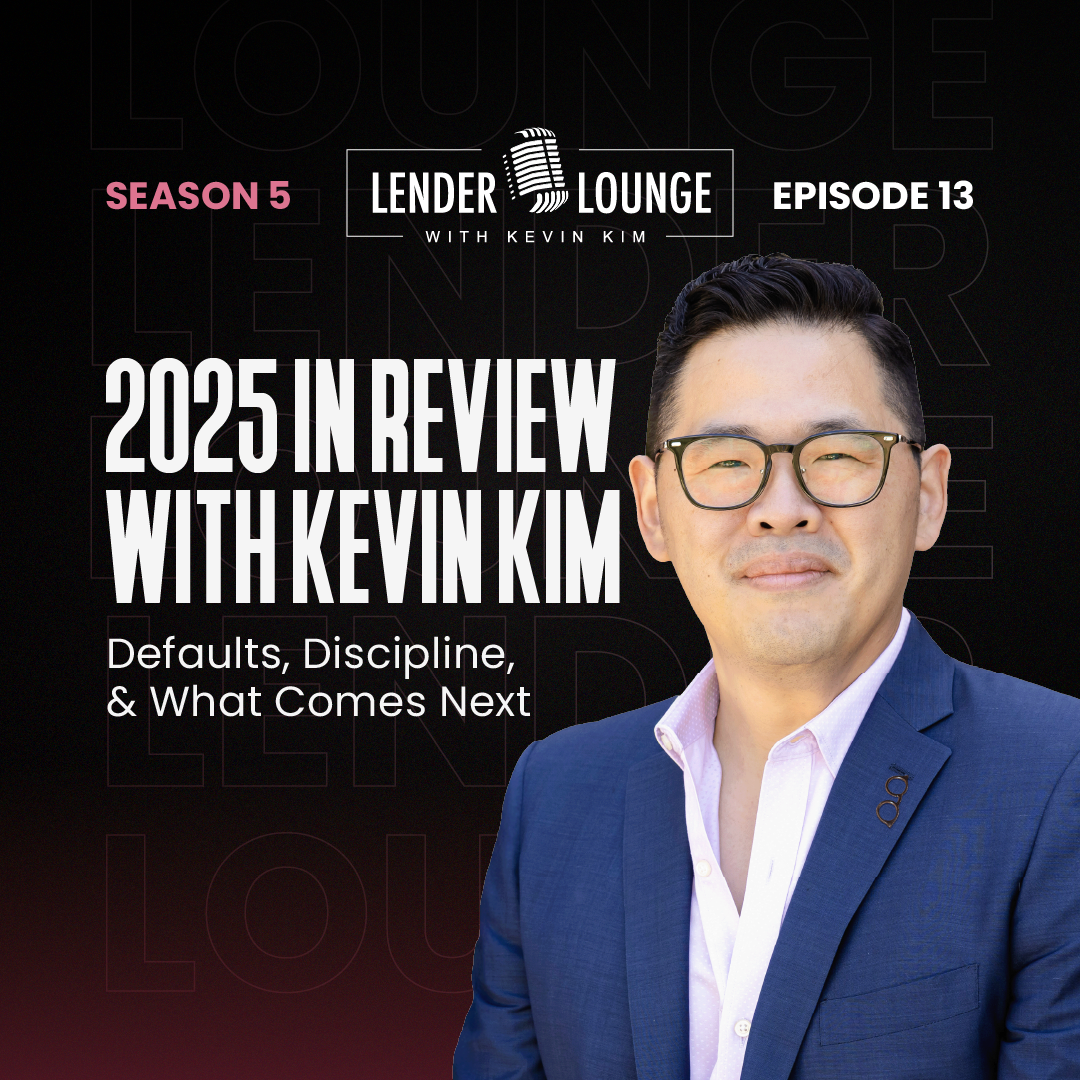


Hey everyone, Kevin Kim here for Lender Lounge. We’re going to record this episode. It’s a solo cast and we wanted to do a 2025 wrap up video to discuss some of the things that we here at the firm have seen and things that we’re looking forward to going into 2026.
First things first, let’s wrap up the year. This year has been a very interesting one. It’s been a year of quote unquote winners and losers, as my partner Nima likes to say.
We’ve had a lot of challenges in the context of increased fraud, increased defaults in certain markets, and overall, lenders are more cautious when it comes to their underwriting. And increased fraud is not just your usual bad actor borrower making something up or lying to you on occupancy. Actually, it’s gotten quite sophisticated, right?
So borrower fraud, broker fraud, and even vendor fraud like we saw in the Northeast with the appraisers has become a concern. And so I think it’s important that lenders really look inwards to make sure that they’re doing their best to mitigate their risk, but also do increased diligence on these transactions. Just because someone else is going to buy that loan doesn’t mean that you can just go through the basic steps, right?
Also, we’ve seen a significant increase in defaults in certain markets and delinquencies as well. And it really has to do with valuation challenges. I mean, namely in Texas, we saw that.
Texas became quite the popular market over the years and values started to face some challenges in this past year and started to decline. Many lenders all over the country are complaining that Texas is really seeing the brunt of these increased defaults, but Texas is not the only one. We’ve seen increased defaults in North Florida and pockets of the Northeast and in California as well.
Noticeably though, smaller markets like the Midwest have not faced these same challenges. It’s also been a year of expansion. 2025, we saw a lot more independent lenders that are not institutionally owned achieve what was once thought to be impossible, securitizations.
We saw an increased volume of unrated and rated securitizations in 2025. And we’re noticing a trend toward democratization of the securitization process. And hopefully that will bring the opportunities to more and more lenders to bring their cost of capital down and increase opportunity for them.
On the flip side, it’s also having a significant impact on their businesses. Why? Because now they have a lower cost of capital, they have more capital, and that means they need to expand.
They need to expand their volume, they need to expand their footprint, they need to start entering new markets, adding new verticals, so on and so forth. Actually, at the national level, we noticed that both what I would call independent shops and the institutional shops have all decided to start adding new markets to their book, adding wholesale verticals or broker channels or table funding or correspondence lending to their book as an attempt to garner more market share. On top of that, we’ve noticed a trend to start bringing servicing in-house and offer third-party servicing as well.
These are interesting verticals, but they come with their own compliance obligations and change in business practices. Another thing we noticed in 2025 as a continuation of 2023 and 2024 was that DSCR continues to thrive. My point at AAPL during my panel with NEMA was that if you’re not doing it now, well, you better do it because if you don’t do it, your borrower is going to go to somebody else and then you’re doing a borrower disservice.
You may possibly lose that opportunity because that other party will likely offer similar products that you do. It’s a means to keep your borrower sticky. It’s a means to offer a significantly lower cost of capital on the interest rate to your borrower and permanent financing for the takeout.
I think it’s a very good thing to add. If you can’t figure it out, go learn how to figure it out. A lot of these wholesale programs are teaching their counterparties how to manage this internally.
Another noticed trend was that construction lending has significantly increased over time. We’ve noticed that over the past few years. I think it’s a product of fixed-inflict lending becoming quite commoditized and pricing and volume have become quite competitive to win those bids and many local lenders have adapted to transition into construction lending.
Now, it’s different than fixed-inflict and it comes with its own risks. So you really got to make sure that you build those underwriting muscles, due diligence muscles, and construction management muscles to make sure that you don’t find yourself in a default situation. Another trend that we noticed is that secondary and tertiary markets are significantly growing.
Volumes in these markets are increasing over time and it’s a good sign. For years, we always joked that private lending was definitely a coastal practice and the Midwest and the Deep South were always left on the sidelines. I don’t think that’s the truth anymore.
For a while now, states like Ohio and Illinois have always had its place in private lending, but other markets like Michigan, Wisconsin, Kansas, Iowa, and other markets have been garnering more attention as the volumes are increasing. Many lenders are also realizing that, hey, just because it’s judicial on the foreclosure side doesn’t mean it’s that difficult. It actually might be easier than some of the non-judicial states.
Other reasons why these markets are being paid attention to is actually the loan amounts are increasing and the borrower quality is remarkably high. Let’s transition into what we’re looking forward to in 2026. So I don’t expect deep rate cuts happening next year.
I think the Fed has signaled that they’re open to one more because of their concerns of inflation and the recession, unemployment. They’re likely going to be hawkish toward additional cuts going into 2026. Now, I’m not an economist, nor do I like talking about economic trends, but I do like talking about industry headwinds.
And so let’s talk about that. There are going to be presenting new challenges next year and I think it’s important that lenders really figure out internally how to mitigate risk of fraud. Not only because you don’t want to be caught with your pants down and be defrauded and have to sue your borrower, but also you have to think about the long-term impacts and big picture impacts.
If you are interacting with the secondary market, with institutional loan buyers, with banks on the line of credit side, you may have downstream effects of those borrower fraud situations or vendor fraud situations in the form of buyback risk or covenant risk when it comes to your transactions with these institutions. We want to mitigate that as much as possible. Certain lenders are looking towards AI tools to help with their underwriting to verify financial documentation.
Others are going back to their old-fashioned methods and walking the properties, but something has to change because fraud is on the rise. Another thing we’re looking forward to next year is that I think servicing will continue to be brought in-house. Many lenders that we know are insistent on servicing their loans in-house, I think lenders are realizing, hey, well, it sounds like the institutions are going to be okay with this as a trend going into 2026.
Are they open to it? And I think that if you’re a direct lender, you definitely should if you can. But also another thing that we’re noticing is that going into next year, there’s going to be more options on the third-party servicing providers as well.
And many, many servicing shops are being stood up. It’s likely that we’re going to see newly formed or rebranded capital markets players coming into the market next year, but I don’t really know that’s going to make a huge impact just yet. It’s yet to be seen because it happens every year.
One different trend that I’m looking forward to in 2026 is an increased attention towards tokenization, digitization, and blockchain being implemented in private lending. I think the upstream capital markets are really listening in for this. We heard about Jamie Dimon at JP Morgan talk about this recently, and I think it’s really important to pay attention to.
There are more and more opportunities in the private offering market that’s utilizing tokenization, digitization of their offerings. But let’s not forget that blockchain technology can also be used to optimize and modernize loan servicing, accounting, capital markets transactions, leverage. And I think that we’re going to start seeing implementation become much more widespread starting next year.
In mortgage, we saw that figure really broke the mold to be the first ones to deploy it. And I think they’re really trying to break into our industry. Hopefully, we’ll see some more of that.
And also private offerings will likely start adopting this as a means to create more liquidity for their investors, but also just broader deployment of the investment opportunity. From a legal side, I’m looking forward to changes or modernization or deregulation when it comes to securities regulations. As an SEC attorney myself, I closely watch the SEC’s activities.
In this current administration, they are pushing towards a trend of deregulation and modernization. Three things to look forward to from the SEC that are germane to our industry. The first thing that’s really important is they’re looking to revive the 2020 proposed rule when it comes to creating a policy around finder’s fees.
That makes more sense as opposed to the current SEC guidance, which is very narrow and very hard to comply with. I think the SEC will also have to reconcile the Fifth Circuit’s decision vacating the private fund advisor rules. And so we’re going to see some action there.
And it’s likely we’re also going to see something happen when it comes to the accredited investor definition, whether it becomes loosened, whether it becomes modernized or adjusted for inflation. I’m closely watching that as well. For our listeners, be sure to listen to our content regarding this stuff.
We’ll be putting out updates on these materials when it comes due, and we’ll be working in conjunction with our friends at the American Association of Private Lenders to get the word out. All right, so let’s get into 2026. 2026 is homework, the action items, things to work on going into 2026.
I think it’s important next year to really think about the little things in our business. A lot of operations are strained and also making basic errors. I think unforced errors can accumulate and become quite the big headache if you’re not careful.
Simple things like maintaining your filing obligations, maintaining your annual reporting, maintaining your licensing reporting, your NMLS fees. These are all things that you want to look out for. If you’re offering securities, you want to make sure that you maintain your securities filings and your blue sky filings.
And if you have a mortgage license, don’t forget to make sure that you file your annual reports and your threshold reports to the local regulator. Regulators are much more cautious these days. They’re being very more stringent these days, so please do not forget to do that kind of stuff.
Another thing that we’re watching for is that as lenders expand their footprints and lenders expand their programs, it’s going to have a downstream effect to the industry at large. As more and more wholesale programs come out, it’s important that lenders and brokers really think about their compliance, both at the institutional level and at the local level. Making sure your lending compliance is in order is going to have a meaningful impact because unless you have that in place, you may not qualify to interact with a lot of these wholesale programs.
You may be able to lend without a license in your state, but that may not ring true for table funding or brokering. It also may not ring true for servicing the loans. So I want you to really think twice about your compliance.
We’re happy to do the consultation here and walk you through what the requirements are for your business model next year. On top of all of that, you also have to do that because you’re representing and warranting to that in your material contracts with the various institutions that are out there. If you’re entering into loan sale agreements, wholesale agreements, if you’re borrowing money from a bank via line of credit, well, there’s going to be covenants in there to your compliance, so you don’t want to breach those.
Many of our listeners have learned that licensing is a real thing in our industry, but to this day, I still hear it. You don’t need a license because this is commercial, right? To this day, I still hear it, even in California.
So please, if you haven’t listened to our compliance webinars or content, take a listen. You’ll learn a lot. Now, don’t feel so bad if you don’t have it right.
Many, many shops don’t have it right, but it’s important that you set yourself right for the incoming year. That way, you’re going to build the business the right way. Lastly, we noticed that there’s a lot of basic failures, basic failures on the operations side.
And as attorneys, we see that happen most often than not when it comes to basic data entry, when it comes to loan document production. Many, many shops are enamored with automating and making things cheaper and faster in their business, but sometimes that comes at the expense of quality. And basic quality standards when it comes to loan document production can have a meaningful effect in your business.
You may not be able to foreclose if you wanted to. You may have issues with your loan buyers. You may have issues with your credit providers.
So basic failures, we noticed, have increased last year. So it’s really important to get your house in order when it comes to this kind of stuff. We ran an audit of some automated loan closings, and we’ve discovered that there was a significant volume of basic errors.
Signature blocks were incorrect. Vestings were incorrect. Borrower names were incorrect.
And sometimes even interest rates were incorrect. So these are basic data entry things that you can’t miss. And you have to remember, software is only as good as the user.
Garbage in, garbage out. So check your teams, check your operations. And if you don’t have the resources, be honest with yourself.
It might be better just to bite the bullet and bear the cost of a professional to help you produce these transactions so you do it right. That’s basically all I have for this solo podcast of Lender Lounge with yours truly, Kevin Kim. I do want to remind our audience that next year, we’ll be going back to the Cosmopolitan Hotel for our Las Vegas conference FortraCon.
And that will be on March 30th to the 31st. Once again, the Cosmopolitan Hotel in Las Vegas. It’s where the very first conference we did was held at.
And we’ll be returning there. So look out for that information. Early bird tickets are available.
So don’t forget to sign up for that. March 30th to the 31st. Don’t forget.
This is Kevin Kim signing off. Thank you very much. Subscribe to Lender Lounge on your favorite podcast platform and visit our website fortralaw.com to learn more about how we can help you scale.