
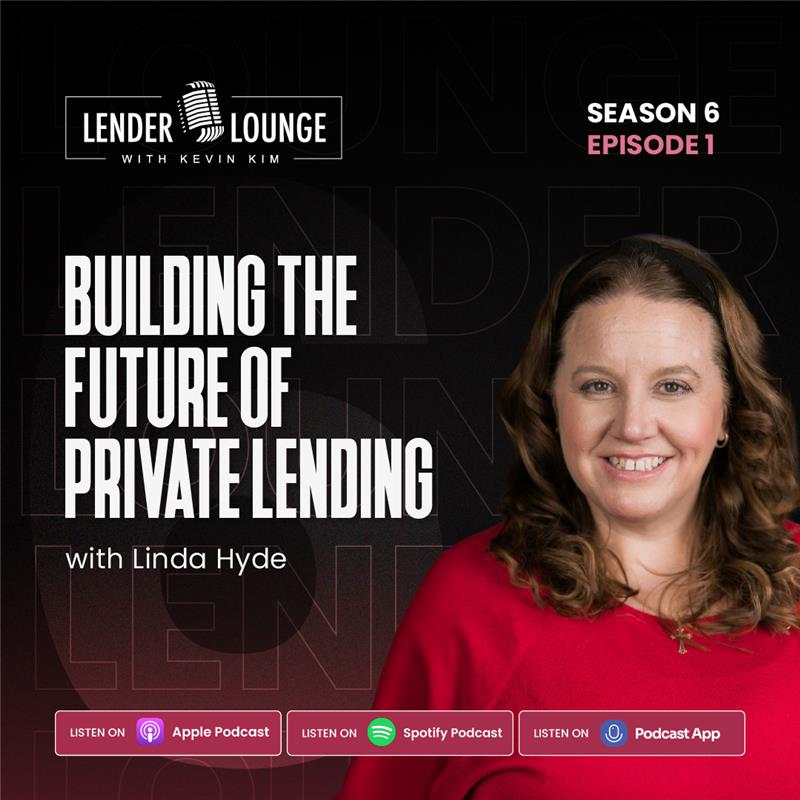


Kevin Kim, Esq: You’re listening to Lender Lounge with Kevin Kim, a podcast dedicated to helping our listeners in the private lending industry grow, improve, and streamline their business. I’m Kevin Kim, partner at Fortra Law, the nation’s largest private lending law firm. Join me as we chat with the best and brightest in private lending. They’re eager to share their years of wisdom and best practices for lenders, brokers, borrowers, investors, and more. Subscribe to Lender Lounge on your favorite podcast platform and visit our website, fortalaw.com, to learn more about how we can help you scale. Check out the episode summary below for other valuable resources. Hey everyone. Welcome to season six. Can you believe it? Season six of Lender Lounge with yours truly, Kevin Kim. We are honored to have someone I consider a personal friend. We’ve been working together for, I, can’t even know how long now. I think 10 plus years. Linda Hyde, the president of the American Association of Private Lenders. Linda, welcome to the show. please introduce yourself to our audience.
Linda Hyde: Hi everybody. I’m, my name’s Linda Hyde president of AAPL. I have been working with AAPL for 12 years. I’ve probably known Kevin for at least 11 of those years. And been in the association and helped grow it. So I started out kind of behind the, behind the scenes and then came out as Eddie tells the story. I’m sure most of you have heard our owner, one of our owners tell a story about how he found me and I had been doing the work behind the scenes and he elevated me and now here I am, named president.
Kevin Kim, Esq: You, you say it so, so, like humbly but you’ve you’ve moved mountains with the association. I remember when I first joined and, you know, thing, the market was small, the association was, was a, a brand… almost basically a brand new association trying to get its name out there and private lending was kind of a niche industry and we were all just trying to figure out what we were gonna do with our lives.
Linda Hyde: Oh, yeah.
Kevin Kim, Esq: Fast-forward to today, we’re, it’s right now for our audience who recording, it’s the end of 2025. We just got back from the annual conference that AAPL holds and what was the, the turnout this year? I was shocked by just the number of people that were involved.
Linda Hyde: Yeah. So we had 972 attend.
Kevin Kim, Esq: Oh my goodness.
Linda Hyde: So, so with the issues with the with the airlines, I think that that affected us or we would’ve been over
Kevin Kim, Esq: Oh, that’s true. Yeah, yeah.
Linda Hyde: So we had some flights that were canceled or we would’ve had over 1,000, so.
Kevin Kim, Esq: Yeah. But I mean, that’s, that’s the, that’s been the fun part about, about the association is, like, every year the conference just gets bigger and bigger and bigger and it’s becoming so big now where it’s like, who are all these people? And I think that’s a testament to what you’ve been able to achieve in the The, the, what, the fascinating part about how this association runs is everyone knows Linda. Everyone likes to work with Linda and everyone wants to work with Linda, right? That’s been the kind of the… You don’t go anywhere in our industry without people talking about the American Association of Private Lenders and how involved they are and how, you know, the conference and all that. But this is not where it began. This is kind of like we’re now, you know, we’re… The market has grown so much and you guys have done so many amazing things but, you know, let’s get some background, right? ‘Cause, you know, we’ve known each other for so long where it’s easy for me to kind of skip over this stuff.
Linda Hyde: Yeah.
Kevin Kim, Esq: But, I mean, our audience doesn’t really know that much about the history of the A lot of our listeners that are new lenders and new brokers and, you know, even the ones that are actively involved, they don’t really know that much about the association. So, please give us some background on yourself and the company and the association and, and, and you know, where it all started from.
Linda Hyde: Yeah. Happy to. So the association was actually started in 2009. I came in in 2012 and I was hired by, at the time his name was Mike Ren. He was one of the majority owners. He had bought it from the four owners that had started it. So there was a couple of minority partners still at the time but Mike was the majority and was running the association. It was kind of set up to be a good old boys club when I walked in. It was very interesting. Anybody I… We actually wrote and published a book for, as an association. We had 17 authors and I wrote a chapter and actually told a story about one my first calls with our board of directors. I was on there and told them, “You know, we need to get more women involved. This is all men.” They were talking about going to country clubs and drinking wine and taking all of these tours and I was trying to figure out what was the point of this group, right? Why… What are we doing here? Why are we here? And I was met with resistance and the comment was, “We don’t need any more ovaries on this call.” … that comment, I said, “We no longer have a board. We are no longer doing business with these people at this point. They’re no longer in charge of what we do.” So, we got off that call and I kind of took over and took control. So there was somebody that was running the association at the time, but I took the lead with everything that was kind of going and started driving things to where I thought they should go and it started with talking to our clients, right? So we had 60 members at the time and we had about 130 people at the first conference that I went to. So it was very small. Not a lot of people, not a lot of engagement. There were just little tables set up in these small little ballrooms. I ran the registration myself. It was just me and one other person that worked with me. And so, what we did is we started just answering the phone, talking to clients, having conversations of what they were looking for. What did they want out of an association? What was an association supposed to be in this industry? And what I knew it should not be was a good old boys club. We were not looking for a country club. We did not need-… somewhere you know, where everybody could come together and, you know, smoke cigars and drink wine. That was not, that was not needed. We needed something that was gonna make a change and an impact in this industry, and really welcome everybody from all different avenues for this industry. So, we started going down that path and marching down the path of education, ethics, and then legislation came. And you were a huge driver of that. You’ve always beat that drum for me in helping us get to that point and saying, you know, “We’ve gotta go down here. We’ve gotta go this way.” And with your and Eddie’s help we’ve really grown that. And so, today we have around 888 members, and we had 972 people at our conference. So, very much grown.
Kevin Kim, Esq: Yeah. Talk about growth, right? And it’s funny, because it’s not just the membership, it’s actually the companies that are involved, right? It’s, you know, you have such substantial companies that are owned by, you know, Fortune 500 companies and they’re just really impressive in organizations getting actively involved in the mission of the association. That’s, that’s just the coolest part to see, right? Like, you have guys that came from Wall Street, and then guys that came… Or an individual broker. You kinda have the whole spectrum of the industry, and it’s all shapes and sizes. And it’s everyone’s involved. And that, that’s one thing I love about the association. It’s not just kind of the big shops. In fact, if anything, the big shops struggle to get more involved, but, like, it’s a more diverse group of companies. It’s not just that country club of people, which is really frustrating sometimes. You go… I mean, every industry has that kind of group, and this industry, being what it was, has changed. Can we kinda talk specifically about, like, when you kinda felt that meaningful shift? ‘Cause you took the ability to… you took the, I guess, the mandate of the association away from them said, “We’re not doing that anymore,” right? But it takes effort, right? Because everyone kinda gets used to this, “Oh, yeah, we’re gonna, we’re gonna hang out in Vegas and get drunk and smoke cigars and be stupid,” right? That, that’s basically what these good old boys clubs are, and, you know, there’s, there’s a time where, okay, all my effort’s starting to really… It’s starting to, it’s starting to gel and starting to show, show results. When was that for you guys?
Linda Hyde: I would say around 2015 is when it really started. We started to grow. We really started partnering with you guys as our general council, as our attorneys in growing our education. We started our education courses in our first few that we started on the certified private lender associate came about. And then we started the certified fund manager with you directly, and growing those. And just bringing those live classes in and bringing the, the attendees. Really started working with bringing more women into the fold. So, at first we thought, you know, we needed to have women on, on a specific panel and have it very specific to women. And then as you watch our agenda you can see where my mind shift where my, where my mindset shifted because I don’t feel like women should be on a specific panel. Why do we have to segment women off, right? For it to be… Women should be included in all the things, just as technology should be included in all of the things. And, and, you know, all of our different service providers should be included in all of the things. We should not have a certain, like, segmentation for them. So, I think 2015 is where I kind of shifted in my thoughts and my, and my mindset of where I thought, “Okay, well, we really need to bring everybody together start including everybody. The, the smaller shops, the bigger shops, and just really mixing everybody in.” We started growing. I think we hit around 300 people that year, and every year it was a new goal. So, every year we celebrated our goal. And I remember every year as we hit new goals as… From our membership perspective, Eddie and I would celebrate those. I would call him or email him and say, “We have 400.” So, 2016 we have 400 members, and it was a huge celebration. We celebrated every one of those wins because we were growing. And he kept saying, you know, “We’re gonna get to 1,000 people. We’re gonna get to 1,000 people at the conference.” And I would go, “Calm down.” Like, “I’m not ready for that yet. Calm down.” And every year, you know, it’s, “We’re gonna have 1,000 people.” Well, this year he’s like, “I think we’re gonna hit 1,000 people.” And I said, “And I think you’re right.”
Kevin Kim, Esq: Yeah. If it wasn’t for that damn government shutdown, right?
Linda Hyde: No. Which, you know, we’ve, we’ve been through worse. We’ve made through COVID and, and some of the other things that we’ve survived and, and been successful. And so we know how to pivot and, and I think next year’s gonna be even bigger. I mean, it’s gonna be even better, so.
Kevin Kim, Esq: And that’s the funny part is, like, it’s not… I think… I like what you said about the education, but, you know, one of, one of the things that is kinda misunderstood when I meet new people who don’t know that much about it, they kinda hear about it here and there, it’s not just an event, right? It’s not just that one event we have every year. It’s, it’s… I mean, we, we meet frequently. I, I mean I know I, myself and Nima do webinars for you guys. But there’s a lot of stuff that’s happening throughout the year with the association when it comes to membership involvement. can you give us some color about that and what you’re doing to kind of… what you did to build that up? Because it, it really isn’t and you guys are able to do it in a way where it’s… We’re not having to fly in to do board meetings or members’ meetings all the time, but at the same time, we’re getting stuff done.
Linda Hyde: Absolutely. So, you’ll hear me … lot we’re more than a conference because I think that that’s very important. We add more value than just once a year in coming together as a big conference. We add value all throughout the year. So we do webinars, we have monthly webinars, we have quarterly webinars where we do the State of the Association and the State of the Industry. We have other things where we provide value from our magazine to education platforms. We’re actually doing some mini courses that we’re working on to provide to our members at no cost, so we’re working on those now. We’re gonna launch those starting in January. We have things like the book that we launched with our members. We’re constantly looking for new avenues and new resources that we can provide with our member directory. So we have so many other things, and then we’re also going to other events. So we like to support the industry and other events. I don’t really look at other events as, as competitors because I feel like we are in a different, a different place and a different part of our journey compared to a lot of the other groups, and we’re just on a different path, right? We’re, we’re doing something different and on a different path in where we wanna go, so I wanna support them. So we’re at the Fortra events, we’re at the NLE events. You’ll see us at different events and supporting our partners to make sure that we’re out in the industry and not adding another event for someone to choose from, but actually going and supporting so we can still be out there and providing education and, and doing, you know, sessions or things like that where we can add value to those events.
Kevin Kim, Esq: And I think it’s a good touchpoint too, right, because the, the challenging issue is like while we’re doing most of this stuff online and through webinars and meetings virtually, the touchpoint is important ’cause then you get to have discussions about where the industry’s headed. I’m sure, you know, members are coming to you like, “Hey, we have a question about this particular ethics issue,” or, you know, “this particular legislation,” that kind of stuff, and I helped you guys get that meaningful touchpoint. I, I know I’ve talked to you. Eh, there’s only so much stuff you can talk about through the through the computer, right? So like, you know, that’s been really valuable to have you guys out and about when it comes to these events and, and what’s been cool is we kind of have impromptu meetings too, like, you know, we’ll, like seven or eight of us sit down and talk about stuff that’s really germane to the association, right? The association really has been meaningfully involved in, I would say, two arenas that are not so well known are the ethics component, right? Like, we… I mean, I was on the Ethics Committee for a few years and it’s a pretty intensive process and pretty, like they take it very seriously. But also keeping an ear to legislation is it’s not just, you know, we’re not… People think that we’re lobbying. we’re not lobbying. Like, we’re actually, like, doing it manually and we’re trying to make meaningful change manually, and so ………………………. Grass roots is what Eddie calls it. So I’d like to get more about that because like the ethics has been an issue. I mean, our industry has a kind of historical stain of being, you know, loan sharking, hard money lending is scary or sketchy and that and, you know, we have a very different perspective when it comes to ethics. I’d like you to expand on that a little bit because I think it’s very not well understood by a lot of the members. Like, no, you can actually submit an ethics complaint and they’ll actually take it seriously and they’ll actually get back to you and then it’ll be a meaningful discussion by the committee. Not many people know about it.
Linda Hyde: I think it’s because a lot of them don’t understand that we provide that because nobody else is providing it, right? We’re the only place that you you can actually do that in the industry. So we’re the only one with an actual process for the ethics complaints. And we actually get quite a few. We’ve been getting more and more as the, as the industry’s growing, as our membership’s growing, we’ve been getting more that come through. And we’re pretty thorough as you know, where we don’t just take a complaint and say, “Okay, well, we’re gonna go look at it.” We actually ask for very specific documents. We ask for documentation to back up what they’re asking for. And everything’s submitted through online, and then we will actually go back and have a conversation with our committee about issue. We keep everything confidential so we don’t necessarily share all the information about who it’s about and all that. We wanna talk about the issue. And then we make a decision on did they violate our code of ethics? And then we make a ruling. And so we share that at our conference every year in the State of the Association so that everybody knows that we do take it seriously and that we do, you know, go through those processes to protect our industry ourselves. We don’t want politicians coming in making those decisions for us. We
Kevin Kim, Esq: That’s right. That’s it right there. Yeah. Yeah. ‘Cause I think that’s where it’s misunderstood is like people think of it as like as like a venue to hash out their, like, legal disputes and like that’s not what this is.
Linda Hyde: No.
Kevin Kim, Esq: This is you’ve got an ethical violation.
Linda Hyde: If it’s a legal dispute, we absolutely will not touch it, and you know that. So we’ve actually had those conversations of if if they’re in court and they’re, you know, they’re in the middle of a battle there, we will not touch it until everything’s been resolved. Because we are not a court. We we are not a legal entity and that’s not something that we’re looking to get involved in. So it is really about the association and how we support the industry and we wanna make sure that we’re putting our name by behind the people that are truly the best and the most ethical people that we’re working with.
Kevin Kim, Esq: Right. And we we want to… I mean, look, one of the things that I took away from my time on the committee was the mission is really about keeping regulators off our backs. Like, we don’t want to garner attention to ourselves because we already have this, like, weird misunderstood reputation. And so we need we need to hold ourselves to a higher standard. And and generally, I think that it’s-… Been pretty good over the years. We haven’t had any significant issues of late, but one thing that I’m, I’m actually very proud of is like, it’s, it was like… The ethics committee was, took things very seriously, took action, but wasn’t heavy-handed, right, in a political or, or, or I guess you’d call legal way. It was more like, “Hey, you gotta take accountability for your failures.” And I don’t know that it’s been like so heavy-handed where the people have been ejected. I think only be a handful of people who have been ejected, right?
Linda Hyde: Yes. We’ve had, we’ve had a few. But most of them that get removed, they have a way to get back or they have a way to fix it, and we always try to give them. So, we’ve only had a few in the whole time that I’ve been with the association that have been removed permanently. So, most of the time we give them a way to come back in and fix the mistake that they’ve made, so.
Kevin Kim, Esq: And I’m really impressed by our industry players, you know, our industry stakeholders. They’re very passionate about keeping the regulators off our backs. Some are a little more passionate than others and kinda go too far, but the nice consensus around the industry, and I think it’s really a credit to what, what the association has done, is we’re all in agreement we do not want more regulation, we do not want more unnecessary government attention,
Linda Hyde: Mm-hmm.
Kevin Kim, Esq: … and we wanna be able to do what we do best. And I think that’s a testament to what the association has done. Lately, legislative stuff hasn’t been kind of high profile. We’ve had a lot of stuff over the years we’re working together. I mean, I remember when NEMA was flying to Florida, like, three times in a week So give us some more color about that, ’cause it’s something that’s not, not, not, you know, not understood because they think that’s… It’s like… Because there are other associations like, like, you know, CMA and CMBA, they have their lobbyists and all that. APL is taking a different tact, and I, and I like it because it gets us really involved, right? I’m not just donating money. I’m getting actively involved.
Linda Hyde: Right.
Kevin Kim, Esq: And give us some more color in that.
Linda Hyde: Yeah, so we don’t believe in lobbying. We believe more in the going in the grassroots tactic of going there and having a conversation. So, going to Capitol Hill, going to the different state level and talking about legislation one-on-one and having those conversations, which we’ve done multiple times. And if we go to decide to go against a bill or even for a bill, we actually go and support it and we bring the grassroots efforts with our, with our association behind us. So, we bring our members in to support it or go against it through letters, through conversations. We have phone calls with legislators. We’ll do meetings, all different kinds of things like that. And it’s been very productive for us, I would say. We’ve been very lucky in how we’ve had conversations. We’ve had… Most of the legislators are very open to having conversations with us and talking through and willing to talk to us. I can say I’ve noticed that there’s been a difference in kind of a shift in how the industry is looked at from the government perspective. In talking to some of the legislators, I’ve noticed a change in, in the way that they look at the industry where it used to be more of kind of like we talked about, where, you know, it’s the bad guys, it’s the hard money. It doesn’t seem to be as looked at the same at least not by everybody. So, I was contacted recently, and I don’t even think we’ve had this conversation, by a gentleman who used to be or just recently retired as a leader in in the in Fannie. So he was in the leadership role in Fannie and is now writing for the Urban Institute
Kevin Kim, Esq: Oh, yeah, he called me.
Linda Hyde: Yeah, he did. So, he’s writing to talk about how private lending is changing the affordable housing, and he sees it, and he sees it through us. And so we sent him to a, a lot of our partners to get some information on how he can write this. So, he’s sending it through the Urban Institute. And we have met with some of the legislators through the Urban Institute while we were there before previously. So, to have him there and kind of beating that drum for us and marching that tune for us is really, really neat. And he reached out to me just blindly through LinkedIn, and I happened to check that message. You know, I get messages through LinkedIn on a regular basis, but I saw it and thought, “Well, this is kind of interesting.” So, I replied back to him, and we set up a phone call and had a really good conversation with him. So, he had retired and just, you know, said I wasn’t done working. I wanted to do something with my time, and he decided to write. So, it was nice to have that conversation with him because you can see the shift in the way that they’re looking at our industry and noticing, and I said, “It’s refreshing to see that you actually are paying attention, that we’re making a difference with affordable housing and helping versus where before it was where you’re hurting everything, right? You’re hurting them.” And it’s not that way anymore. So, I think we’re slowly
Kevin Kim, Esq: Yeah, how many years of explaining and explaining explaining what we do with an industry. It was like, there were times where they just didn’t
Linda Hyde: Right.
Kevin Kim, Esq: like they just, “Huh?” Like they just And that, and that’s something that people don’t really appreciate in the industry. We’re making It’s a bigger objective, right? It’s, it’s about lack of awareness as to the market that we serve and the impact it’s having, and that goes to kind of the institutionalization of our industry. I mean, when we first started … working together. The market was very much private organizations, small companies, you know, one-man, two-man bands. You know, funds that were, you know, 100 million were very, very big. And so, that’s shifted into a significantly larger industry and significantly more professional industry. I mean, the membership alone shows you have people that have come from the biggest companies across the country, and yet the association is still accessible to everybody, right? And that must have been a very challenging dynamic for you guys, because, you know, it kind was sudden. I remember, it was like, 15, 16, when suddenly, like, these giant companies were jumping in and getting involved and spending really big checks. and I mean, how did how did you react to that? ‘Cause I never actually asked you this perspective, is… because at at one point, we have to serve the industry at large. But then, at the same time, you have these massive organizations, and now there are more of them, with a vested interest that may not necessarily be the same, a little bit different perspectives, different priorities. How does the association balance all that? How do you personally balance all that? Because, you know, some of these guys are very different than than the kind of core stakeholder membership that we’re used to seeing.
Linda Hyde: Yeah. So who I am at the core is I always do what I think feels right for for the association, right? so, I always make decisions about what I feel is right for for the company, for the industry, and that’s not necessarily the popular opinion. It’s not necessarily what even Eddie or, you know, the owners are looking for, right? Because the end of the day, I’m not here to make a dollar. I’m here to make an impact and build this association. That’s my goal, and that’s my win for me, is as we make an impact and we grow, that’s what drives me. So, some of these guys, we have been approached, and I have been approached by some of the larger shops and, you know, like, “Can we be exclusive?” And, you know, we started the at one point, we didn’t have title sponsors, and then we got a few, or we had one, and then it turned into two. And today, I’ve had offers. You know, I’ve had probably four companies almost within a month of the conference. I mean, it’s been, what? Almost exactly a month since the conference? And I’ve had four companies come to me and say, “I would like to be your title sponsor.” And I have to say, “I appreciate that, but that’s already taken, so let’s talk about what we can do for you.” Right? So, they’re all looking for exclusivity. They’re all looking to spend that money and be the top sponsor and get involved. But it’s not always about who’s got the most money to me. It’s about who’s going to support us, who’s going to partner, and then also maintaining the or the membership rate, so that it’s affordable for everybody, right? So, we have newer people that are wanting to come in, and we have to make that barrier of entry available to them as well. So, I have to balance all of that. And that’s not always popular. You know, I’ve been told, I don’t know how many times, “You need to raise your rates for the membership.” But I want to make sure it’s affordable for some of the new people that are starting out. We were just talking to a professor at a university that wants to teach. He’s teaching private lending, and remember the days… I’ve never heard I mean, years ago, I can’t imagine that there would have been a college teaching private lending, right? And now that’s happening. So, they’re wanting to send them through the association and go through some of our stuff, and use some of our resources and become members, but they’re college students, so they have to be able to afford it, right? and I don’t want to have to discount it down and dilute what we do to let that barrier of entry happen. So, I always try to make sure I balance and make sure that we’re balancing who our partners are, who’s supportive of us, and we do have some people that, you know, we work with, and we want to make sure that at the end of the day, we’re paying our bills, but I also want to make sure that we’re doing what’s right for the industry, for ourselves, and making sure we’re continuing to grow.
Kevin Kim, Esq: And I would imagine there’s also been, like, I guess, you can call it an agenda. Like, ’cause the institutional shops have a different agenda than the local shops do, and have have you ever had to reconcile those two ’cause their priorities are different, right? I mean, we’re we’re all ultimately trying to make loans and fund loans and service that industry, but they have different priorities. They have different desires to achieve, right? And, have like, talk about reconciling those two competing interests as an association director.
Linda Hyde: So, that is a balance in having those conversations, and that is really just trying to figure out what needs they have and what they’re doing, and then how we do that. So, it may not like, we’ve talked about, we’re more than a conference, so it may not be at the conference, but we do it in a different way, right? So, we may do it throughout the year, or give them an upfront opportunity. So, we have to make sure that we balance it depending on what we’re looking and what they’re trying to achieve. So, it’s just a matter of me having those conversations.
Kevin Kim, Esq: Yeah, ’cause I remember, like, there was a conversation I had at at some event, and it was an institutional shop, and he’s like, “Man, I wish people would just teach these folks how to do these things better or underwrite better.” I’m like, “You know APL has courses and webinars for this stuff, right?” Like, “Why don’t you just bring it up? They love education. Why aren’t we why don’t you do more of that?” and then nothing ever happened, right? And that was kind the frustrating part. guys, like, there’s a huge avenue to educate your audience, which is the membership. Why aren’t you doing it? And that’s kind of been the hard part. Like, guys, you can easily get involved and do stuff. And that’s where I’ve I’ve been trying to, like, get them to get more involved, ’cause like, I hear a lot of complaints-… and I only hear a lot, see a lot of action.
Linda Hyde: Yeah. They don’t talk to me necessarily, they talk to you. I know that happens with Nima as well. He and I were talking and he said, you know, “Somebody came to me and said, ‘I need 4APL to do this.'” And he goes, “Then you need to go get Linda on
Kevin Kim, Esq: Talk to Linda.
Linda Hyde: Yeah. I sure, I’ll bring Linda onboard. And he said, “And she may tell you to kick rocks,” right? and I might, but I do take feedback and that’s how we built the association is based off of what people are looking for, right, like what our members are looking for. So if they have ideas, I will take them and I may not implement them tomorrow, but I always keep those in the back of my head. I mean, an example is the jobs board. I had somebody call me and say, “You know, I just got let go of my job and I’m struggling to find job in this industry. It’s hard. There’s nowhere set for this industry that I can go look for just a specific industry.” That was my trigger to say, “Okay, we need to do something today.” So I put the jobs board up within … We had it up within a day based off of that because this person had called me and I knew it was something that was on my list, but we hadn’t got to it yet. But I turned around and said, “Okay, this needs to be a priority,” right? So pay attention. I may just not move as fast as other people want me to move. But again, it’s because I’m gonna do what I feel is best and it may not be what everybody else and what their priorities are. It’s gonna be what I feel like is best for for our company and for the industry, so.
Kevin Kim, Esq: Let’s kind pivot about … I mean, a lot of folks don’t really know much about you, Linda, right? So, you know, I like … I mean, you’ve told me your story and your background and I love it, right? And we talk about family and kids. you’ve seen me get married, have two kids. Like we’ve known each other for that long. But like, a lot of folks don’t really know your background and where you came from. So I kind of would like you … pivot a little bit and get to know Linda a little more, ’cause you were … So before AAPL, what were you doing before AAPL?
Linda Hyde: So before AAPL, I ran a call center for Sprint.
Kevin Kim, Esq: Mm-hmm.
Linda Hyde: And I did that for 13 years and I didn’t even know what private lending was or that it existed. Even when I got hired, I was not … that was not the job that I was getting hired for. I actually was hired to create a call center for the insurance company. I just happened to be sitting there and got nosy and bored and picked up the phone and started making a difference. So Mike had me stay there. So I ran a call center, but even before that, I’d been … So I’d been leading and been a leader or a leadership role of some type since I was 18 years old, but I’ve done everything from when I was a teenager, I, you know, was a hostess and waited tables to I started running call centers and working for call centers when I turned 18 and … leader very early on. So I actually worked for Sprint for 13 years and when they closed our center, that’s when I went looking for a new job and decided, you know, I was in between
Kevin Kim, Esq: There’s so many parallels. I see so many parallels, ’cause like in the call center world, I imagine having to manage personalities is a big thing, right? And I feel like half of this industry is managing personalities right? Like our clients have to deal with it all the time because they’re borrowers. There’s so many different types of borrowers. But even in our industry, there’s so many types of personalities and managing all of that and trying to marshal all of it, I mean, it does a lot … I see that parallel. Let’s talk about … As translation into what what we’re doing today is how much of that do you call back on? ‘Cause I know that you recruited some folks from your call center days in … to help you guys at the association, right?
Linda Hyde: Yeah. So my old director who I reported to now reports to me and works for me, and he’s kind of … I call him my emotional support human, but he’s got the title Chief of Staff, so he’s there to keep balance on the team help me. He’s the one I bounce things off when I need help or if I have a leadership issue or you know, any kind of thing, you know, keep things kind of moving along. His name’s Craig. So I’d work for him for probably nine of those 13 years and then did recruit him. I introduced him to Eddie and then he’d work Came and met Eddie and Eddie hired him. And now our business development manager, Ryan, actually worked for me as well at the call center. So he worked for me for a long time. He was my right hand as far as taking escalations and talking to some of our clients that had, you know, issues. We had some of the more technical issues and he was the one who handled those, so he now handles business development stuff. But yeah, it is very much, you know, I talk to Sprint, some of the Sprint executives on a regular basis and I had to present things and having conversations and talking to 300 reps on the phone at one time. I said, “I can walk in a room and talk to 300 people in just a room. I can just, you know, start talking, but don’t put me on a stage with lights because it makes me anxious and I start-“
Kevin Kim, Esq: We all know this, yes.
Linda Hyde: Yes. But it’s funny because if I walk in a room, you know, I’ll just start talking and one time Kat looked at me and said, “What just happened?” And I said, “Oh, I can do that all day long. I’m used…” Like that’s not unnormal for me, right? I can do that. I I don’t like the I can’t see, I don’t have control. It’s a whole thing, so.
Kevin Kim, Esq: Oh, yeah. Yeah, yeah, yeah, yeah.
Linda Hyde: But yeah, I do bring some of my skills from … I learned from the call center, but a call center it’s a lot and it’s hard work. So just some of the skills that you bring from that. It’s good. And I’ve worked with Eddie. I don’t know the association and I apologize. … again, I cut you off, but I may not know the like, I don’t know I didn’t know the industry when I came in, but I knew how to run a business, right? So that’s how I can come in and do this.
Kevin Kim, Esq: And let’s talk about that, ’cause, like, learning the industry must have been a huge climb. ‘Cause it’s like it, they’re not banks. everyone understands what banks do, but these aren’t banks. These aren’t, like, basically, a lot of the early on, a lot of them were just, like, really annoying rich guys who were being … who wanted to just get drunk and play craps, right? So talk about learning the industry from your perspective. Because I feel like one of the things that our industry needs more of is helping people translate. ‘Cause we have a lot of people migrate from different businesses, right? And translate their skills and grasp an understanding of what it is that our people do, right? And you came from a completely different industry. I’ve been in banking my entire life, so it was a really easy transition. But, like, for you, it’s a completely different practice. Like, your counterparties are completely different human beings. Talk about learning the market and learning the industry.
Linda Hyde: I learned a lot of it by observing. So I get… Whenever I get into a room or I go into a meeting, especially if I don’t know what I’m talking about, I get very quiet and I start observing. So I did a lot of that from the beginning and just sitting and listening to calls, spending time with you and Nima, and having conversations and watching you guys interact and listening to the way that you talked and having webinars and having those conversations, reading the magazines and all of the things. So there is not a lot of information out there. It’s really just having conversations and talking. And it’s a constant, right? I’m constantly learning. It’s constant for me and the things that I learn and the changes of the market and all those things. And there’s so many guys out here that are so smart and they know all of these things, so I’m always taking those things in and having those conversations and just interacting with them. And so, if you ever see me out there just listening and looking, I’m taking it in. So I like to observe and really take it in before I make those like, have those true conversations, and…
Kevin Kim, Esq: Right. And you’re also not afraid to get curious, ’cause I remember when early on, when we called them the aggregators of other people calling the institutional shops, like when they started coming into the market, it was confusing for a lot of people, like, “What are these guys?” Like… And I remember yourself and a few other team members were just like, “What?” Like, it was a very curious perspective to learn more about and that you guys ask them directly what are your what your goals? And we talked about, you know, kind of the difference and their role in the market and that was the cool part too, like you guys took a very curious position. It wasn’t, you know, we it wasn’t one of those, like, you have to fake your knowledge, which is really nice.
Linda Hyde: Yeah. I’m a very much what you see is what you get person. I’m pretty direct when you talk about getting to know me. Most people that know me know I’m pretty direct. I say what I think. And I’m really… I mean, that’s who I am, no matter if it’s in business, in life all the time. So I don’t really put on a show. I don’t If I’m thinking it, I’m gonna ask it. And I’m not gonna fake something. So if I don’t know something, I have no problem saying, “Look, I don’t know. Let’s have a conversation because I wanna learn.” So I will ask, I will ask those things to find out. and again, that’s how we’ve built it, right? So I had to learn. And I still, to this day, tell our committee members, “Listen, this is not my business. I’m not a lender. We’re not service providers in this industry. We don’t do this on a regular basis. So I may not know all of the things, which is why we have the committees and things that we do today.”
Kevin Kim, Esq: Give us some more color on the committees, ’cause we haven’t really talked about that. Like, how does… This is actually a better question. How how does someone who’s listening and has heard about AAPL maybe has been to a show once and is like, “Okay, well, I like what I’m hearing. How do I get involved?” Right? How how do how does a person like that, someone maybe a newer lender, you know, or a broker, how do they get involved?
Linda Hyde: So there’s a couple different avenues. And everything is through our website, so everything’s automated through our website. We have opportunities for webinars to be submitted if you have webinar ideas where if they’re education based, we will take those into consideration. We have opportunities for writing, whether it’s through digital or in our magazine. And then we have our committees. So our committees are there’s applications for them, and they’re two years. So they’re based for two years you’re running. Our committees currently will run through next year, and then we’ll start taking applications, like, midyear next year for the following year. And we really look for people that are going to give us time, so we don’t ask for a lot of time. It depends on the committee. Some of them are quarterly, some of them are monthly. And it usually is an hour or so of your time. And then we ask for people to write. So all of the information on our committees is online, but we have a government relations, we have the education committee, we have a fraud committee now based off of what we have been seeing in the market. And then we have, what’s the one that I’m… And then the ethics committee. So the ethics committee is probably the one that it’s the least, so we meet on a quarterly basis still to talk and talk about the code of ethics and all the things going on the industry. But they really do meet if there’s something going on. So if we get an ethics violation, then we will meet impromptu for that, but…
Kevin Kim, Esq: So with with the fraud committee, that’s a newer add-on and I kinda wanna ask the development about the development of that, ’cause I’m guessing it was in reaction to all the fraud reports we saw this past year-… but I remember having a discussion with both you and Kat about kind of the industry’s reaction to all the fraud. There was kind of two camps, or schools of thought when it came… when all that stuff happened, right? And and I’d like you to kind of expand how you guys, like, how you guys got read into it, how you guys reacted to it as an association, what the call what the call was, and why. ‘Cause it was a very, I thought business friendly and diplomatic decision being made. But, you know, I’d like our audience to hear from you.
Linda Hyde: So are we talking about the list? Is that what we’re talking about? Okay.
Kevin Kim, Esq: Yeah. The demand for lists and the demand for, you know, I call it the blacklist, right?
Linda Hyde: Yeah. So I’ve been pretty open about it in person. And this is not the first time, right, we’ve had demands for a blacklist. I think
Kevin Kim, Esq: Oh, yeah. There was a broker blacklist a few years ago, yeah, yeah, yeah, yeah.
Linda Hyde: We were asked for a few years ago, and and I said no then as well. So I just want to make it clear, I don’t believe that it is in the best interest to have a list in the way that it’s being… that it’s gathered from people putting it together themselves, or even an association. So I don’t believe in an association, that we should be the ones putting it together and putting it out there. I don’t believe that different companies should be sharing it and putting it together and then sharing it amongst themselves. If somebody wants to share with your neighbor, say you’re a lender and I’m a lender, and you wanna say, “Hey, I did business with this person, I don’t think you should there,” that’s fine. It’s not my, not my business, right? But as an association, it is not our place to do that without the proper process in place.
Kevin Kim, Esq: There’s a lot of room for error in and abuse.
Linda Hyde: Yes. I think there should be a proper process. I don’t think anybody’s taken the time to really sit down and think about how we protect our industry, how we protect ourselves. I mean, as I’ve said many times, how many lenders would want me, as an association, to provide a list of everybody who’s had an ethics complaint? Because that’s the same thing, right? You have no way of knowing who got on it, but you have no way to get off of it either. name’s just on a list. You have to have those details of how did they get on it, how do they get off of it. It’s not just because I didn’t like how I did business with this person. I mean, we have no idea how they’re getting on this list. And they have no way to get off of it. I think if we did something similar to, like like, a credit score and had a true process behind it, then that would be something that would be beneficial. The way that it’s happening today, in my opinion, is just asking for legislators to step in. The first time they hear, “Oh, you you have bad guys? We need a blacklist?” We’re asking for them to get involved. Because then we need legislation for them to protect us against it, right? And I don’t feel like that that’s what’s needed.
Kevin Kim, Esq: Right. And I think that also garners unnecessary legal attention. Like, you… That abuse, right? So like, room for abuse. If it’s viewed as abusive, well, now you’re interfering with their business and that opens the association to liability. Arguably defamation, too, and we’re liable. And so, it’s one of those things where, like, I was very concerned when the idea of it came up. my perspective on it was you guys are all colleagues and competitors. You should be sharing this information amongst yourselves and make a decision as a business owner.
Linda Hyde: Of course.
Kevin Kim, Esq: It’s not like we’re dealing with individuals here.
Linda Hyde: Right.
Kevin Kim, Esq: And so… And also, frankly, this pulls back to, like, are you doing the right thing? Are you doing the proper underwriting yourself, right? And that’s, like, I don’t want you to… I don’t want you to get victimized, but I also don’t want you to pass the buck off on a vendor. Like, ultimately, it’s also… if it’s an arena that you can do, right? If it’s… you can’t be a lawyer, you can’t be an accountant, I get that. But, like, underwriting is something you can do. And know, are you passing the buck because of that, you know, the appraisal fraud we saw back east? That’s kind of one of the weird things is, like, the market wanted to point fingers. And I was like, “Well, you know, should we take accountability ourselves, too, as as a business?” Was my question that I wanted to ask, ’cause no one really answered that question, right? It kind of just was easier to point the fingers.
Linda Hyde: Yeah. I think it’s easier to point the fingers. I think we should take accountability as as an industry, from from the business perspective. I think that part of the reason why we did the fraud committee was to create some checks and balances to help
Kevin Kim, Esq: Yeah, here’s some tools.
Linda Hyde: Yes, absolutely.
Kevin Kim, Esq: Yeah.
Linda Hyde: Tools. And what prompted the fraud committee was not what happened back east. we had already had this going. What prompted it was I was sitting, actually, one of your conferences almost two years ago now. And there were some leaders on the stage that were talking through it, and they called us out and said, “We need help. we’re combating these things and these different fraud elements, and we need help from the association to streamline this process for us and get us help.” Right? So I took that as a challenge of like, “Okay, well, we need to step in here. We need to step in here and give them some guidelines.” So I never want to be the person or the group that dictates. We’re not gonna do that. We’re not gonna tell people how to do their business or how to run their business. But we can always give them guidelines or even set some standards out there and say, “These are the the” … type of business standards that we’re gonna set for the industry, right? So, kind of like our code of ethics. And so, that’s where we where we took the, the fraud committee was, let’s help provide those resources to help combat this, and how can we try to, try to push back against this, from what, what’s happening, so…
Kevin Kim, Esq: And I, I like that approach. It’s not protectionist, it’s not overly, it’s not a heavy hand by the association. Ultimately, it’s a business association. We’re not talking
Linda Hyde: Right.
Kevin Kim, Esq: you know, an
Linda Hyde: Not a legal entity.
Kevin Kim, Esq: Right, right. I like to, you know, ask you about kind of the community that you built, right? ‘Cause along the way, I mean, we work so closely together, but there’s, there had to have been other people and then other members that have been really in integral in, helping both yourself and the association really grow and, and strive for where it’s at today and where it’s gonna continue to go. are there any people that you’d like to kind of give some credit to? ‘Cause I know you can’t do this all by yourself, right? I know you do a lot. And there have been, had to have been people along the way who’ve helped. Are there any people that you can kind of think about top of mind?
Linda Hyde: Yeah. Absolutely. So, absolutely do not do this by myself. Let me be very clear. I have a team behind me. I have a very
Kevin Kim, Esq: They’re a great team, by the way. I love your team. They’re a Christmas-like people.
Linda Hyde: Amazing team behind me that I could not do this without them. So, I will say that first and foremost, it’s my team, right? So, they’re the ones that have been there. They, they are the ones that support us and they’re the ones that are making things happen. So, without them, wouldn’t be doing it. Outside of that, there have been lots of different companies, and if I start naming companies, I’m gonna miss somebody and then somebody’s gonna go, “Why didn’t you name me?”
Kevin Kim, Esq: Oh, yeah. Happens. People get their feelings hurt, yeah.
Linda Hyde: There are lots of people that have supported us over the years and have supported me personally. I have some very close you know, some people that I’m closer to that I spend more time with because just naturally, they reach out. So, I am naturally an introvert, so I don’t… I’m not the one that will reach out first usually. It, it takes a little more effort for me. So, I look for people that really make that effort and reach out to me first, and then make that connection. I know, like, you and I really connected when we were in Atlanta shooting for CFM. That’s when we really made our relationship. That was our trip. We spent time together and we built our friendship there because we really got to know each other, and we spent time together in shooting that, that, course. And we got to, you know, have dinner and lunch and just spend time talking and kind of getting, getting to know each other even better. We’d been working together for a long time but we really hadn’t had that time one-on-one with each other. So, I look for, there are people that I look for, like, where I have that connection. And so, I have a handful of people that I have that with, so. And most of them I can say if you have my cell phone number, I’m probably close to you, ’cause I don’t … them very often. Ask Eddie what the
Kevin Kim, Esq: So, you know who you are, people, if you’re listening.
Linda Hyde: Ask Eddie what the consequences are of handing out my cell phone number, so…
Kevin Kim, Esq: Right.
Linda Hyde: That’s a great story.
Kevin Kim, Esq: Okay, so the, the last kind of area of thought I wanted touch into is, know, where, where, what your perspectives are as it pertains to our industry, ’cause it’s just, right now, it’s a strange time, I believe. It’s, you know, it’s growing. It’s, there’s a, it’s very dynamic. There’s a lot of winners and losers in our space, and we, there’s different perspectives. You serving the broader broader audience of of membership, I’d like to get your perspective on where, how you feel about our membership, our association, but also where, where the market is headed, because times are kind of weird right now. I would say times are tough for some and times are great for others.
Linda Hyde: I feel like this kind of happens every few years. We’ve been through this before. It’s very familiar to me. And what I’ve noticed is that we’ll see some players that will, will, that will go away and we won’t see them anymore, right? They’ll, there will be some people that will disappear and they’ll just kind of go into the background. We’ll see some that will, will grow and grow very large and some that will go away because they’ve gotten so big, then they just kind of go on and move on to something new. I feel like the industry is still so new and still has so much more room to grow. I think that there’s still lots of opportunity, so I don’t think it’s going anywhere. I think there’s still lots of opportunity for new people to come into the industry, which is, to me, shown by our conference. Look how many new faces were there.
Kevin Kim, Esq: Like, new faces. Like, I had, like, they, there was some brand, like, they had never made a loan in their life and they wanna learn about the industry and brokers and they’re like… This is awesome.
Linda Hyde: Yeah.
Kevin Kim, Esq: You don’t We never we haven’t seen that in a while. So, that’s, that was awesome, yeah.
Linda Hyde: I just, I feel like that the industry has an opportunity to continue to grow and we’re gonna see change and, but I think that we see that cycle every couple years, right? Like, every three, probably three years or so. Three to four years, we’ll see that cycle and it’ll change. And we’ll change over and we’ll lose some of the players and, and we’ll start, start new we’ll have some new guys that’ll come up and some go away faster than others. So, I think everything’s gonna be just fine. I think people are gonna be good. I think the market’s gonna grow. But I mean, we’ll have to wait and see. It’s kind of all up in the air. You don’t really know.
Kevin Kim, Esq: Yeah. Well, I know the association will be there no matter what to support ’em. And the, the question will become, if crisis comes, right? We’ve had some crises, right? We’ve never had a huge I mean, arguably, COVID was probably the biggest crisis we’ve dealt with, but, but like, we haven’t had a mass casualty event like we had in, you know, pre, in the last great recession. But, you know, what, what would be, what would the association’s kind of plan be if we had another crisis on our hands, like another COVID or kind of, you know, pretty serious time, you know?
Linda Hyde: We will have to… I mean, we’re pretty good at pivoting. Our mind is very nimble in figuring things out. So depending on what’s happening, we will make ourselves available, we will figure out what resources are needed, and we will make sure that we’re there to support the industry in every way that we can as we did for the you know, for COVID. We changed things very quickly. We remained… Our events remained intact. We remained diligent in having our calls, and just, we just had to change how we did things, right? So it’s just a matter of figuring things out a little different but we will, we will always be here to support the industry.
Kevin Kim, Esq: I remember during COVID, like, the association stepped in and, like, played almost, like, traffic cop. “Hey, what do you need? Do you need this? Go to those guys. Do you need this? Go to those guys.” I don’t… They were helping people find the solutions ’cause they were all facing weird problems, different problems, and I remember being heavily involved, like, “Oh, okay, yeah, send them here because this is a more of a legal issue on this issue, or an accounting issue, or insurance issue,” or whatever. And it was a frantic time, but that was really when I felt like the association really stepped up and took care of its members, and it was awesome to see.
Linda Hyde: Yeah. Well, and you guys were a huge support, so having, having the whole Fortra team behind us and supporting us has been really important. You guys provide I mean, and on a serious note, providing the resources, the education. You guys do so much more, and I’ve been asked, I mean, multiple times of, you know, “Why do you continue to use them?” You know, there are other, there are other attorneys, right? Have I ever looked at any other attorneys? And the simple answer to, that I have is, is you guys are the ones who are the best partners for us. You come to us and you are proactive in what you provide to us. You have the education. You’re always supportive, you’re always right there to, to help us, and that’s what good partners do, right? And we try to reciprocate with you. So having you guys behind us… And, and you’ve been there since through all of those things, right? So we’ve supported each other through all of those things. I think that that’s been important, and so I wanna say thank you.
Kevin Kim, Esq: We appreciate the, the opportunity, and we also appreciate what we can do for the … That’s where we wanna be, too. We wanna service the industry, and there’s about… no other better way to do it, you know?
Linda Hyde: We’ve grown together, and I’ve liked… watched that journey,
Kevin Kim, Esq: Oh, yeah.
Linda Hyde: it’s been important.
Kevin Kim, Esq: Oh, yeah. Also, got a lot older. I can’t believe how long it’s been. That’s been the funny part, like, it feel like yesterday when we were in… we were joking about that when we were in… when we were together in Vegas. I was like, people were watching the old recording, and I was like, “Do you know that we recorded that almost, like, I think that was 10 years ago?”
Linda Hyde: Yeah.
Kevin Kim, Esq: I haven’t… I wasn’t even married yet, so…
Linda Hyde: Mackenzie would have been She was five. She’s 18 years old now. She’s driving. I’m not ready for that, and high school, and all the things. So you just buckle up with your two girls.
Kevin Kim, Esq: Oh, yeah. I know. And that’s been also the coolest part is, you know, as, as I’ve, you know, gone through those milestones in life. Man, I remember you guys sent me an AAPL onesie for my oldest.
Linda Hyde: Oh, yeah.
Kevin Kim, Esq: That was… We still… We found it the other day. That’s the best thing ever.
Linda Hyde: We love that. Yes, we’ve been through milestones with all of our families, and, and watching them grow, and yeah, I mean, just having that friendship has been really great, so.
Kevin Kim, Esq: Awesome. Well, I want you to… I wanna ask you one last question. What can the industry be, you know, looking forward to with, with AAPL next year? We’re gonna be going in 2026. We’re recording right now, it’s the end of 2025. I mean, obviously, the conference, but what, what’s, what, what are some things that are on the agenda for next year and our, our audience can get involved with?
Linda Hyde: So my wheels are always turning. I never know what’s gonna come up really, but right now, we’re focused on education. So as I said, we have some small little courses that we’re gonna provide and we’re working on from some of our service providers that we wanna roll out to our members. It’s gonna be free to our members. We’re working on rolling out some of our other education courses, like the certified private lender associate, the broker course to some other partners, like we’re rolling out the broker course to actual university, so we’re working with a university. And so that’s gonna start going That’ll be happening the first of the year. So we have some really big things happening as we grow and really focused on education this next year, so.
Kevin Kim, Esq: And, and one thing that I wanna remind our, our listeners, if you’re a member, get involved. Education is not just something that, that, that the lawyers and the CPAs, and they want you guys to get involved and help teach, as it… our industry needs the, the volunteers.
Linda Hyde: Yes, we’ll be looking for new teachers to help throughout the… throughout this next year, and participate in webinars and all of the things. So if you’re interested, go on our site and sign up, and we will reach out to you. So we’re always looking for more people to get involved from that perspective.
Kevin Kim, Esq: Sure. I love to see people get involved and, and learn more about the association that way. Well, that’s about all the time we have for this episode. We are in season six. This is our first episode for season six. Linda, thank you so much for doing this. I know public speaking isn’t your , exactly your most favorite thing to do, but I really appreciate you doing this.
Linda Hyde: Thanks for having me, Kev.
Kevin Kim, Esq: Of course, of course. All right, guys, that’s all the time we have for this episode of Lender Lounge, with yours truly, Kevin Kim. This is Kevin Kim signing off. Thank you very much. Subscribe to Lender Lounge on your favorite podcast platform, and visit our website, fortalaw.com, to learn more about how we can help you scale.