
Kevin Kim, Esq.:
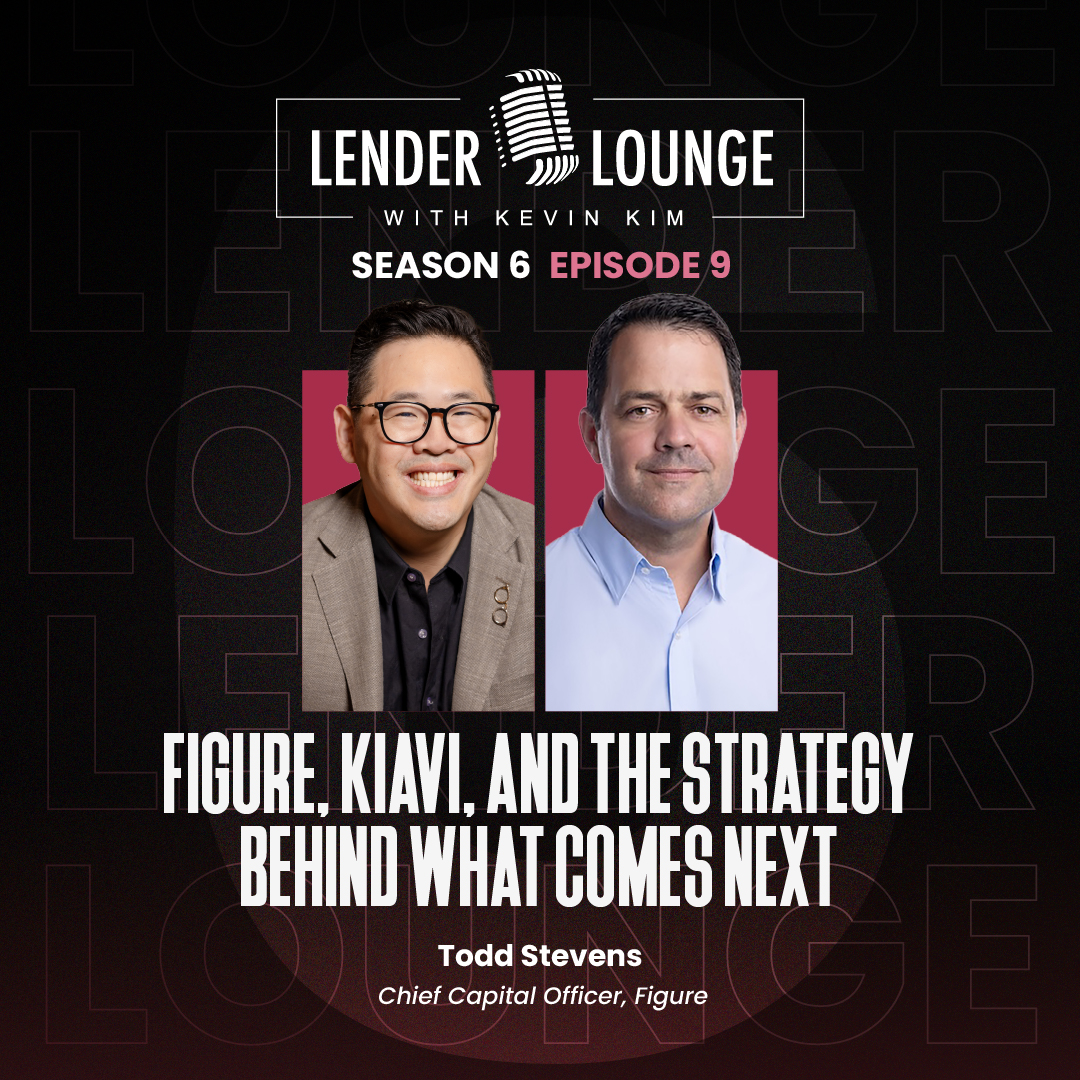
Welcome everyone to another episode of Lender Lounge with yours truly Kevin Kim. Today we are in the computer and we are interviewing our friends at Figure. Thank you for joining us today, Todd.
Please introduce yourself to our audience and introduce the company that is Figure for the uninitiated and let’s get started.
Todd Stevens:
Thanks for having me. Todd Stevens here. I’m the Chief Capital Officer of Figure. We’re a Blockchain marketplace company.
We do a lot of lending in the private lending space and we’re just happy to be here.
Kevin Kim, Esq.:
Figure has a lot to offer to the private lending industry, but my experience and my interaction and my kind of watching Figure beforehand over the years, we had understood Figure to be more of a consumer mortgage, you guys were like the very first ones to do, you know, issuance of securities through Blockchain and in the mortgage sector and all that. Like is this been a transition to private lending? Is it that you added on private lending? Kind of give us the bigger umbrella story about the company.
Todd Stevens:
So we were founded by Mike Cagney. Mike in 2012 founded SoFi, which is a big non-bank lender. He founded us in kind of 2017-2018 timeframe and we never really set out to be the world’s largest non-bank lender.
We really wanted to be a marketplace, but you do have to hang your lending shingle out there. Really to kind of get people to kind of play in your marketplace. So we started life as an originator where we did all the lending on our balance sheet.
We sold it off to the capital markets. But that was really a proof of concept. We were the originator at that base.
That was like 2018 to 2021. And then from like 2021 to 2024, we kind of went into the white-label space. We became less of a direct originator and more of a white-label.
We brought on a ton of white-label partners, which we currently have over 400 right now that do our bidding in the lending market for us. They all follow our same process, but it’s their white-label on the loan. And then probably about two years ago, we really started really kind of hitting go on the marketplace model, where we set up an entity called Figure Connect.
And now we do probably 70% of our volume where our originators can connect into our marketplace, and then they sell to kind of like investors or they can pledge into securitization. So again, it’s all our process, but we probably will do 20,000 loans just on the HELOC side in a month.
And then we just bought a really exciting business called Kiavi, which I think you guys know pretty well.
Kevin Kim, Esq.:
We know about that, for sure.
Todd Stevens:
They do another kind of 600 million a month plus. So we’ll do about two and a half billion a month in production. So we really have to kind of like keep the plate spinning because we’re all constantly working with investors and securitizations and trying to just move the market forward.
Kevin Kim, Esq.:
Now, so to understand the lifecycle, we always want to talk about lifecycle, right? So the company was founded with the thesis that it was always to get to that marketplace supported on chain and creating these opportunities for lenders to interface with institutional capital markets through your platform, right? Supported by blockchain technology, but you guys took the approach where, well, I mean, the big question I’m trying to understand is most platforms run into in that fintech world or tech world is they’re really kind of concentrated on the platform and they come to the market as a platform, but then the trouble is getting adoptees to the platform.
And so what led you down the path of becoming a lender as a means to get there? Because to me, what I’ve seen at least is kind of a reverse approach.
Todd Stevens:
Well, the funny thing is like what Mike did when he started the company is, I mean, we had this great thesis like blockchain would enable, blockchain technology would enable kind of more peer to peer. So you wouldn’t have as many rent seekers in that process. And if a borrower and a lender could just work together, you guys do great in the direct lending space, but in other spaces where you create securities or whatnot, there’s a lot of middlemen in the middle clipping a little bit of toll or rent in the process.
And so we said, we went to a lot of banks and really the securitization process was that, hey, we think a blockchain, a securitization or blockchain could take a hundred basis points out of the cost of doing it. And that would be great for the borrowers and great for the lenders. And then all the banks said, this sounds really interesting.
Let me attempt to do it. And we said, oh, geez. Okay. No one’s coming to the marketplace.
Kevin Kim, Esq.:
So, that’s the thesis. Okay. That’s the thesis.
Todd Stevens:
So we just said okay, we’re just going to hang our shingle out and we’re going to lend and we’re going to do our own securitization and we’re going to show the world how you do this and how you take kind of fees out and just one of the values and the benefits of having an asset that starts life and kind of like continues its life on a blockchain. And so that’s been the interest.
And we kind of caught a tiger by the tail with the HELOC product because it’s obviously with the rates where they are today and they continue to seem to go higher. I mean, it’s just it’s a beautiful thing for junior liens. It’s not such a good thing for first lien refi. But but it’s been a it’s been a product that’s really brought a lot of people into the marketplace. And it’s allowed us really to diversify across different products.
And that was part of the thesis on Kiavi. Part of the thesis on bringing some other products onto the marketplace. So so really that flywheel of the marketplace.
Like we needed to be that direct lender to to really kind of like solve that cold start problem that that many, you know, marketplace…
Kevin Kim, Esq.:
It’s always been the adoption issue, right? Like a lot of folks have trouble when we first started seeing blockchain being discussed in our sector. The biggest hang up was, well, how do you institute it, institute it into a sector that has such rigidity in how they do things, right? And not just not just the legal aspect of things like the recordings and the and all that, but like the actual business side of things.
There was so much rigidity because it just kind of how it’s been done and how do you break that mold, if you will. And so you guys came, so the way I’m understanding it, you guys came and said, you know what? Well, I understand the objections.
Let us show you how we can do it and we can do it well. And then here we are today.
Todd Stevens:
And so yeah, I think that’s right. I mean, but again… It does take a while.
Kevin Kim, Esq.:
It’s taken a while because you’ve been around for a long time.
Todd Stevens:
It does take a while. And the process is it’s not linear. I mean, it’s just two steps forward, one step back in many cases. And we always needed some legislation and GENIUS Act was helpful.
Clarity would be pretty helpful, but it’s not necessary. I mean, clarity failed two weeks ago and two days later, the SEC came out with some innovation exemptions around tokenized securities. So there’s paths to get there.
I mean, there’s such a tailwind in the market right now. And we’re just trying to ride that. And what Larry Fink thinks every asset is going to be tokenized.
And we agree. And so we just want to be that marketplace where people come to. And again, I think blockchain really starts working really well where people stop talking about it as a means to an end.
It’s just a settlement layer where once you start seeing benefits and say, I can settle stuff outside banking hours or I can settle stuff kind of like in smaller denominations or I can kind of make sure my loans aren’t double pledged. There’s a lot of benefits that are there. But I think it starts getting a groove when people start saying, oh, it’s on blockchain.
And same way it’s like, which fibers are we kind of like transmitting over for this internet kind of by conference?
Kevin Kim, Esq.:
Yeah. I’ve always viewed as just another way of recording information and a more efficient way and a more technologically supported way and a more secure way. The challenge is from my perspective as a securities attorney, it has always been the tokenization component. It’s just Washington can never understand technology.
And then the real estate people, I mean, frankly, the mortgage industry, both residential and commercial has always been remarkably in the stone age. And so it takes a long time for anyone in mortgage to adopt new technology, meaningful technology. And so finally we’re here, it seems like.
And now that you guys are broken in, I mean, on the on the HELOC side, it was pretty apparent that you guys have built quite the mousetrap. Well, well known among non-QM lenders and others. But now the breaking into RTL with the acquisition of Kiavi.
Was there a particular strategy that like pushed you guys? I had seen Figure come to different, I guess you can call them industry, smaller industry events, some reps being sent over, but nothing in a meaningful way. I did not expect for Figure to have much interest in RTL lending.
What was the transitionary kind of like realization internally for you guys? Is it similar to the Wall Street perspective or a different perspective?
Todd Stevens:
Well, I mean, there’s a little bit of Wall Street perspective in it. I mean, we go public, you start looking at your kind of like your growth and we’ve been growing over 100% a year on year for the last year and a half now. And you know, you’re going to bump up against some of those kind of year on year comparisons.
So you say, okay, we got a lot of cash on the balance sheet. Maybe inorganic growth is a path. So once you put your shingle out there, you get so many phone calls.
We looked at so many companies. And we don’t really have a proper corporate development team. So we kind of like triage it a little bit.
And then we started of looking then Kiavi came around and we had a common board member and we kind of looked at it and said, this could be quite interesting from a number of perspectives. One, we’ve been kicking around the idea of a HELOC on an after repair value. But we said, we don’t really have the after repair kind of like milestone based payments and whatnot.
And we said, these guys kind of do. And so we said, okay, RTL on one side, HELOC on another side. There’s an after repair HELOC after repair value HELOC that could be interesting to unlock.
And then we started thinking about, wow, like the average house in the U.S. is 40 years old. There’s been a major lock-in with rates being so high on kind of refi or to move. So there’s a lot of people that are in houses that might not want to be there forever.
What’s going to get them out of moving? Well, if rates come crashing down and then there can be a refi boom, okay, what does that look like for the Kiavi business? That’s a big boom because we think they’ll take a reasonable good share, RTL will be a good share of that unlock.
And then we said, okay, wow, our core business of HELOC might start drying up a little bit more and then slowing down where there’s would pick up. So it looked like a nice kind of like kind of hedge to our business, operations.
So we said, okay, that’s quite interesting. And then we just started talking to them and their philosophy on automation. And we really want to drive as much automation as possible to the sector.
And I can see, Kevin, how you guys would look at it and say, huh, this is more of an asset management lending business than it is just a quick kind of like underwrite them in five minutes and then give them money in kind of two days to five days. But our view is there’s just a ton of upside and automating it more.
And that’s on the origination side. And then we looked at the capital market side. We said, ah, like the RTL securitizations in the market, they look like the HELOC securitizations.
But like three years later. And so the top rating on an RTL securitization is only single A. We said, ah, we can probably work with the rating agencies.
We can implement policies. And if we get that up to AAA, that’s an unlock on value. And our whole philosophy on kind of execution, wherever it comes from, whole owner securitization is just take that and put that back into coupons and benefit the borrower and drive more lending volumes.
And so we thought that was an interesting virtuous kind of a feedback loop.
Kevin Kim, Esq.:
Interesting. Not just product, but also capital markets.
Todd Stevens:
100% product capital markets.
Kevin Kim, Esq.:
But on the product development side, it didn’t sound like, I mean, we’ve seen a ton of, I guess you can call non-QM lenders look at RTL.
They creep in through DSCR. They see RTL. They try to do it.
But they don’t look at it the way you’re thinking about it. They’re just looking at it as a means to increase their volumes. Right.
And they’re just going to do the traditional RTL kind of construction loans. Right. And you saw many a shop try and do that.
Many a shop has tried and failed. Some are making it through. But this is a different approach.
Like from a product standpoint, you guys looked at it more. If we combine what we’re doing with what they’re doing as a combination product, not necessarily like we want to do RTL now.
Todd Stevens:
That’s absolutely right. I mean, so we product was one. Capital markets is another.
A third one’s go to market as well. I mean, they are pretty much a direct, they have a sales force that sells to these kind of frequent borrowers. We said, well, what if we plugged in our 450 partners and we could maybe add some volume at that side as well.
And then the fourth dimension, which is quite interesting is what a lot of people don’t think about is data. The more you automate the business, the more data you have, the more data you have. There’s a path to monetizing that data.
We’ve not monetized any data ever. But you will see us kind of bringing out our data in a thought kind of like leadership type way whereby, where if you look at our data, there’ll be something you could see maybe on stress in the market or whatnot. And so we’ll use data to create our credit box.
But we want to share that data as a thought leadership. And then possibly find a way to monetize it via subscription or whatnot. But Kiavi, it’s got a tremendous amount of data that they can call up as well.
So that’s probably the fifth component.
Kevin Kim, Esq.:
And that’s kind of been part of the value component for them on their valuation tool. How widely accepted it’s become is that the data they’re sitting on is allowing it. So back to the capital markets component.
The open question in that arena, when we first heard inklings of this, it felt like it was an opportunity more along the lines of Figure coming in and becoming a capital provider to the sector. And to buttress both, because Kiavi’s always been very a heavy retail business. And so borrower facing direct, not a huge wholesale platform.
But Kiavi’s, I mean Figure’s always been a very large wholesale platform. And so it felt like it was a good combination in that respect. But is that part of this game plan?
Because your existing white-label program that I’m aware of on the HELOC side is quite robust. And we’ve talked to a few counterparties of yours. And it sounds like the same tools can be effectively used if you guys can make it work towards RTL and just supports it even further, right?
Because a loan’s a loan from your marketplace perspective.
Todd Stevens:
Absolutely. And again, we can definitively can be a capital provider into Kiavi, whether it’s through our own resources or through other kind of warehouses, capital market endeavors or whatnot.
Kevin Kim, Esq.:
But to a broader market? Because that’s one of the things that Kiavi never really did. They never really took on wholesale, TPO wholesale to other lenders, whereas every one of their competitors had to, right? And so is this also part of the vision in those different pillars you’re talking about?
Todd Stevens:
A hundred percent wholesale is definitely part of the vision as well. Again, we love those pro borrowers and they’re the best credit, but there’s a path to get the kind of the more retail borrower type, with a tighter credit box certainly. And those are the borrowers where you can drive price a little bit more.
I think you might be a little more of a price taker with the pro borrowers. But there’s something there definitively. That was a hundred percent part of the calculus when we were kind of running slide rule over the acquisition.
Kevin Kim, Esq.:
Right. But always the open question that I had from a product standpoint within the capital markets arena is like, there’s a proposition of blending the two products together, right? And bringing like a business purpose HELOC to the marketplace, which doesn’t really exist at scale. It exists, but not at scale, right?
And then there’s the question of, well, is this going to support your conventional, like what we call conventional RTL product? You know, your 80 ARV, 85 ARV, you run it down the middle of a fairway rehab loan or construction loan, you know, kind of product to bring into like the, is it the marketplace that will support it as a means of capital or is it going to be some type of like more on the, you know, I would say supporting the securitization aspect of it for them to onboard loans, right? Because the issuers are independent of you guys, right?
Todd Stevens:
100% – we’re massive believers in securitization markets. We just priced our 17th securitization yesterday. We’ll do another six this year.
So we’re always going to be in the securitization market. We think the securitization market for this product can be a really good kind of backstop because you’ve priced a securitization. You have three years to fill it up with eight month collateral.
And then so you know your liabilities. So it’s almost like the, we look at almost like the Fannie/Freddie cash window. You go to your borrowers and it’s like, we’ve got funds.
So if market dislocates, we’ve got funds. So, so you guys go originate to your hearts’ content because we’ve got funds.
So, so that’s a big part of the marketing is like, it’s a reasonably fragmented space RTL. We want to grow and become 20% of the market from the whatever 10 odd percent that Kiavi is now. So we think there’s, there’s that ability there with a, with the financial wherewithal, with the brand name, with the ability to access capital.
And so yeah, and then also just the product innovation between the two. Like an ARV HELOC. That’s a great idea.
I mean, some, some companies do that already. We think we can dominate that market. But, but anyways, but also the product side.
I mean, you mentioned the, the valuation ARV valuation models built in-house. We think kind of like kind of market leading. We’d love to figure out how we can maybe leverage that more on our side.
We do a lot of digital lien matching and obviously title insurance and lien kind of is really a, a friction in the RTL process. So maybe there’s something there where they can leverage our, our product expertise. So, so really this is a one plus one equals three, four, five side proposition.
Kevin Kim, Esq.:
I can see that expanding beyond just like I would call it originators and lenders, but also being, I mean, adopted by. I mean, even the lender finance outfits that are third parties that just want the technology. Right?
Because that seems to be a very useful tool in a world where we have double pledging being the number one issue. So, with the lender finance outfits. And so that’s very cool.
Okay. So, back to kind of the capital markets marketplace, you know, with the wholesale aspect of things. If a third party lender wanted to, is, is going to work with Figure, I mean, immediately right now, it has the, has the program been built for like an RTL third party origination or it’s still kind of being worked on after the whole, the dust settles with Kiavi?
Todd Stevens:
We had a third party origination where we had third party lenders come in through our marketplace and we’re still doing that, even post Kiavi. So it hasn’t scaled as much as we’d like it to have scaled, but, but it’s still there and we’re still going to be doing it. So, so….
Kevin Kim, Esq.:
And that’s supported through the tokenization marketplace, right?
Todd Stevens:
That’s right.
Kevin Kim, Esq.:
Okay.
And can you expand on that for our audience? Cause like, I’ve, I’ve run into it personally, like what we’ve had calls with your team as lenders council, right? As, as originators council, but like our audience, I, I’ve spoken with folks and a lot of them aren’t aware of that product.
So like there, how does that, how does this system work for the uninitiated?
Todd Stevens:
Well, I’m going to zoom out a little bit and Figure really started life I mean, again, we, we, we, we wanted to be a marketplace. We said we had to be a lender.
We were lending on our own kind balance sheet that we were lending on, and then we’re doing white-label. And then like, these are all our LOS, our loan origination system. Then we said, okay, the way we really can grow is if we can let other people bring their loan origination system and, and originate their loans.
And then we can, we can take the loan as they’ve originated through their loan origination system. And we could, adapt it into our transaction management system. We’ll do obviously some AI-based kind of like re-underwriting or underwriting in time with their underwriting.
And then they can pledge, they can, they’ll adapt it into our system. It’ll be a tokenized asset. And, and at that point, we’ll provide typically for these people 100% financing or high or solid warehouse for them such that like we really want to remove friction from these lenders.
Just go out and lend the product. And if it’s something that it meets our hygiene standard and we think the capital markets will take, then we can be very aggressive on the advance rates or, or maybe 100% advance rate on those, that production. So, yeah, it just could be plugged into our system.
We do, we abstract away all the vagaries of the blockchain and whatnot. And then it sits on our transaction management system. Think about, like a BlackRock Aladdin transaction management system or capital markets guys, grab loan tapes, they sell to all the buyers, they sell to securitizations.
And that’s just normal course of business for us. Because what we think about, and of course, I would say this as the chief capital officer, is we think one of our superpowers is certainly being capital markets. And then we can be outsourced capital markets to a lot of these lenders.
So, like I would say to lenders, I mean, what you’re good at, we just want you to do what you’re good at. You don’t need to bolt on a capital markets function on your side. You can outsource that to us.
We can allow you to do that. Or you can, you can do a kind of an a la carte if you want, you can do the warehousing yourself and have your capital markets person kind of work with us to find the investors. And at that point, what you’re buying is standardization because like if you’re a capital markets person on an originator side, you probably have one buyer or two buyers because it’s really expensive on the buyers. I mean, it takes multiple months and a couple hundred thousand dollars of legal fees to get this stuff done. So, you don’t have too many buyers.
The beauty of a marketplace is you get access to 20 buyers when you join the figure marketplace. And so, it’s really kind of like you can get to market and you can get some price kind of tension from the buyer base.
Kevin Kim, Esq.:
So, in the intermediary aspect, the tokenization, I kind of want to zoom in on that part. You guys have your own means of funding through that tokenization. But the end loan maybe is going to be sold off to an institutional buyer.
Todd Stevens:
100%. In some cases, we will tokenize everything on our platform because even if the paper copy is still the authoritative copy and even the token is a digital twin, because you made a point that one of the top issues is double pledging. The thing is if a loan comes to life on a blockchain and we’ll tie the two, the digital twin with the paper authoritative copy and we’ll say, like if you sell, assign or pledge that loan via the paper copy, you don’t kind of like show the representation on chain, then you lose all rights or rights are void ab initio.
And so, it’s a forcing function to get people to show the movement on the blockchain. And the movement of the blockchain, what that does is it allows our lien registry, DART, to be able to say, ah, yes, Kevin’s the owner of the loan and there’s no secured party. So, if I’m a secured party, I want you to play on the Figure system because as I can just go into the lien registry and say, yep, Kevin is the owner.
And I see that he’s been the owner for life, since it came to life. It’s never been transferred. And now I’m going to be the secured party.
And that perfection that that offers is something that really kind of gets bank risk management departments more comfortable, certainly opposed to a tri-party or MFS or First Brands or all these other examples. It’s a hygiene componentry there as well as we ultimately think it’ll be an efficiency componentry because then the efficiency componentry really is like, um, transacting in the same rail is very valuable because, like, today, if I want to sell a loan to you, I have to say, Kevin, here’s my, here’s my loan tape Excel spreadsheet.
And then we’re going to trade on the, on a paper copy. And then the, the, the financing is going to come in via Fed rails. And then we have to have back office people reconciling the payment rail versus the asset rail.
On a blockchain, they all trade on the same rail. So you don’t have to have that reconciliation. So the token, if it represents value, you transact, you hand it to the buyer and they hand you a stablecoin and that all happens atomically.
And so then it’s, it’s immediate settlement. And so that’s the world we’re going to, we’re not quite there yet. We’re kind of like, in a half in, half out world, but that’s the world that we’re going to get to.
Kevin Kim, Esq.:
But it’s the challenge of the practicalities of real estate, right? It’s this, I mean, our world is so still so manual. I mean, or not manual, but like in, yeah, the state level, it’s just so physical, you know, like, you know, recording itself.
It’s just one of those things where it becomes so hard to manage because the government isn’t changing their posture anytime soon.
Todd Stevens:
And I’ll give you another example. I mean, some states have good funds laws where like what, what’s considered a good fund that they never even thought about stablecoins at that point. So if you’re not a, if you’re not a US dollar, you’re not a good fund.
So there’s a lot of stuff that we need to work to get kind of like fixed in the system, but it’s going to, it’s coming. I mean, the tailwinds are, are blowing faster and faster.
Kevin Kim, Esq.:
Yeah. I was hoping the GENIUS Act would have included the necessary, I don’t, I don’t want what you call asset in their contemplation, but it didn’t. So it doesn’t really help that much.
It’s a good posture. It’s your point. Clarity Act, we’ll get there.
But I think it’s going to be a neutered version of what we’re at, what’s been written, which is expected out of Congress. So then that opens the door on the token side to investors who like that product, right? And who are looking for alpha that way too, right?
So it’s an interesting component from that perspective. So you’re supporting it through a tokenized raise on the warehouse product while you’re holding, while you’re leveraging the paper until you ultimately sell it off.
Todd Stevens:
Correct. And so again, the flywheel is origination, aggregation, warehouse, and then, and then securitization distribution. However, it gets into whole loan or securitized hands.
Kevin Kim, Esq.:
Yeah. Wherever bucket ends up. And that securitization is a, is a, is a Figure issuance, right?
Todd Stevens:
That’ll be a Figure shelf issuance. Correct. But only the more, the interesting side is, is on the aggregation.
So we’ll provide like a warehouse for these lenders. And some of them will be traditional finance and some of them will be tokenized finance. So we have probably 800 million of, close to 800 million of DeFi liquidity supporting probably 600 million of warehouse borrower kind of demand.
So, we have the ability to, to provide that kind of like alternative warehouse to a bank because I mean banks are great, but sometimes banks just say, don’t pledge me loans or you change your guides and banks say, I’ll get back here in two weeks to see if that’s an okay guide charge.
Kevin Kim, Esq.:
Or just, just draw off the loan.
Todd Stevens:
It’s just, you know, pledge me once a week and no more.
And, and banks love to needle you with upfronts and exit fees and our, our tokenized warehouse product is just what you see is what you get.
Kevin Kim, Esq.:
Yeah. Yeah. I’ve met a fair amount of investors that actually are buying those tokens.
Local. I mean, we’re being in Orange County is a good amount of token buyers and off the platform. So how they’ve explained it to me is a different perspective, but it’s, is very interesting to me.
Okay. Now, coming back on, I want to double click on that thing you mentioned, or the thing you mentioned earlier about the, I guess you can call it the single rail. Right.
And how, how that’s going to be something that you want to get, you want to get there in the future. You’re running into the headaches that come with that. In RTL specifically, it’s even more of a complication, because the loan is a short term.
Right. We’re looking at 12, eight, you mentioned eight, we see 12, right. 12 month loans.
And then you also have lenders that are selling and they have their own warehouse lines. Right. And so like, what’s the vision on reconciling the physical recording with the UCCs or the, or the county recorder’s office or all of those aspects that are still kind of in the Stone Age, comparatively speaking?
Todd Stevens:
Yeah. And so Bitcoin and certain other kinds of like cryptocurrencies, these are bearer, completely bearer assets. Like, like in, in the mortgage world they’re going to be hybrid bearer assets, meaning that there is going to be a componentry off chain, which is going to be in the recorder’s office.
Or if it’s an auto loan in the DMV or where the loan will sit. And so the componentry works with that. And then what we’re trying to do is just get to a place where the loan itself and the lien are, are, are represented kind of on a, on chain such a people can look and say, ah, that’s where my loan is.
That’s where my lien is. It’s like, um, my wife has this app called Life360. She loves to track where our kids are.
And then I call, I call the blockchain Life360 for like your assets. You always see what your assets are.
Kevin Kim, Esq.:
And then if there’s a disconnect, if there’s a, if there’s like a sudden assignment by the lender, then it just blows up everything up and they’ll, you’re no longer eligible for that loan to be on the platform.
Todd Stevens:
Yep. And if goes from wallet A to wallet B, and it’s not supposed to go to wallet B, you’ll get a risk signal and to you as a risk manager department, something has happened to the collateral of your loan. Please check in.
Kevin Kim, Esq.:
And so that’s, that’s, I guess from a security standpoint, my question would be like unrecorded assignments. You see, you still see them. Right.
And so like, how does it, what’s the plan or vision to address that? I mean, I don’t know that there is one. You have people that are still doing that.
You know, and there’s some banks that allow it too, you know.
Todd Stevens:
Those are tough. I mean, but I, I think there’d be a forcing function that people see the, the ease of using a high hygiene product. I think more people will move to that high hygiene product. But again….
Kevin Kim, Esq.:
There’s adoption. We need to get more people using the system to make sense. Yeah. I would imagine that this, like, this is an added vertical from a service standpoint.
Is there, is there any vision to go in that perspective? Like, I can imagine many, I mean lender finance for one thing, but any lender could utilize this technology for themselves.
Todd Stevens:
Yeah. I mean, so. The goal really is, is the technology to be kind of like enabled to, to any lender.
I mean, then you, bring up the servicing component, which is quite interesting. And if you should think about this. So think about, like, P and I payments get made from borrower to lender via the servicer.
Servicer take those, there’s almost 100% of time are going to be in fiat and, and, and, and U.S. dollar or wires or ACHs. And so the servicer, like, with just a little bit of technology, they can take that, that wire. They can flip it to a stablecoin.
Stablecoin can hit the loan smart contract, update the balance, come back to fiat and be sent out to the, well, probably sit in the servicing account for 30 days and then then get distributed out through the waterfall of whole loan buyers and securitizations. But the, the fact that they’ve hit that stablecoin, you can have real-time servicing. So you don’t have to wait till the 25th of the month to see your remits on your assets.
So the beauty of a blockchain is like seeing that real-time servicing and, and like, you might say, yeah, that’s nice. It’s just like, maybe that’s too much.
Kevin Kim, Esq.:
I mean, in the world we live in, real-time servicing is so important because construction management is tied to that. And everyone these days is doing loans with draws and accountability matters, you know, because a lot of funny business happens in those two weeks or three weeks, you know.
Todd Stevens:
Yeah, 100%. And, and even more broadly beyond RTL, which is, you lay out a really great use case for that. I think, I think generally, as technology evolves, like, you just never go backwards.
Like, you had the dial-up and then you had a broadband and you were just, even if dial-up was free, you’d never go back.
Kevin Kim, Esq.:
Okay. Now, I kind of want to come back sort of on the, on the Kiavi component, you know, the acquisition was a little bit different than we ordinarily see. So just kind of give, give the audience some color.
Figure had bought the platform, correct, not the assets, just the platform, was that the nature of the transaction?
Todd Stevens:
Yeah, that’s the nature of the transaction. So we have a partner, Sixth Street, they were kind of the balance sheet. We set up an original JV and they’re, they’re doing all the balance sheet, heavy lifting, but, but all the, all the customer related and technology related to fulfillment, everything related to borrower experience, that’s us.
We’re doing that. And so, so we care about the borrower, they are, they’re, they’re really just the balance sheet to really take down the existing balance sheet as well as….
Kevin Kim, Esq.:
So there is a connection between the two. It’s not, it was an independent buyer. There’s a JV between the two of you.
Todd Stevens:
No, it’s very connected. But that JV, they had the majority of the economics in the buyer-originator JV. So, I mean, again, you buy loans and you bulk them up and you sell them.
That’s their economics as a loan. Sit on a balance sheet and get bulked up. And I mean, they’re also a takeout buyer as well.
So it’s a strong partnership, but, really what we wanted to tell the market is, like we are a technology company and, and we are leveraging our technology and the Kiavi technology really to drive that marketplace. So again, we don’t want to be the world’s largest non-bank lender. We want to be a very tech-enabled marketplace.
Kevin Kim, Esq.:
Right. And, and that was kind of the, well, if the funny part was that was actually the founding vision behind, behind Kiavi before it was Kiavi. And then they transitioned to be the nation’s largest direct lender in RTL. But like, that was their foundational aspect.
And, and with you guys now, with the marketplace, kind of bringing them full circle. I mean, there’s just so many angles and so many opportunities. Like how does, how do you guys stay like disciplined about this?
Cause there’s so many ways that this, this marketplace can play in the arena. Right. And you guys have some diversity in asset classes, but it’s not like that your credit, you’re not going after every single type of loan and say, hey, come use us.
So, but besides what’s the, what’s the internal company, like I guess call philosophy or culture around maintaining some level of discipline? Because the, the platform is so robust, can be used for so many different products.
Todd Stevens:
So only, I think our core regulating kind of like limiting factor is the capital markets. I mean, we have to have access to the capital markets. So, so it means we have to have good performance.
And we have good performance. You have to pay attention to your lending standards and your borrower. So you can’t just go spray and pray out there to the borrower base.
So, again, we want to attract a high hygiene originator to go to a high hygiene borrower. And so again, we think there’s quite a bit of kind of market share we can take in the RTL space and DSCR we’re tiny. It’s a pretty competitive space.
So we think there’s some RTL to DSCR kind of combination products. We can think about. So, for us, really just making sure that the flywheel continues to spin.
And when you’re doing two and a half billion a month, I mean, you have your regulator is the capital markets.
Kevin Kim, Esq.:
Correct. Yeah. And we also have to have the appetite for this product. Ultimately.
Okay. Understood. All right.
It’s always, been an open question. We’ve always seen platforms jump in for marketplace platforms, jump in, and they get distracted. And, but this is not that because they’ve been more, much more of a peer to peer type product.
Which all things being equal seems to be dead. Right. I mean, this is, this is the next evolution.
Todd Stevens:
Yeah. I mean, peer to peer is hard because I think you have to, you have to be able to offer the services for whatever people want. Not all borrowers
and originators are the same. Some want to do it themselves, somewhat like the white glove treatment. And I think that’s, that’s how we approach life is, like just bring your volumes through and we’ll accommodate what you need.
It’s an a la carte type menu. But again, but for the investor side, people want to see that as a Figure product, but with a Figure underwrite. Or Kiavi product with Kiavi underwrite.
And so, that’s what we had. That’s got how we got to manage the investor world. But really our, our, our goal really is to drive much, much more origination through the channels.
And then we think we can, we could do a lot with a Kiavi on their products.
Kevin Kim, Esq.:
Yeah. So, I mean, going into, you know, it’s already the end of Q3, 2026. You know, you guys, shook the RTL world when this acquisition happened.
You know, so going into 2027, what are the goals and vision for a Figure in the RTL DSCR sector, specifically in going into next year? Well, I mean, will we be seeing you guys at every single trade show and just everywhere? Or what’s the, what’s the kind of the mission?
Todd Stevens:
Well, yeah. So we’ll definitely be very active. We want to keep a space in the securitization market.
We want to leverage our broker network to originate. We want to kind of like automate the products more. I mean, again, like there, it’s still a very, very kind of analog originated product on the Kiavi side in many cases, wet signatures, which makes us shiver.
We hate that. We think all that could be automated. And then having stuff at a custodian with a bailment and takes five days to move in and out, we think we can automate that.
So there’s just a lot we can do because, I mean, they’re, they’re terrific at what they do and we’re pretty good at what we do. And every day we find kind of new, interesting things. Oh, we can optimize this and we can leverage that.
And so I think it really is just, it was a really good business. A really well run business. So it’s not a turnaround at all.
It’s really about just like throw some petrol of dollars on it and just grow the origination. Listen to the customers, listen to the borrowers and really just grow volumes. So it’s, it’s a pretty simple playbook.
We’re not trying to recreate kind of like quantum physics here. It’s, it’s really just about kind of enabling them to do more.
Kevin Kim, Esq.:
And will, I mean, I’ve already had this interaction in my practice is Figure going to be pushing its own, the, the HELOC products into the sector in a meaningful way next year? We already, I’m already seeing mentions of it from clients.
Todd Stevens:
Yeah. So, I mean, the beauty of the HELOC product is like we’re, we’re a market leader in that product with rates where they are. People, people really need something to kind of feed them and then the affordability is an issue in the market.
So, we’re having a lot of the phones ringing off the hook with really quality names and the sales cycle is really collapsing. So you will see us in, in many more places on the origination side. And then however we can kind of cross sell that, however, it kind of like makes sense.
Could we do business purpose HELOCs as well?
Kevin Kim, Esq.:
Well, that’s what I was talking about, right? I mean, because we’re, we’re, we live and breathe RTL. Our business purpose lenders have been approached by Figure, they’ve been asking questions on compliance and like, wow, this is great.
Like us, they’re coming. I thought it would be through Kiavi, but it’s coming through Figure, which is fantastic.
Todd Stevens:
Yeah. And so like, if we want to find a way of getting dollars in people’s hands, and if they actually have, they, they have a personal residence with, with borrowing capacity, like game on, we can help income qualify you through your business to get that HELOC. So, so I think we can kind of connect to the dots a little bit just to really make sure we get the dollars in people’s hands.
And that’s really our goal.
Kevin Kim, Esq.:
All right. Cool. You could mention this kind of rate environment, right? And like we just had, I guess a year of, almost a year. Weird expectations in RTL, like the rates have been all over the place.
And rates are, are dipping in RTL, climbing in other parts of the market. You know, what, what are your guys’s perspectives on that going into next year? You mentioned like if rates are to fall, HELOC may not be as valuable to you guys, but like, what is your perspective on considering how much volume you’re doing, and what was your perspective on it in the RTL product?
Because unlike the other industries in mortgage, we have been, we have seen a good amount of rate compression in the past year.
Todd Stevens:
Yeah. So, I mean, we argue around, we all act like we’re kind of macroeconomists at times, but really we don’t know much. But I do think that the technology is pretty deflationary.
And I think you will see rates come down in time. I mean, maybe, maybe in the AI game right now, the CapEx is causing inflation. Obviously, there’s geopolitical stuff causing inflation as well.
But I think when, when rates are like this, our business is humming on the HELOC side, humming. But when rates come down, like, we’ll still do very good on the HELOC side, because we had our very robust first-lien business on the HELOC side as well. And we also do stuff through people like Lowe’s and whatnot, who are more home improvement type stuff, which is less rate sensitive.
But, but we really think that the, the Kiavi business, the RTL business will, will massively hum and, and that, at those times. I mean, it’s, it may be a little painful as, as rates rise, because it’s, you can’t really pass through the rate increases. I think you intimated that like rates are still coming down in some RTL sectors, even though base rates are going up.
So, fine. Like, that’s, that’s the reason God invented swaps, so you can hedge these risks.
Kevin Kim, Esq.:
True.
Todd Stevens:
So, I think we can enable some financial engineering just to make sure we get to the outcomes we need. But I think size in this space should matter. And, and that’s the muscle we’d like to flex.
Kevin Kim, Esq.:
No, I mean, you guys made the right move by acquiring the, we always joke about them being the 800 pound gorilla in the room, right? So, it’s a good choice.
Todd Stevens:
I mean, I think the point is we’re not turnaround artists. I mean, we’re, we just know how to run it.
Kevin Kim, Esq.:
It’s a different job, right?
Todd Stevens:
And then, and so like we’ve, Arvind’s phenomenal, his team’s great. And we said, Arvind, just do more of what you’ve been doing. We’re going to give you a bunch of resources to do it and some know how.
And then access to our network. And, and so the, the, the philosophy wasn’t that hard, but it’s just, um, yeah, we’re, we’re not turnaround artists here.
Kevin Kim, Esq.:
For sure. For sure. Well, you know, I hope we can see more of you guys coming into the end of the year and going into the next year. For our listeners out there who are originators on both sides of the house. We’ve got a large, I’ll call it originator audience and direct lender audience.
How, how, what’s the best way they can interact with you guys? Where can they find you guys?
Todd Stevens:
We would love to talk to the, all of the originators. And we do have a business where you bring your own origination and we’ll validate it and we’ll adapt it into our system. And we can sell it into our whole loan buyers or our securitization programs.
So, you can find us on our website. You can find us on Twitter. We’re on social media all the time.
Or you could just hit me at tstevens@figure.com And we’ll definitely get back to you.
Kevin Kim, Esq.:
I love it. Yeah. A lot of clients have been asking about it.
And some of them already have been speaking with you guys and it seems like a pretty exciting proposition. So. All right.
Well, I think that’s about all the time we have on this episode of Lender Lounge with yours truly Kevin Kim. Todd, thank you so much for joining us doing this with us.
We appreciate, you know, Figure making the effort to interview with us and kind of giving this side of the story to the audience. And you’ll probably be getting a lot of inquiries about the capital markets programs because people are always looking.
Todd Stevens:
Thank you for having me.
Kevin Kim, Esq.:
Absolutely. All right guys. That’s all the time we have.
We’ll see you guys on the next one. This is Kevin Kim signing off. Subscribe to Lender Lounge on your favorite podcast platform and visit our website, fortralaw.com to learn more about how we can help you scale.