
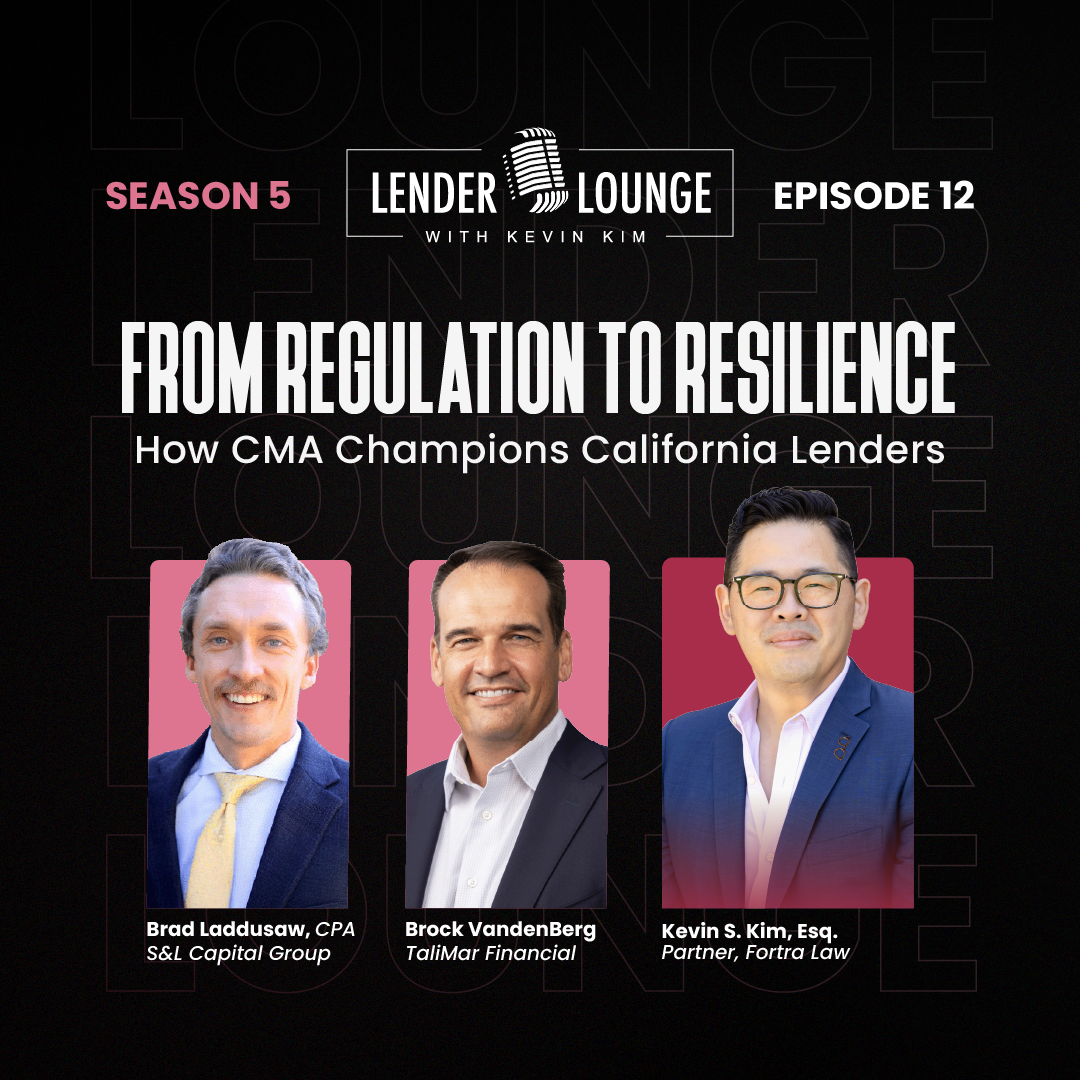


Kevin Kim:
You’re listening to Lender Lounge with Kevin Kim, a podcast dedicated to helping our listeners in the private lending industry grow, improve and streamline their business. I’m Kevin Kim, partner at Fortra Law, the nation’s largest private lending law firm. Join me as we chat with the best and brightest in private lending.
They’re eager to share their years of wisdom and best practices for lenders, brokers, borrowers, investors and more. Subscribe to Lender Lounge on your favorite podcast platform and visit our website, fortralaw.com to learn more about how we can help you scale. Check out the episode summary below for other valuable resources.
Hey guys, welcome to another episode of Lender Lounge with yours truly Kevin Kim. We are in a new setup today. We’ve discovered this awesome studio down the street from our office and so we are shooting live on location with these two fine gentlemen here.
This is gonna be a little bit of a different episode. We’re gonna have a much more lively discussion about the private lending industry at large, in particular, in association with our home state of California. And also just talking in general as well.
Before we start the episode, why don’t you guys introduce yourself for our audience and we’ll get started.
Brad Laddusaw:
All right. My name is Brad Laddusaw. I am with S&L Capital Group.
We run a private lending company based out of the Oceanside area. I’m also president of the California Mortgage Association, which I’m sure we’ll be touching on quite a bit today. Born and raised in Southern California, lending in our backyard is all we do and advocacy on behalf of CMA and the industry.
It’s all that CMA does.
Brock VandenBerg:
My name is Brock VandenBerg. I am vice president behind our president here, Brad. I’m with TaliMar Financial.
We’ve been in the private debt space for over 15 years. We are a private debt fund and fund loans throughout the state of California. So excited to be on set.
This is a beautiful new set. I’m excited.
Kevin Kim:
Great.
Brock VandenBerg:
Yeah.
Kevin Kim:
Shout out to Casey, my executive producer for the show, for locking this in. Now, Brock’s been on the show before. You haven’t.
You have your own show, effectively.
Brad Laddusaw:
I would not call it a show. We’ve talked about this a lot. Like I have, and it came up again on the drive up, like the whole real estate investor podcast scene has always kind of rubbed me the wrong way.
But that’s not what- It gets a little hokey. I attended a conference. It was, I think, 2021.
And there was a guy that was up on the stage giving advice on how to raise capital for his deals. He said, you start a podcast, you get good people on your podcast to build credibility. And then you go take down a deal.
And I’m like, holy shit, you said that live. You’re going to lose a lot of other people’s money.
Kevin Kim:
But this is fundamentals. Fundamentals are important in practice. And you’ve been on the show before, Brock.
And like the show, ordinarily, we’re here to kind of get eyeballs and promotion for our clients and also for the firm and really kind of bring eyes to lenders who are really making waves and doing great things. Today, I kind of want to change up the narrative a little bit. Before we do that, I want to get some more history on your guys’ companies, because both of you guys are different.
You’re not the same kind of lender. You’re not the same kind of business model. You’re both south of Irvine.
That’s basically all you have in common. And we’re all in CMA together. But just give a little history to your companies, a little bit of profile to your companies, and then we’ll get started talking about California at large.
Brad Laddusaw:
Very good. So, my business partner and I, Corey, we started S&L Capital Group, shoot, a little over eight years ago.
Kevin Kim:
Has it already been eight years?
Brad Laddusaw:
Flying by. We follow what’s called your traditional trustee-to-investor model. So, we privately place our loans with high net worth individuals and family offices.
We don’t fractionalize our loans, which I think differentiates us from the rest. And we’re able to push loan amounts up to $10 million loan amount sizes. We oversee the loan servicing of all of our loans, but we actually outsource that to a third party.
Liability purposes, and mainly trust accounting. I’m a CPA. I was in audit before I got into the loan business.
I think I’m a gentleman and a scholar, but I don’t want to be sitting next to myself in an audit. So, that is one of the main reasons why we outsource loan servicing.
Kevin Kim:
And at that loan size, then that means you’re also doing commercial real estate.
Brad Laddusaw:
Yeah. So, we do our target food groups, I like to call it 1 to 4 unit. So acquisition bridge for investment properties or income properties, as well as a fix and flip product.
And then we have a large allocation for multifamily, I say about five to 50 units is our sweet spot, industrial warehouse. And then we’ll even do select office and some retail storefront across the state of California.
Kevin Kim:
So, commercial on retail and office, mostly multifamily, and then a big chunk in SFR.
Brad Laddusaw:
Yeah. And I would say between the commercial food groups, multifamily and industrial, we push those.
Kevin Kim:
Are you guys California only?
Brad Laddusaw:
California only.
Kevin Kim:
Okay, okay.
Now, Brock, you’ve been on the show before, but a lot’s changed. You guys have grown a lot.
Brock VandenBerg:
So yeah, I started back in 2010, actually earlier than that, funding individual loans myself. Most of this was in the fix and flip space before that really, you know, kind of blew up.
And then we were on a individual trustee, similar platform. 2021 we connected, actually, it was 2020. And we got to a point where we just had too many investors and too many transactions occurring, where we felt that the mortgage fund model was a much more efficient platform to be lending off of.
We could scale quicker, we could bring more investors in. So in 2020, we launched today what’s called TaliMar Income Fund. At most recent numbers, we’ve raised over $125 million for the fund.
Kevin Kim:
Those serious numbers, man. In five years? That’s fantastic.
Brock VandenBerg:
Yeah, no, it’s been a huge success story. Now, again, we were able to build off of our existing investor base from the trustee model, but it just goes to show you how deep the bench is for investors looking for a fixed income investment, especially in the real estate side.
Kevin Kim:
Yeah, it’s compared to what they’re seeing out there and what’s called private credit. I mean, it’s much more conservative. You’re first position loans, there’s no weird unsecured commercial credit in the portfolio.
Brad Laddusaw:
That you’re aware of.
Brock VandenBerg:
So, I mean, it just, again, it goes to show you how deep, I mean, there’s a lot of eyeballs, we get a lot of interest from an investor standpoint, I would say.
Kevin Kim:
A lot of them are locally in California, too.
Brock VandenBerg:
Oh, yeah, probably about 75% of our investors are in California.
Kevin Kim:
That’s a very rare story to see. And your lending activities are residential only or?
Brock VandenBerg:
Residential and commercial. So, we really, right now, as the fund grows, we’ve kind of had to morph in terms of just doing focus on larger loan sizes. So really, we’re focused on the 1 to 10 million space.
Still SFR, still multifamily, commercial, retail, industrial, whatnot, kind of is our is our focal point.
Kevin Kim:
It’s funny, because loan amounts in California just skyrocketed since I started here. And compared to when I was a loan officer at a bank, it’s back then a big loan was 1.5 million for anything kind of class B, you know, commercial real estate now, 10, 20 million on is considered small. And California, mostly?
Brock VandenBerg:
California, mostly we’ll do Western United States. But we know, you know, the Southern California market, which is where the majority of our portfolio is.
Kevin Kim:
Because you used to be like San Diego only.
Brock VandenBerg:
Oh, yeah.
Kevin Kim:
Yeah. And now you’ve kind of…
Brock VandenBerg:
Now we’ve got to, you know, as we raise more and more capital, you know, we have expanded our footprint.
Kevin Kim:
Right. All right. So, California, the one thing we all have in common is California.
We’re here, we’re involved. We, you guys lend mostly, I was a concentration, you’re all in California. You’re still like 75, 80% you said, even more than that.
So, you know, California is a strange, strange state. We’ve become an interesting state because it’s, as an attorney in the sector, it’s… It’s great for you.
It’s great because we’re just a highly regulated state, right? California is probably the, has the most complicated regulations for a private lender than any other state in the country, comparatively speaking. But the interesting part is also it’s the largest market.
And I would say the volume that the state produces in just private lending alone is probably makes the entire, it pales, the rest of the country compels in comparison. You cannot compare the numbers that are produced and the dollar amounts in the loans. Right.
So, it’s fascinating because there are times where I tell lenders don’t lend in California. Like I get guys from Texas looking for opportunity, guys in Nevada, guys in Florida, I’m looking for opportunity in California. I’m like, why would you subject yourself to this state?
And why? Because of the regulations? Because the regulations.
It’s there, you’re a lender in Florida, in Florida or in Texas, there’s almost no licensing regulation. Foreclosure is relatively straightforward. There’s not this big boogeyman.
We have two boogeymen, right? So the perspective, but at the same time, there’s a, I get it, Kevin, but we have to have it. Right.
And you look at any national shop in private lending, they all have California on their bench. And so I think that this podcast is really important because people, while they dismiss California, they also have to recognize the importance of the state.
Brad Laddusaw:
You touched on a couple of key points there, especially foreclosure process. But pre-COVID grand scheme of things for how regulated California is, it was pretty, I don’t like using the term fluid, but compared to some of these other judicial foreclosure states and regulation is, there are stall tactics, but all in all pretty efficient foreclosure process.
Kevin Kim:
But it got pretty bad.
Brad Laddusaw:
It got really bad real quick, which is something I always highlight. It’s the legislative risk. When anyone asks me where I see most risk in the deals we do in California, it’s on the legislative side, because it changes quickly and the laws they pass, sometimes they’re retroactive.
And you’re like, well, I got these loans on the books already.
Kevin Kim:
Yeah. And it’s not only that, but the cases, the cases that come out. I mean, we, it’s so frustrating being in California because it’s like, what do they just not want?
Brad Laddusaw:
They want us to leave? That too.
Kevin Kim:
I almost left. They, they, they not want us to lend here. They not want our money.
Like it’s the amount of tax revenue that can be produced, right? Alone, just property, just tax revenue alone. I mean, it’s, it’s, it’s just fascinating, but like, I want you guys to kind of give the audience a little more information about the California Immigrant Association, your roles in the association.
We’ve actually never really brought on an association per se. We plan on doing it. I think it diversifies the content for us.
But CMA, unlike many of the associations that I see in private lending, it’s very different in what it does. And I think you guys are the only groups that actually have had lobbyists for your entire existence. I mean, CMA has been around forever.
So, please give us some more color on CMA, your roles in the association and all that.
Brad Laddusaw:
Yeah. So, the California Mortgage Association is a nonprofit trade association. I like to say represents the asset-based private lending industry across the state of California.
Major pillars, education, compliance, best practices, and advocacy. CMA is a nonprofit trade association. We have had lobbyists throughout the inception.
Kevin Kim:
The mics.
Brad Laddusaw:
Yeah, the mics. So, CMA formed from two associations back in the day. So, we actually have a direct line to Sacramento.
Our lobbyist, Mr. Mike Belote, of the recent battle we’re currently having with AB130, his name actually got dropped on the floor. And that does not happen. But that also shows the reach and the power that CMA does in making sure private lenders today operating in California still have an industry to lend in a decade from now.
So when we’re all long and gone, and no longer in the business, the steps CMA has taken and currently doing, it’s not going to guarantee it, but it’s going to help to increase the chances that there is still a private lending industry here in the state of California.
Kevin Kim:
And you are now, you’re currently president.
Brad Laddusaw:
I’m currently the president of the California Mortgage Association. And my biggest thing is just been doing this because CMA in the past had a stereotype. We’ve talked about it.
It’s, oh, I’m ready. I’m looking forward to it. But something we’ve been trying to do, it’s when you touched on the, the podcast that I’ve been doing, I call them interviews, but we’re just trying to highlight members and service providers and attorneys in the space that allow all of our businesses to function.
What a lot, I think mortgage brokers and investors don’t realize out there, even other lenders, if they had a bridge loan in the last decade, chances are they’ve worked with a CMA member. And when CMA has stacked up over the years, we just have never shared them. So, we just want to, my biggest goal is just to increase visibility for CMA.
Kevin Kim:
And you can’t deny the impact. The impact has been meaningful over the past, I mean, for my career at the firm.
Brock VandenBerg:
And let me highlight, I mean, I got involved with the CMA about 10 years ago, and I will tell you, it was the defining reason that I was able to scale my business, because it is really the only association that is dedicated to California and educating its members on what, you know, obviously upcoming regulations, what are the current rules, and then connecting you with other successful lenders in the marketplace. And so that I think that really differentiates us from some of the other associations as great as they are, but they kind of are on a more of a national footprint.
Kevin Kim:
Yes.
Brock VandenBerg:
And so that’s why, you know, as I think that’s why we are around, and that’s why we’re continuing to grow. Being out the fact that California by far is the largest lending market as well.
Kevin Kim:
Right. And private lending has been the challenge. CMA continues to face, I think all the associations continue to face is private lending in and of itself is very fragmented, right?
Even your business models alone, right? There are people that do not do your business model, whether they don’t, they don’t do trustee, they don’t do commercial, they only do what we’re calling now RTL, right? Fix and flip loan or construction loans, right?
It’s a funny phrase. Yeah.
Brad Laddusaw:
No, I’m just the rebranding that has gone through the private lenders. Some of it is great, but some of it it’s people ask me to do I use this example all the time. I talked to a residential real estate agent or broker.
And they ask if I do hard money. I say no, we do asset based bridge. I was like, “no, I need I need a hard money lender.”
Kevin Kim:
Same thing.
Brad Laddusaw:
I go talk to a commercial mortgage broker. If I throw the H word out there, they’ll hang up the phone.
I say I’m an asset based bridge under like, good, we don’t use hard money. So, when people ask what the difference is, I say their marketing departments. And I think it’s the same thing for RTL, asset based bridge.
Kevin Kim:
RTL is a new thing. It’s a totally new thing. It’s a, I think it’s really Wall Street trying to figure out like, how am I going to put this under my umbrella, bucket of weird loans under a cool sounding abbreviation.
Brad Laddusaw:
But I think also goes down to the capital source that they’re they’re raising money from and doing they don’t necessarily want to say they’re cranking out all this high risk stuff and hard money. Yeah, we’re just doing hard higher, higher risk and RTL.
Kevin Kim:
What the fascinating part is that hard money has a bad reputation to it. But like, one of my favorite lenders, I’ve been around 20 years, they are super conservative, their portfolio LTV is like 40%. And they, they lean into it, right.
And if you ask Adam, there’s the CEO we had on the show, like why? Like, well, that’s what the borrowers call it. I’m like, yeah, actually makes sense.
Like, so it’s like, there was this whole fight, like, I think about five years ago, oh, we should not use this phraseology anymore. I’m like, I don’t care. What do your borrowers call it?
Because ultimately, you serve your borrowers, and we serve you as a law firm. So like, it ultimately, if the borrower calls it hard money, go with it. It’s hard money.
It’s kind of same set of loan documents. It’s the same loan documents, the same laws, it’s the same LTV.
Brad Laddusaw:
And it’s not like your hard money in 1975, or cousin Vinny’s coming after you.
Kevin Kim:
Exactly, exactly. It’s not 18 and six. And you know, it’s not that right.
So the funny part, though, is that, yeah, since the market has changed so much over the past even five years, it’s insane, right. And so you have since COVID, especially the predictions around commoditization and concentration to some degree have happened. You have shops that are exclusively touching only things that are residential.
So SFR, one to four, fix and flip construction. And then that now, with that, in the past two years, that becoming its own, overly commoditized product moving into multifamily. And so, but at the same time, CMA has always been a very diverse set of members.
I mean, I think the longest time for as long as I’ve been involved, at least over 10 years now, the majority of people there didn’t just do SFR.
Brock VandenBerg:
I was a, I don’t think that no, I’d almost say we use the word property agnostic. Yeah, they they’re very opportunistic. They look at the opportunity, the lending request, and then they kind of work around that.
And I think that really works well, when you’re kind of on a trustee model where you can find individual investors to be lending for that asset class. And that’s so you can be much more flexible from that standpoint, versus kind of what you’ve seen now you talk about commoditization of the fix and flip space. I mean, your your credit box is this and you got to underwrite to that.
Kevin Kim: (17:03 – 17:03)
Yeah.
Brock VandenBerg:
And you know, when I think of hard money, I’m thinking again, the credit box is this, right? Figure it out under you’re trying to figure out what’s going to work for, for you, the lender and you the and the borrower as well.
Brad Laddusaw:
It’s truly asset based. Yeah, it’s it’s asset mindset is asset first, and then back in but still real estate. But yeah, but real estate assets.
Kevin Kim:
So it’s what to your point, SBA loans over here.
Brad Laddusaw:
Yeah, no, but what your point is fascinating. It’s you have consumer bridge lenders, construction lenders, land lenders, ag lenders, cannabis lenders.
Kevin Kim:
That’s been the cool part about CMA is that you see a diverse group of lenders in the in the room. And the first agricultural lenders and I left the bank I met was at CMA. And there’s a few guys that we still work with that are focused on ag.
The interesting thing though, is like, okay, so that’s the case though. If that’s the fact pattern we’re presented with the market that we see today on national footprint, because California is own kind of version of the national footprint, because every major shop is here, both commercial and residential, they’re all ending in California. So, then you have this weird dynamic, you have you have the subset of the industry that just does residential, you have a subset of the industry that does just as commercial, and then you guys that like you guys that do both, right, a lot of members, and then you have the guys that do consumer stuff, right, the non Q, but then the non QM guys don’t really participate in CMA.
So it’s kind of like, how do you what’s, what’s the mission on CMA’s perspective? Like, are we trying to capture the entire audience? Or trying to capture just kind of like the guys that just do bridge lending?
That’s been kind of the question mark in my head.
Brock VandenBerg:
I think you can capture all of it. Yeah, because I think again, California is on its own island.
Kevin Kim:
Yeah.
Brock VandenBerg:
And I think that there’s so many changes legislatively, that, you know, even if you are lending on a national footprint, you can still be in and it’s very important to be involved in the CMA because you need to know what’s going on in California. Yeah, your biggest market.
Kevin Kim:
Yeah.
Brock VandenBerg:
So if I would tell any lender out even outside of California, or is on a national footprint, that CMA plays a critical role in educating you and your team as to kind of what is going on in the state of California.
Brad Laddusaw:
And I don’t think it’s specific to just lenders. It’s also your mortgage brokers, even your investment sales agents and brokers, because I like to say bridges bridge. Yeah, it’s, you need to close and sub 14 days on your ad.
So you got a 1031 on the line or distressed property, perm lender dragging their feet. Chances are, like I mentioned earlier, if you’re using a bridge loan, chances are that they’re involved with CMA.
Kevin Kim:
Yeah.
Brad Laddusaw:
So why not just come and network with all the asset based bridge lenders that touch all the food groups in the state of California, but on the legislative risk side and compliance. You and I have talked shop damn near every single conference. Yeah, we have over drinks.
But what I think differentiates CMA once you’re actually at a conference or our mixtures that we have a lot of our members and attorneys, everyone lets their I don’t like saying let’s just let’s their guard down. But yeah, they’re willing to talk shop trade where war stories and share insight on a deal that maybe went sideways seven years ago. And they implemented a change in their underwriting to catch that going forward.
So there’s little things like that that are picked up that I think are invaluable. It’s not about how much volume we’re doing. It’s, hey, what are we doing to make sure we’re still going to be here in a decade.
Brock VandenBerg:
And I wanted to also highlight something that was funny. A couple years back, I had a chance to listen to you at a conference. And you were doing a q&a session about, you know, lenders could ask you various questions.
And I think every question that came up was regarding California. No, you actually finally came up and said, Hey, everybody, I’m going to, you know, let’s not just ask questions about California being that this is a national conference. So it goes to show you how much focus there is in California.
And how many how many questions people have about what’s going on.
Kevin Kim:
Well, that’s the funny part, right? So that’s how I kind of rationalize it in my head. If we exclude consumer from the conversation really quick, and look at if you’re doing business purpose one to four, or you’re doing commercial real estate financing, whether I don’t care if it’s short term, long term, it doesn’t matter, right?
Name it. licensing, foreclosure, best practices and underwriting, servicing. Oh my god, servicing is so complicated in this state.
So like, all of those things you can learn from you can do you can get value, not just learn in seminars and the sit downs. But like, one of the things that I asked a national under like, Hey, why don’t you like not the actual CEO, like, why don’t you send your GC? Because she keeps asking us all these California questions, like, I’m billing you at $800 an hour, just send her to the seminar.
Because she can sit down with I mean, I always joke about Uncle Chuck, but really, literally, if you want to learn something, sit down with Uncle Chuck, he didn’t come anymore. But like when he was coming around, like, guys like that, you know, and you can actually learn a ton just by listening to him for 15 minutes gap on about what his willingness to share.
Brad Laddusaw:
I think that’s what’s really highlights that I think one of the biggest value adds for me over the years sky got involved, see me around the same time 2014. And I call it the old guard versus new guard. You have the old guard that have been through cycles.
And I think that shows how resilient this industry is. And we have some members have been lending since the 70s. Yeah, we have one company that is going to be pushing fifth generation, they started in the 20s.
Yes. And then you have others in the 50s. But they’ve gone through many cycles.
And they’ve, they share what has worked and what hasn’t and some of the stuff they dodged. And I think that I always like asking those questions. Yeah, because they like to just share it.
And it’s not about how great they are.
Kevin Kim:
It all recons of repute itself, right? The same problems we saw 20 years ago are coming back, regulatory over overreach. And you know, how do you combat that?
Right? And we’re that’s another part is our our, our clients are always like, I just don’t get it. Like even guys who’ve been here for 15 years.
They are completely misconstruing what the regs are. And so it’s like, well, as your lawyer, I can tell you this all the time, but you probably should find practitioners to talk to as well.
Brad Laddusaw:
And someone that’s potentially gone through an audit. Yeah, it’s not if it’s one.
Kevin Kim:
Yeah, if you’re doing business, we were at a CMA a couple years ago, literally at the welcome reception, and they were just exchanging what this examiner said versus that examiner said over all the you were in there, I think you were at the cockpit that that round, and we were just talking about, man, this is what I’m going through an audit. And this is what I’m going through. I can’t say that because I’m counsel, and I have attorney client privilege, but you guys can easily share ideas and share war stories and ask questions to each other.
I think that’s more valuable than me sitting there like, because my reaction is going to be, well, we have two choices. We have a compliance to them. At this point, it’s kind of all we can do.
Brock VandenBerg:
Theoretical versus realistic.
Kevin Kim:
100%.
Brock VandenBerg:
And that’s what we talk about. You know, I think one of the great panels that they host at the CMA events is a legislative session. And they go through all the regulations that have changed.
Kevin Kim:
Yeah.
Brock VandenBerg:
And then you can get up and ask, ask questions to, to those on the panel about how does that impact your business. And it goes along way to adjusting how you are doing your business here in the state of California. And I love that panel.
I think it’s a great panel. And there’s no way you’d, you’d be able to gather that information or interpret it anywhere else, anywhere else on set or interpret it.
Brad Laddusaw:
Yeah, we have. And even when we do private money basics, we started a couple years ago. And that’s where I think that’s what Nima is awesome.
And we, we dive in heavy on title insurance. And he’s always, there’s how the law, like how it’s written. And here’s how it actually, actually happens.
And it’s, again, you’re guys, I can’t speak highly enough of your, your willingness to just share and add value to the industry, because it’s not, it’s not easy. It all takes time.
Kevin Kim:
But it blows up in our face a lot. What happens is we’ll put out education, then our competitors will take that who don’t participate in CMA. And they’ll, you know, basically use that against us.
I’m like, no, hold on. Right. And it’s like a quarter of what actually needs to be taught.
But like, you know, we’re giving as much starting point.
Brad Laddusaw:
It’s a starting point here. Here are a list and any panel that we try and all right, I moderate doesn’t matter the association. It’s like, this is not 100% exactly how to do everything.
Here are the potential landmines. And here’s a list of questions you go talk to your legal counsel about or your service provider. And they Hey, I need to make sure I’m covered here, right covered here.
And then also CMA is I think, great relationship we have with the DRE.
Kevin Kim:
Yeah, I was really impressed by that this past round, because like the DRE is the big boogeyman in California. We always joke about like, there’s two boogeyman in California, and one of them is scary than the other. And the DRE is that boogeyman.
But this was got back from Monterey. They see me just held held there. Is it the spring?
Brad Laddusaw:
Summer?
Kevin Kim:
Yeah, fall seminar, fall conference. This guy brings up the commissioner of the DRE on stage. And I’m like, and she’s so nice.
Brad Laddusaw:
She’s awesome. She’s awesome. Right.
Kevin Kim:
And you were actually going back and forth on some regulatory stuff that I, my entire career here at the firm, I’ve been trying to get an answer on. And it’s like, thank God you guys have opened up the channel to for us to ask because unlike the DFP, DRE is a lot harder to get answers from. And I don’t know if it’s I think it’s really not intentional on their part, just bureaucracy and all that stuff.
Brad Laddusaw:
Yeah, they’re massive. And it’s so little story about Chica Sunquist, the DRE commissioner. So when the fires hit Southern California, I receive a cold call from someone.
It’s like 6:30, 6:45 at night. And I was like, I don’t want to pick up this phone. I’m trying to get out of here.
I got two kids at home. I pick it up. And it was a DRE commissioner.
And she was just calling to see how membership was doing, what the exposure was like with the Los Angeles fires, get our input as an association, how we think things might play out from insurance, recovery. And, but she was taking notes. You could hear her taking notes because she was going to escalate it to other departments.
And it was like all hands on deck and she did not need to call us or call me and do that. And she genuinely cares about the industry. And that’s why I was excited to have her come because I wanted to not just have her come and give a presentation like some others in the past.
I was like, let’s have a conversation. You’re a real person and let’s get a better understanding how it works behind the scenes at the DRE on hierarchies to where if you are going through a DRE audit, what can I ask to escalate? Or is it just a staying still here?
And then she highlighted, which I thought was, I had no idea that she can’t really opine directly on a case directly with your attorney because she’s not an investigator. She is now the commissioner. But again, another value of the CMA, and I’m not saying all of you to flood me with your stuff and emails, but if there’s something that has gone through the channels that we do can document might be a misinterpretation from the auditors because the statutes are very convoluted and confusing and vague.
There is a channel to the commissioner.
Kevin Kim:
And that’s, I mean, that’s more than we can ask for. That’s been the challenge in California is that the DREs, the only way we have precedence is through audit. And we like to avoid audit if we can, right?
Brock VandenBerg:
Well, and that’s a good point. I mean, let’s talk about what happens to get to an audit. Let’s focus on what we can do today so we don’t get audited.
Kevin Kim:
Or an examination, God forbid. Or an examination.
Brock VandenBerg:
And, you know, if it’s from accounting or it’s from trust fund accounting to, you know, if you’re selling notes off, if you’re doing that correctly, making sure that you have the right documentation in place. I mean, that is imperative that you have that set up.
Kevin Kim:
And that’s the thing is that what I’ve, and I’ve been telling people for a long time that guys, the national industry, guys, you’re all buying, like buyers, you’re all buying in California. You’re all lending in California. You’re all brokering in California.
Like whether you send, whether you come, I don’t care if you come CEO, but like maybe send your GC or chief operating officer, head of compliance, bring them on over because they’re going to gain a lot out of this, right? It’s not necessarily just networking like everything else. And that’s why we’re so heavily involved for like, we don’t get in, we don’t get involved as deep in education.
The only two we get really that deep with are you guys and APL. And that’s because APL, APL is national education. You guys are local education.
But at the same time, we know the national landscape Texas doesn’t have one of these. Florida doesn’t have one of these. Like it doesn’t exist.
Well, they don’t have as many regulations. I mean, we always joke like Texas has, you know, the number of laws they have compared to California. But at the same time, like it’s complicated.
Foreclosure is tricky in Cal- in Texas. If you’re, if you, if you’re uneducated, it’s the industry and same thing in Florida.
Brad Laddusaw:(29:43 – 29:50)
And so like, and then Texas, I just felt we don’t do deals in Texas, but I just found out like trying to find your own sales comps. They don’t list the sales price.
Kevin Kim:
No, no.
Brad Laddusaw:
Yeah. So how, for how heavily regulated California is, I always like to say, I could figure out exactly who I’m working with in about 45 seconds.
Kevin Kim:
Right. There are some pros that come out of these legislation. Yeah.
Brad Laddusaw:
But, but it’s a, and more so on the licensing, it’s a pain in the ass. It’s called a spade a spade, but it’s some inefficiencies and different licenses for doing the same thing. I know when I sat down with Nima, he was, we were having a fricking crack up over that.
Kevin Kim:
It’s like, yeah.
Brad Laddusaw:
Lenders from New York come in here or vice.
Kevin Kim:
The thing is that that’s probably on the licensing side of what we do. It’s probably like Jen and I do license applications for private lenders. And I’ve 30% of the conversations are in general, and probably 6, 70% about California Pacific is like, help me understand the landscape.
Right. And even the big national shops, they’re just confused. And you have a lot of lenders that are East coast lenders that lend here because they’re national.
And they’re just flabbergasted by how complicated it is here. And what’s, what’s this kind of interesting though, as they evolve through it, the CEO has had to become, oh, I get it now. And they know more than their compliance officer.
Brad Laddusaw:
And it’s like, that’s sometimes I present and someone’s like, I wish, how long you’ve been practicing law? It’s like, no, I just talked to a lot of attorneys.
Kevin Kim:
To lend here in California, you actually almost have to have, there are some lenders as CMA that have a better understanding of the DRE than I do. And it’s fascinating, because it’s just they’ve been audited so many times. And there’s like, there’s the nuance.
And then there’s, and then there’s the practical nuance, right? The legal nuance, we understand better, the practical nuance, they understand a lot better.
Brad Laddusaw:
And that legal nuance, I don’t think it’s touched on enough. That it’s just saying you have a real estate attorney in the state of California is not enough. That attorney needs to have a focus.
Kevin Kim:
It has come up a big, big commercial shop up in LA. Their servicer, their big national servicer was mistaken that they did not need a department of real estate license in California to service loans for other people. I’m like, who told you that?
It’s a big law firm. Some very famous big law firm in real estate. I’m like, oh, that’s why.
There are big law firms that know this stuff, but like you didn’t ask the right questions and it sucks, but like, it’s going to be solved. But those kind of are worst case scenarios for us because we know how aggressive the regulators can get here. If you’re in blatant non-compliance.
Brock VandenBerg:
I call it the lights out. DRE comes in and you are not following those regulations. It’s lights out.
Kevin Kim:
Right, right, right. Well, I’d like to ask something in a similar vein. It’s okay, we’ve gotten into how important CMA is on the regulatory and the advocacy front.
But if I talk to lenders about CMA, and I bring this up, hey, your COO, your head of compliance should come out. Like, well, we give it a shot. It’s kind of small.
The usual complaints. I hear it’s too small. It’s a lot of these guys are doing commercial or consumer.
Isn’t that a consumer show? I’d like to be able to dispel some of those issues because I personally think that CMA can provide a ton of value to the national audience because of all the different issues that you’re talking about today. But there’s a weird resistance.
And I don’t understand. I can’t put my finger on it. But there’s a weird resistance.
Because like for example, number one private lender on hard money on RTL, Kiabi, right? They have a chief compliance officer. They could easily come down and come to the San Diego show or the Monterey show or whatever.
Or if we do one in Bay Area, they can easily come out. They know about it because I brought it up before they’re like, but the marketing team for some reason doesn’t really see the need to go to it or they don’t really understand the need to go to it.
Brad Laddusaw:
Yeah. And I think that’s something we’ve been working on changing heavily the last year and a half is messaging.
Kevin Kim:
Yeah.
Brad Laddusaw:
Invisibility for CMA and the value added brings. I have said this countless times. I did not join CMA to quadruple my business.
I joined CMA to increase the chances of still being in business 10 years from now. And that is I think the again, maybe a misinterpretation on messaging. I pretty much exclusively refer my deals to CMA members just because I know that their shops higher probability, their shops are set up correctly on the compliance side processes are in line.
They’re lined up with the right attorneys and service providers behind the scenes. And I know they perform, but it’s, it’s more so on a sharing that it’s like, it’s, you’re probably not going to send your head origination, whoever heads up originations for fix and flip loans to come to a CMA conference, but the compliance officer, an underwriter, the nuances in the California private lending laws are very heavily open for interpretation at times. And I would challenge some, it doesn’t matter the lender, whether they’re institutional or not review your RTL loans, and you’ll be fricking shocked.
You might have an oh shit moment of how many actual consumer loans you might have on the books just based on disclosures on the front end. And there’s it’s, it doesn’t take 100 loans to put you in a tough spot with a regulator or someone filing a complaint. It just takes really one.
Kevin Kim:
At the national scale, you’re also making reps and warranties and all your contracts that you’re in compliance with all relevant laws and servicing and origination. Like it’s a serious risk. The well-heeled shops will come to me, Kevin, I have this clause in the NLP coming up.
I’m a little bit nervous about this. Can you take a look at everything? I’m like, yeah, sure.
No problem. That’s a major concern for these guys. And you guys are worried about bringing regulatory risk up.
That’s a factor. But, but the challenging issue on my end with these guys has always been like, I think that the executives are more concentrated on growth, right? And volume and numbers and profitability.
Maybe they shouldn’t be at the show. But maybe their head of compliance should be at the show.
Brock VandenBerg:
I would not discount that because I’d also say it’s a good opportunity to get a feel for where the market is going. I mean, when you go to these events, you sit down and I’ll talk to Brad about kind of what am I seeing in the marketplace where we’re, you know, a lot of these large shops are focused on SFR, small multifamily, especially on the RTL side. And you know, you may not on a broad level understand what is going on specific in certain sub markets of California.
I mean, we are seeing home value starting to stagnate. And how does that impact your underwriting? If you’re not, if you’re just looking at it a macro level from the US, you’re not looking at what’s going specific in Los Angeles, the Bay Area, San Diego, you’re gonna be missing out on a lot of probably long decisions that you’re gonna make on the short term on what you’re underwriting is going to happen.
Kevin Kim:
I mean, even on specific, like right now, right now, germane topics, like the fire issue, like, it’s constantly evolving. I didn’t even know. I was surprised.
I got a lot of good intel when I was in Monterey together when we were together. I had no idea what was going on, like to that degree, in terms of what the redevelopment like, it’s not happening nonexistence. Yeah.
And why? Right. And so that level of intel gathering is important, because people are trying to position themselves.
Brad Laddusaw:
They’re not they don’t know what’s going on on the ground. And then even just with the fires, or the nuances of navigating the city of Los Angeles, different departments there. So your ground up construction deal in Los Angeles is completely different than what you’re going to be doing.
Let’s say in Salinas, California, or down in San Diego. And you’re only going to hear get that from talking to lenders that are actually have exposure to that market.
Brock VandenBerg:
Or let’s talk about ADUs. I mean, ADUs. I mean, that’s a whole topic we could talk for an hour.
Kevin Kim:
I mean, you San Diego people are like the experts of the ADUs.
Brock VandenBerg:
But like San Diego is taken over by ADU projects. But if you’d actually listen to somebody on the ground, you know, it’s not all daisies right now. I mean, there there is such a potential for oversupply of these little micro ADU units.
But again, if you’re not at these events, I mean, you understand that regulatory, you don’t set it up, right?
Kevin Kim:
You’ve got a consumer law in your books. And that’s a youth structure, correct? Yeah, yeah.
Local guys in San Diego have really perfected it. But like anywhere else in the country, because that fad will spread. Right?
Any other city that faces density problems, they’re gonna, that fad is going to spread. We’re already hearing about it on the East Coast. Right?
So you guys understand, like, this is what we’re seeing on the ground here. You don’t think that your local legislature is going to follow suit, right? So that’s really important.
And zoning wise, and all that kind of stuff, too.
Brock VandenBerg:
Now, don’t get me wrong, there’s huge opportunity. I mean, a lot of these cities have really now refocused and said, Okay, we’re gonna loosen up our zoning allowances here. And that opens up huge opportunity for lenders.
But you have to understand what that means.
Brad Laddusaw:
Yeah. And I’ve often said that I think the ADU play is going to bury more investors and it’s going to create successful ones. If you’re looking for purely value add play on ADUs, even with cities loosening things up, they’re all overworked and underpaid.
They don’t have the manpower to get these applications through and review. So if you’re doing a high leverage value add deal as a lender, and it’s a 12-18 month loan, I’m hoping that that borrower is actually going to be able to start breaking ground within 12 to 18 months, let alone finish the project.
Kevin Kim:
So these perspectives are important, right? Because what I like about CMA is the majority of people in that room are remarkably conservative lenders. And that perspective is important.
Because an underwriter, they can, whether they whether the business follows these guidelines or not having that part, because the business is in their ear constantly, which is telling them to push leverage, push deal flow, they have to have a balancing sounding board on the compliance side.
Brad Laddusaw:
And I think you make a good point. You say a lot of conservative underwriters and lenders, but I’ve talked to some institutional guys, I love talking to them, because I think there’s a lot that CMA could learn. Oh, yeah, from processes, infrastructure, and all that.
But then also, it’s, I tell them some of the deals we do on the commercial side, and they’re, why the fuck would you do that? That’s risky. But it’s, it’s beauty is in the eye of the beholder.
Kevin Kim:
Commercial, that’s also it too.
Brad Laddusaw:
Well, but that’s, but that’s where I’m getting at. There’s opportunity everywhere, no matter what type of shop, or no matter how you’re structured, there are inefficiencies in everyone’s process.
Kevin Kim:
There’s inefficiencies in mine. It’s bias too, right? It’s confirmation bias in a lot of ways.
A lot of the RTL shops, they could easily do, for example, 20 unit multifamily, they won’t touch it, right? Because it exceeds whatever buy box they’ve set up, that is informed by the institutions and their credit facilities and whatever. And that creates confirmation bias.
Oh, it’s risky. Well, no, it’s not any more risky.
Brad Laddusaw:
You don’t have money for it.
Kevin Kim:
Let’s call a spade a spade. You don’t have capital for it. But secondarily, like you just don’t know how to underwrite it.
It’s a different underwrite. You need to have a different mindset and underwriting those kinds of assets, true multifamily, as opposed to a five unit, 10 unit project.
Brad Laddusaw:
And it’s about scalability as well. How can we get, automate our processes to get… That’s one thing.
Yeah.
Kevin Kim:
So that’s a good segue. So CMA is also has this reputation of being a lot of the old guard. You mentioned that earlier, old guard, new guard, right?
As part of… we’re the young guys at CMA, right? We’re the young guys at CMA.
And this is the challenging question is like, okay, I really believe in what CMA is doing. I want it to be there for another 50 to 100 years. I don’t know that it’s going to continue if we don’t get new blood in, right?
And so the new, the institutional shops, the guys are in California, but not coming, not showing up. They’re not institutional by any means. Then it’s not showing up.
Like, how do we get them to show up? How do we get them to participate? Because that will drive new membership, that will drive new engagement.
And when we’ll have those discussions about how to improve your business, we don’t do a lot of business talk. You know, we don’t do a lot of business optimization talk at CMA. I would love to see more of that, too.
But how do we do that? How do we achieve that?
Brad Laddusaw:
And I think this is the only way I know how, right? So that’s exactly what I was gonna say. That’s why it’s, it takes energy, confidence, and someone that’s just willing to call it how they see it.
And I think that’s…
Brock VandenBerg:
Well, I, and again, I think you’ve done a wonderful job, too, Shafiq, prior to yourself as well. And I want to highlight one of the things is these, we’re just talking about these pop-up events that you’ve been hosting. And we used to have, the CMA would have four events per year, and you’d all go, you’d all go to those events, right?
Kevin Kim:
But they were the only four. They were the only four. So it wasn’t taxing.
Brad Laddusaw:
That’s true. Everyone just lent to their backyard.
Kevin Kim:
It was relatively easy.
Brock VandenBerg:
So COVID hit, we had to shut down the events, but we brought, we got two events, two core events per year, one in Northern California and one in Southern California. But now we’re doing these pop-up events. And they’re great events.
They’re a couple hours. You go and network with other CMA members. We invite vendors and other brokers from the industry to these events.
And they’ve been, it’s been a boom for the CMA.
Brad Laddusaw:
Yeah. And membership. And it’s just, I think it’s just going back to the basics with CMA, education, compliance, best practices, and advocacy.
I think there is a drive to education currently and compliance. I do think you’re probably, I don’t know.
Kevin Kim:
Our surveys tell us that too. So we’re getting a lot of feedback right now.
Brock VandenBerg:
So again, your private money basics that you host, that you hosted, we had how many people at that event? So we cap it at 60 and we have 60. We had 60 people at that event and it was basics.
Just we’re going straight down to the basics. What is private lending? How do you not get in trouble?
How do you grow your business? And it was a huge success. So, those kinds of events have attracted, which is why we’ve seen an increase in membership.
Kevin Kim:
I don’t deny the quality of the education.
Brad Laddusaw:
Yeah, but it’s more some messaging, right? And how do we continue the growth? And I think if you went to a conference in Monterey versus a conference five years ago, I think you would see, you would grown, but the faces in the room have also changed.
There are, there are new lending companies that have popped up that are coming through. I would say the energy and the tone in the room is completely different. It’s a lot more inviting type experience versus feeling like you’re going to walk in and you’re, you’re a, the bread hits the chopped child.
I don’t know if I could say that.
Kevin Kim:
Well, I think that it’s been, it’s, it’s a different environment. People are more open-minded to kind of what you consider the current landscape of the market, right? It’s like Ryan, a sailor from Dia came out.
That was, it was nice because he was surprised. Like, he’s like, a lot of these guys already do DSCR. They just don’t know it.
Brad Laddusaw:
So, we could do really well here. I’m like, yes. And that’s, and that’s the outreach that I think it’s not only on Brock, myself, or you to share the value CMA brings.
It’s also membership reaching out. Where are you going for your meat and potatoes and vegetables? Where are you also going to expand your lender network in the bridge space, DSCR coming?
So it’s, I, me, I personally think it is a, just a messaging and delivery type thing where CMA is a nonprofit. We don’t have a marketing budget, our team like that. Whereas some other conferences where they might have a team exclusively for marketing and promotion and all that CMA, we have, our committees are made up of members that are volunteering their time.
Brock VandenBerg:
Yeah.
Brad Laddusaw:
So, and I think that’s, that’s the challenge we’ve had because we’re all running our own businesses and it’s a thankless thing.
Brock VandenBerg:
It’s a volunteer thing for sure. But again, I think that’s the value at, we are running our own businesses and we can bring in our own inputs as to what we’re seeing in the market. And again, people, I mean, from a lending perspective, everybody has a little different niche that they’re coming into the market with.
The other thing I wanted to highlight is that we are, you know, reinventing the fund manager committee. And so this is where we bring in fund managers from within California together and having an open discussion about what is going on in the industry. We bring vendors like yourself to come in and explain what is going on in the marketplace.
And it, you know, this is a great opportunity for people that are not only looking to launch a mortgage fund, but currently in a mortgage fund and trying to figure out where to go in today’s marketplace, especially with the advent of institutional capital, you know, where is the opportunity? I think there’s this misconception that because institutional capital has come in, that, you know, the opportunity has gotten slimmer. That’s far from the case.
It’s actually grown, right? Now this idea of, we use the term hard money. Forget the notion.
It’s an industry now. It’s a private lending industry. We’ve taken market share from conventional banks and we’re going to fill that void.
And there’s the opportunity there. So I would say that, you know, if you want to find opportunity, you want to talk to people like ourselves about what’s going on in the industry, the CMA is a great platform to do that.
Brad Laddusaw:
And not to plug Ryan Saylor with DIA, but I thought he had the funniest line in Monterey when he was talking about, he’s like, some people are just so against the institutional money. And I asked him, do you have leverage on your fund? You are an institutional.
I was fucking rolling in the crowd.
Kevin Kim:
There’s a resistance, there’s a semi resistance to the institutional, I guess you’d call it counterparties in the sector. I remember when a lot of the institutional guys that were that were popping up in 14, 15, 16, started to show up. And there was this resistance to them.
They shouldn’t be here. They’re bad people, that kind of stuff. And I mean, that pushed a lot of people away.
So this inclusiveness is important, right? Getting people more involved is important.
Brad Laddusaw:
I call it shaking hands and kissing babies and talking shop.
Kevin Kim:
Like it’s what I’ll tell you. One of the things I’ll tell you is that if you look at the other associations, the bigger shops, they eat it up getting involved. So there has to be a way for them to get involved.
They really, especially on the advocacy, they real and also like kind of education, they really like getting involved.
Brad Laddusaw:
I because the other big one on the advocacy side, I would say what is it NPLA is the one that’s heavily involved.
Kevin Kim:
They do some of their East Coast concentrated.
Brad Laddusaw:
Yeah, but what other associations are more big on?
Kevin Kim:
In California, specifically, the only association that works on legislative besides you guys is NBA. APL will support anything that CMBA and CMA does. I think we’ve done some stuff together with CMA and APL in conjunction with CMBA.
California only stuff that’s germane to hard money lenders, private lenders. CMA is the only one that does. Here’s the question, though, is if I’m, you know, kind of a regional shop, right?
And I want and I really like this stuff. I’m gonna get involved with it because I think it’s important for my business. There’s got to be a way to get involved, getting involved.
So volunteer, right? So it’s a volunteer program. They need to know the pathways to get involved without too much hoopla, hoopla and red tape.
They want to get involved, help me get involved. Right? That means the world of these guys.
And so getting it and it does for us to getting involved is something that we really want to do. Not only because it, we think that it also helps with the messaging. But the challenge is also like engagement.
I like that. I see it all the time on the other on the other associations, they get really engaged because they’re involved. So like, if we can get these, Ryan, we can get Ryan involved, right?
Or the big foreclosure trustees or the big servicers involved, people would get more excited to be part of the association.
Brad Laddusaw:
I agree wholeheartedly on that. And it’s, and again, it starts to come into a pop-up mixer and find it just talking to people that are in the industry that are also involved with CMA. It’s like, get everyone out from behind the logo.
Like, let’s just have a conversation. And it also, I still talk to people today that have been involved for CMA for a number of years. And they didn’t, they don’t know we’re a nonprofit trade association.
They don’t know we have a lobbyist.
Kevin Kim:
We don’t know our involvement.
Brad Laddusaw:
And that comes to sharing our wins. Like in the past, we just didn’t, CMA didn’t like to share their wins. They never did.
But it’s like, here’s what, here’s what’s currently going on. Here’s the battle we’re up against.
Kevin Kim:
In today’s world, if you don’t promote it.
Brad Laddusaw:
Well, but it’s also, to your point that you just touched on messaging and your firm’s involvement and growing involvement. We greatly appreciate it. And it’s, shit flows downstream.
A lot of times it starts in California. It does. And it’s, we have stuff currently going on and has been going on where something’s been resolved.
Other issues have not to where, hey, if it picks up steam here in California, it may start trickling to some of these other markets.
Kevin Kim:
And I’ll give, I’ll give our audience an example. Like there’s this huge sub industry in residential real estate called HECs, right? Home Equity Contracts.
California will likely be the first state that will deem that to be a loan. Do you not think the rest of the country will deem that to be a loan? Eventually, they’re going to follow suit.
We saw the same thing in factoring, right? So then the nice part is that other other states didn’t follow suit in factoring. But HEC is different because it has to do with someone’s house.
And so like, I, it’s a huge market, and there’s a lot of activity in that market. But California is the wobbler state they’re all kind of scared of. And if they make the call that it is a loan, well, here we go.
Right. And so that’s the stuff I always warn everyone about, like what you’re thinking about. You’re in, you’re, you’re in a sweet spot right now in Texas.
But will Texas all of a sudden, make a left turn like, like Nevada did if another crisis comes? Right? Nevada is a, what used to be a red state.
They made a left turn because the recession, if another recession comes, I don’t, I don’t think that these red states will stay in this whole free, no, no regulatory arrangement. And I hope you plan on being around for over 20 years.
Brad Laddusaw:
You know, so not to go down the political landscape too much, we’ll start drinking way too early for today. But it’s power of the dollar. I mean, it’s actually an interesting question.
Kevin Kim:
Has CMA ever done anything like that with like fundraisers or anything like that for politicians?
Brad Laddusaw:
So CMA’s PAC is designed for that, for outreach to our legislators, promote things like that. But it’s when your Lobby Day is a big thing that we did.
Kevin Kim:
Yeah. Tell me more about that. Because I don’t know that I don’t, I’ve never been involved with Lobby Day.
I think our audience will hear about that.
Brad Laddusaw:
And NEMA, no, NEMA couldn’t make it up. Steve made it up. And he’s, he wants to cruise again.
So in the past, CMA had Lobby Day. This is pre-COVID. And it was a big outing where we would get a lot of members.
We fly up to Sacramento. We schedule anywhere from 15 to 20 meetings. And we sit down with the legislators and their staff and discuss a couple of pressing items.
Mike Belote, our lobbyist, his office is up there right by the Capitol building. So we have lunch at his office first. He’s like, here are our pressing items.
Here’s our agenda. Here’s things you cannot discuss with legislators in their office. Don’t discuss fundraising.
No fly zone there. But then we go and sit down and we’re, they, what I was surprised about is they genuinely wanted to listen. Some of the staff, you could tell, like, I’m forced to be here.
But for the most part, they’re like, this will negatively impact the industry because of X, Y, Z. We did that again this past May. Odell Murray brought it up.
We teamed up with the United Trustees Association.
Kevin Kim:
Oh, great.
Brad Laddusaw:
And we’re going to be, we formed a subcommittee with CMA to bring this back with some vengeance going into next year, or I should say momentum. That’s great. And we want to have, I want to have 40 to 50 members up there.
And you don’t necessarily need to be just a member of CMA. It’s like, if you’re an industry participant, come up with us. We’ll meet at our lobbyist’s office before.
Then we go sit down with these meetings just to educate them because they see us as one big lending industry. They see us as potentially Bank of America, Wells Fargo, the big bad lenders, which we’re not. We’re just a lot of small business owners, lenders that are driving value, providing liquidity.
Brock VandenBerg:
And I went there for my first time. You had suggested I go up and the takeaway I had was this. Number one, you’re right.
They kind of lump us into one big organization.
Kevin Kim:
So, there’s ignorance on the hill as well.
Brock VandenBerg:
So the next thing… Well, since we’re going up there next year, I would say it’s lack of understanding.
Kevin Kim:
They don’t know the industry we are. They don’t know what they are. I don’t want to say.
Brock VandenBerg:
So the second thing is we sat down with a lot of these legislators and they listened and they asked great questions. They’re pummeled with thousands of pieces of legislation every year. So there’s no way they can just focus on our piece of legislation, but they’re willing to listen and they ask great questions.
I was blown away by how willing they were to understand our side of the industry. And maybe it doesn’t go our way, but you’re out there educating them and hoping that if any new legislation comes up, that they’ll see it our way.
Brad Laddusaw:
And some of those, and it’s just like I said, it’s getting out from behind the logo. And some of these bills, they put a lot of reliance on their staff to tell them what’s in there. And their staff just may not know what’s on page 95 of a 250 page bill that could potentially impact a sector of the market that will have a ripple effect.
So Lobby Day plays a very important role with that. And we’re not the only one that has a Lobby Day. CMBA, I sat down with Cody with SLAT, heavily involved with CMBA.
And that’s what we’re talking about is just doing more of that. Getting those assemblymen are huge important.
Brock VandenBerg:
And if you’re not doing it, somebody else is on the flip side of what you’re trying to accomplish.
Kevin Kim:
Is there any thought with the advocacy and with the lobbyists to do any kind of political, like supporting, like picking candidates and fundraising for them?
Brad Laddusaw:
That I cannot confidently answer that question right now on how that would actually play out.
Kevin Kim:
It’s tough, California.
Brad Laddusaw:
Yeah. So, and I don’t even know what the do’s and don’ts are.
Kevin Kim:
There’s a lot of, California has like 10X the rules on lobbying and fundraising that the federal government does.
Brad Laddusaw:
And that’s what the PAC is for, to kind of support certain legislators that agree with kind of pro-business, if you want to call it that, in the state. But then you also have what CMA used to do in the past, and this is more pre-COVID, you had, advocacy is not just going up to lobby day for one day. It’s, if you have your local legislator is having an event, you go to those events or you invite them to a fundraiser that you put on behalf of the industry.
Because they are in the people business, just like we are. And they only know what they- And that’s a great point.
Brock VandenBerg:
I mean, we were writing, I wrote a couple of letters out to my legislators and I actually got some responses back from them that they received it, that they understood and that they felt that we had a good position. So, you know, this idea that our legislators are not listening to us is a fallacy. I mean, they are, and they want to hear from you.
So, my recommendation is reach out, if that’s an email, through their website, a letter, going out to this advocacy day, it’s important to get involved. And it impacts you.
Brad Laddusaw:
Yeah, and it’s similar to if you’re talking to a borrower or let’s say a title underwriter, you’re trying to get your title policy in place, you’re not going to go hostile at them with something, but it’s, you need to have a professional, open, educated dialogue and they’re happy to have it.
Kevin Kim:
And then with getting involved with all that stuff, like I think one of the things, I’m not entirely sure how this works, how, let’s say someone’s listening and they want to get involved, how do they get involved?
Brad Laddusaw:
Shoot me an email.
Kevin Kim:
Okay.
Brad Laddusaw:
No, it’s literally as simple as that.
To get involved, you have to be involved, as cliche as that sounds.
Kevin Kim:
Become a member.
Brad Laddusaw:
Yeah, so it would start with becoming a member, but it starts with a call first. Is it, I’m not here to pitch CMA, it’s not for everyone. It’s not for every company.
I just share what I’ve gotten out of it over the last decade. And it works for some, not for others, but you also don’t need to be a CMA member to come to conferences, to come to mixers. But there are value adds of being a member and getting involved just starts with, when applying for membership, and then just talking to me or any of the committee members that you go to our website and you’ll see all the different committees and you can reach out and say, hey, I’d like to get involved with XYZ committee.
And then it’s reach out to the committee chair and if there’s room for the committee, get them on. And a lot of members will rotate off of committees just for lack of time.
Brock VandenBerg:
I think for anybody that just kind of signs up for an organization, going to your first event can be daunting. You don’t know anybody there. And I think we do a very good job of making those introductions.
A lot of our panels are very interactive. So you can ask questions, you can respond, you can share stories and share ideas. These pop-up events are wonderful events to show up if you’re not involved already, just to get a feel for the organization.
We’ve really opened up the opportunity to people get involved. And then as you go to the event or you go to one of these pop-up events, you start to talk to Brad or myself or somebody else and talk about what is it that you’re trying to accomplish and maybe we can put you on a committee. The committees I find are also great ways of just connecting with other people in the industry.
It’s not just over a beer, but you’re actually accomplishing something together. And I was involved in the budget committee, very mundane, very slow committee. But it was a great opportunity for me to connect with two or three other lenders out there and just a stronger bond relationship that I have with those people.
Brad Laddusaw:
Or if you just like to swing the sticks, you can always shoot me an email.
Kevin Kim:
This is the most golf-centric association out there, by the way. It blows my mind. The amount of golf that was played in Monterey.
Brock VandenBerg:
Yes, yes, yep.
Kevin Kim:
Collective probably like 300 holes probably was played.
Brad Laddusaw:
I think we and Gary with Pride Co and Jeff with Valkris, I think they played every single day.
Kevin Kim:
Yeah, and that’s the funny part is like Valkris is very involved and people don’t know this, but Valkris is in the top 50 in the country when it comes to volume. And so like they’ve been in the CMA for, I mean, for as long as I’ve been part of CMA.
Brad Laddusaw:
And I think a very good point on the volume that they do and they follow your traditional trustee route. They do.
Kevin Kim:
They have not evolved the bond that much yet.
Brad Laddusaw:
So it’s, I mean, we could learn from other shops and other businesses out there. And I think that’s what also excites me in connecting with more of the institutional crowd, the DSCR lenders, the high volume fix and flip institutions.
Kevin Kim:
There’s ways that they do stuff that we can learn from and that we can learn from us on. Processes, baby.
Brad Laddusaw:
And it’s not always about trying to quadruple your business. And I think that is a byproduct of CMA, but that’s not necessarily why someone joins in the beginning. And that’s, I think, just a misconception out there, a lack of delivery on the messaging.
And some others in CMA say, hey, no, Dom, it’s all about networking. Networking is a very important part of it, but it’s a byproduct. We’re coming to make sure that we’re still gonna be around in years to come.
And we learn from each other. And I think that’s a big part of an association that actually does have a voice in Sacramento, does have wins and does have a growing bench of younger lenders that are getting more involved. And it’s fricking fun.
It’s exciting.
Kevin Kim:
I will tell you, it’s growing. The new generation of lenders are coming out. And I like to see more of it grow because California is, I mean, as Jeff Tesh at RCM puts it, largest economy in the country.
You can’t ignore it. And so if you’re a lender, you have to lend in California if you’re trying to grow. Clients all over the country lend in California.
So that’s one of the reasons why they should get involved. But at the same time, they’re gonna get value from, well, there are other ideas in this sector and we can play into the other ideas. It’s not the end of the world, right?
And it also, here’s how we can learn how to do these loans better than others.
Brock VandenBerg:
And if you’re an aggregator, if you’re an aggregator of these loans, I’m not sure why you wouldn’t be there educating the entire organization.
Kevin Kim:
Well, that’s the other side of it too, right? Because there’s a whole other part of the market that doesn’t come and they can provide a ton of value, both financially, educationally, and just process-wise, but also just like explode the access for a lot of the shops there. Because what’s funny is that you’ll meet folks that have 30, 40 years of mortgage banking, but they don’t realize, oh, I didn’t know I could translate that experience into this sector.
That exists. That’s the funny part. Absolutely, it exists.
Welcome Ryan Saylor, welcome other shops that can come through and educate them as to what they are willing to provide. I think something that appeals to them, the hard part for them is gonna be, they have to see the value in it monetarily. And I think that’s gonna be the hard sell for these bigger shops.
They have to make money off these shows.
Brad Laddusaw:
Yeah, or potentially not become the next case study. So it’s opportunity costs.
Kevin Kim:
Compliance, right? And that’s the biggest thing.
Brad Laddusaw:
In your guys’ docs, very clear, you cannot table fund in California. I’m still surprised how many people table fund in the state of California.
Kevin Kim:
It’s very often done, yeah.
Brad Laddusaw:
And it’s not insulated to just a few.
Kevin Kim:
Oh, it’s frustrating. We’ve been warning folks about it for decades, but then- And it’s gonna take- But that goes to a different point though. A lot of folks are kind of at a size and scale or willing to take risk.
And it’s like, okay, well, that’s your risk to take. And there can’t be any judgment about that.
Brad Laddusaw:
No, it’s a business decision. But where I’m getting at, the monetary value, right? It comes down to compliance.
Because we’re all one case study away from- Agreed, agreed. Taking a hit.
Kevin Kim:
You’re a CPA, which is why I’m an attorney. So we’re both in that mindset. But a lot of these guys, their perspective is more like, all right, Kevin, what’s it gonna cost me if I get caught?
I’m like, oh boy. And so like, it’s okay. I used to get really upset when I say that, but as I got older, I’m like, okay, ultimately this is your call to make.
It’s opportunity cost.
Brad Laddusaw:
It’s a business decision and what they’re looking at. And it’s like, am I gonna have to change my complete infrastructure and sell?
Kevin Kim:
That’s the thing, yeah.
Brad Laddusaw:
But maybe there’s a way to learn on, hey, maybe that shift is not as bad.
Kevin Kim: (1:03:32 – 1:03:32)
Correct.
Brad Laddusaw:
Or maybe the messaging or delivery to that end borrower is not a big deal.
Kevin Kim:
And we’ve solved this problem for a lot of like West, East Coast shops break into the West Coast. They’re like, okay, this sucks, but this does solve my problem.
Brad Laddusaw:
And it’s everything’s publicly available in state of California. So that concurrent note assignment is not fooling anybody on the table funding side of things. So it’s, and you’re potentially, and I’m not their attorney, this is not legal advice.
I’m of the belief, if you give title one more thing to record, there’s one more thing that could get effed up in the process.
Kevin Kim:
Yeah, so it’s- Multiple layers of complication. But okay, so let’s talk about looking into the future. Because you guys are both, you know, the young crowd of CMA.
You guys, you have two little kids. Your kids are growing.
Brock VandenBerg:
I have a seven year old though.
Kevin Kim:
Now we’re growing our businesses, right? We’re growing and we’re growing in private lending. And the market is totally different from when I first met you boys a long time ago, right?
Where do you guys see this association also industry going to? Because it’s a, we were talking on the way in today, right? Another securitization just happened.
Like it just, this market is so interesting and so- Dynamic and so- Frothy scares me. Frothy scares me. I’m not scared yet, but that’s my perspective.
I want to hear your guys’ perspective because you’re living in the heavily regulatory landscape. You’re also different businesses, right? You’re doing both residential and commercial.
Like where do you see the California market headed? And where do you see private lending for you guys headed?
Brock VandenBerg:
When I first started my business, fix and flip loans were everything that we did.
Kevin Kim:
That’s where everything was at. You guys didn’t even do construction loans.
Brock VandenBerg:
No, no, there were no construction loans. And I was, I had just done a video for our investors where we kind of have made this like evolution from when we first started, where you could do fix and flip loans at 60% of purchase and the borrower would come in with the remaining 40% plus the construction funds.
And then- Open three, baby. Then you’re lending on, you’re lending the construction funds. So, now you’re trying to set up a construction draw process that was kind of relatively new.
And then, you know, obviously the leverage had gone up. Now, then you kind of did an evolution into more addition. So, you know, the old fix or paint and carpet job was gone.
So, now you’re adding to the existing structure, okay? And then essentially dwelling units became big. And that was actually bigger.
I had funded a couple of these projects down around San Diego State where they were building it for student housing. It wasn’t accessory dwelling units, it was student housing at the time. And then California came in with these new ADU regulations.
So, now you’re effectively doing ground up construction loans at that point. That fix and flip, you know, made an evolution into these ADU construction loans. But what I think the institutional market has done was kind of create some general, I don’t want to use stabilization, but some guidelines- How this works.
And so I think that has been extremely helpful, you know? And I think that the opportunity still exists, but, you know, there comes a point where, you know, what is the long-term trajectory and the opportunity in the fix and flip space now with a potentially slowing market? So, I think we’re going to go through that transition.
For a debt fund like myself, the other transition that we’ve had to make, and I think a lot of debt funds are having to reevaluate, is, you know, looking at other property types that we’re going to be lending on, where you’re not having to stretch loan to value ratios. Maybe you’re not having to have so much exposure to construction loans.
Kevin Kim:
And so I think, you know, again, that transition- It’s fascinating that there’s another debt fund that was commercial heavy, and they’re making a transition into residential, which is fascinating.
Brock VandenBerg:
Well, you know, and maybe you’re going to have to be open-minded to that. You have to kind of look at all property types at this point to, you know, make sure that- But it’s also kind of typical.
Kevin Kim:
Because I remember when most private lenders in California did a little bit of everything.
Brad Laddusaw:
Yeah.
Kevin Kim:
Yeah.
And so they did commercial, they did resi, the occasional cannabis loan, you know, they’ll kind of mix the bag up a little bit. And it seems like that’s where we’re headed again.
Brock VandenBerg:
Well, you have to be. I mean, again, from a private lending space, you’ve got to be open-minded. Your credit box has to be relatively open.
You have to find the opportunity there and be able to structure a loan around that. You know, I think that is conventional private lending.
Brad Laddusaw:
So, yeah. I have a lot to say about this. Get a bourbon after it.
So, not doom and gloom, but in the one to four space, the California Association of Realtors actually does a decent job at posting historical data. You could go all the way back to the Great Recession and look at certain data points, days on market, median sales price for properties throughout the state, download it in Excel and see where it’s at. The market’s been trading relatively flat the last 12 months, pulling back in some pockets.
We’ve seen some markets, five to 10%, pullbacks from the highs. I have said many times that all the market needs to do is trade flat at certain leverage being offered for the pain on the books to start increasing. I don’t know what level of pain hurts, but if you’re pushing, and this is just math, this is just basic math.
If you’re pushing potentially, and this is not anyone’s potential loan structure, 75, 80% ARV. I saw an 80% ARV in the market once.
Kevin Kim: (1:09:00 – 1:09:03)
80 ARV is no longer uncommon.
It’s pretty common, actually.
Brad Laddusaw:
Which is insane. So if you talk to someone in 2012 or 2013, but if you shared the leverage and pricing being offered today, they would say that there’s no way that’s happening.
But you do your appraisals, market pullback 5%. Your appraisals off by 5%, which is, it’s within the margin of error on that. Now you have your agent commissions on the back end, five to 6%.
You have a 5% buffer. You’re not really factored in holding costs, closing costs, overruns on the rehab budget. So it’s not, we talked about this the other week, it’s not necessarily that that project’s finished and can’t sell and that seller’s gotta come up with cash to close that sale.
At what point of the process, with very little skin in the game, do they realize they have a loser on the books and walk from it? And now you have wind blowing through the properties. So I think in the next 12 to 18 months, we’re gonna have a repricing and rebalancing of leverage and pricing being offered.
You look at certain leverage and pricing being offered on fix and flip loans right now, 95% loan to cost comes out to 130% of the purchase price, 75, 80% ARV. I could confidently price out a 60% loan to purchase price bridge loan at more attractive pricing than what’s being offered.
Kevin Kim:
Which is also why a lot of the NPL shops are looking at chops. They’re busy with Texas right now.
Brad Laddusaw:
Yeah, and so what I’ve shared, so where I think things are going, I think there’s gonna be a repricing. I think that the- Repricing in the sense of repricing of loans? Repricing of loans and leverage.
And I think in 24 months, not everyone that is doing business now is gonna be still doing business.
Kevin Kim:
It’s a question of how they handle their foreclosures.
Brock VandenBerg:
And I think there’s gonna be, not to jump in, I think that RTL market is maturing in itself. And I think there is gonna be a rebalancing of loan to value ratios.
Kevin Kim:If you study the borrower concentration of the high volume, right? Like there’s a lot of heavy concentration on these really experienced flippers and they get pricing like no one believes, right?
Brad Laddusaw:(1:11:06 – 1:11:07)
And it’s not marketed.
Kevin Kim: (1:11:08 – 1:11:22)
No. And it’s like, it’s fabulous. It’s not public, right?
But it’s fabulous risk for sure. But they’re willing to buy that risk. It seems like at least, I don’t know how much of that volume translates to the larger RTL sector.
It can’t be a large segment of it.
Brock VandenBerg:
You’re saying that the high volume borrower being a large percentage of the volume.
Kevin Kim: (1:11:26 – 1:11:39)
Yeah, I don’t know the high, it can’t amount to the entire, because my initial thought was, okay, I know for a fact these big shops are pushing leverage with these guys, but are they pushing leverage with the masses?
Brad Laddusaw:
And that’s the question mark. And that’s, I think the value coming to CMA and see what deals am I losing out to for a borrower that’s got their second one under their belt at 95% of the cost in the low nines. And so it is being pushed.
And I think that shows in the one velocity of capital, they got to keep it moving, especially with the securitizations that they got. But then also the lack of transaction. Transactions have come down in the state of California.
Kevin Kim:
Volume’s down.
Brad Laddusaw:
Yeah, volume is down. Margins are continuing to be squeezed.
So it’s, you have more money chasing a fewer buyer pool on some of these flips. And it’s supply and demand of capital. We had a panel, like Nima and I had a panel, I think about four years ago.
Kevin Kim:
And the question we asked is fix and flip debt, right?
Brad Laddusaw:
And I was like- No, it’s RTL.
Kevin Kim:
RTL.
Well, RTL includes construction loans.
Brad Laddusaw:
I’m kidding.
Brock VandenBerg:
It’s not a dead market in the sense that there won’t be opportunity there. It’s just the, what are you buying in at these properties? And how are you structuring the debt?
San Diego, I think, what, 65, 70% of the housing stock is over 50 years old.
Kevin Kim:
Yeah, but that’s the case in a lot of markets.
Brock VandenBerg:
I know, but that’s why the opportunity exists.
Kevin Kim:
But with San Diego having come the moment like Austin did.
Brock VandenBerg:
Yeah, that’s where, that’s the big question. And we’ve seen within our own loan portfolio where days on market after final draw usually was, I don’t know, maybe a week, maybe two weeks. You’re pushing 30 plus days now.
And so, and that’s just a small, small subsection of what I think generally you’re seeing across the board. Now, what does that domino into a higher default ratios? Who knows?
These borrowers can maybe hang on, willing to take a haircut off to get out of the loan. We haven’t seen it yet. You talk to the servicing agent, the servicing companies, they haven’t seen it in California.
Kevin Kim:
Oh, I don’t know. Randy’s pretty busy right now.
Brad Laddusaw:
No, it’s coming. And then you talk to third party fund control administrators that are managing rehab funds, things of that sort.
So again, this is not a market crash, doomsday call, it’s just, there’s a shit ton of money chasing a similar type of product with transactions down. So that’s where you see leverage continuously increase while pricing going down. The risk return profile is slightly skewed, I think, on some of these, even if you’re a high volume borrower.
Because it just takes a few to kind of slow things out. Liquidity crunches do happen. And if you’re unable to sell some properties, it could create a little riff.
But I will say there are a shit ton of borrowers out there looking to acquire the next investment property. I think a very good opportunity in the next 18 months, they’re gonna be buying these broken ADU deals. You have value-add investors that are not doing these to hold them long-term for cashflow.
They’re trying to put on two or three ADUs to then sell it for a profit. I’ve seen a lot of refinance requests already hit my desk. Lenders, I think, it’s not getting bold.
They’re gonna just start realizing, I need to call these loans due just because the longer I drag it out.
Kevin Kim:
Well, that’s been happening for years now. I think lenders are having to do that.
Brad Laddusaw:
They have no choice. But I think it’s gonna start coming quickly. And I think what’s just tricky on the institutional crowd where it’s when they sell off the paper and someone’s holding it, that holder of the paper is putting reliance on that loan servicer.
And they’re filing the NOD six months too late. And we’ve seen some to where I think it comes to them being educated a little bit more on that F word, the foreclosure, NOD is not necessarily a negative thing from a lender’s perspective that protects your investment.
Kevin Kim:
Yeah, you have to understand the California nuance too, right? That’s 1075.
Brock VandenBerg:(1:15:09 – 1:15:24)
And that’s where it gets tricky. The other interesting point is if you were to look at our takeout, so we always track, okay, how did we get taken out? A sale or a refinance?
I bet you 50% of the takeouts on our fix and flip loans have been refinances into non-QM loans.
Kevin Kim:
I think Nino probably has that data. The question is how much of that goes into the DSCR refi, how much that goes into non-QM refi, how much it goes into just cash buy. What does that go to, right?
What’s funny though is that at the same time, new builds that are actually happening, at least in my little Orange County bubble are selling out. It’s the most fascinating thing. And they’re not expensive homes.
Well, they’re expensive for the national market numbers, but like for California, they’re not expensive when they’re starter homes and they’re selling.
Brad Laddusaw:
And that’s where I think rehabbers and the capital providers funding the loans need to look in that local market to see, are there any new builds coming to market? Because now my one point- Are they not factoring that in? Well, I’ve seen it in some pockets.
We’ve told some borrowers, hey, we’re going to give you the leverage, but keep an eye out this, because you have these new builds that are going to be trading at 950 grand and you’re going to try and sell a remodeled home for 975. There’s not going to be a yard on the new build, but it’s new construction. So you’re going to see, and we’ve seen some flips, not get highest and best in some pockets as these new builds come to market, because the builders need to get them off.
And if I could get a brand new build for 950 grand or a fixed- With really favorable financing too, because they get the best rates. No, exactly. Or this for 950k, I might go with that new build, especially holding all things constant.
Brock VandenBerg:
And that’s something that- But I think it’s also a price point. So, if you look at San Diego market, where we’re more heavily concentrated, stuff sub 1 million is still moving.
Kevin Kim:
Oh, yeah.
Brock VandenBerg:
If you’re North of a million, it’s a little, it’s slower.
Kevin Kim:
Anything North of 2 million. It’s the same thesis, but it’s just 2 million. That’s kind of the thesis.
Like if it’s sub 2 million, it’s going to move fast. If it’s over a $2 million property, it’s going to take a long time, but still they’re moving.
Brock VandenBerg:
Well, let’s talk. I just looked at the 10-year treasury. I mean, we just dropped, what, sub 4%.
And how’s that going to impact the housing market? Any thoughts on that?
Kevin Kim:
I mean, I never have to correlate directly. I don’t believe in correlation directly, but DSCR is directly correlated to us. I think DSCR is going to continue to make headway into California.
Ryan told us at Monterey that California is his biggest market. Now they’re a smaller DSCR provider. I think that that’s another thing that CME needs to understand.
DSCR is here to stay, guys.
Brad Laddusaw:
Not going away. Oh, he’s coming back? Yeah, and he should.
We’re actually going to be doing a panel on DSCR. Nino’s going to be on it, Ryan, and then we’re going to get, now to put all you guys on notice, Dylan Freeman’s going to be on there as well. Yeah, but just from the originator, boots on the ground, how do I handle these objections with certain borrowers?
Kevin Kim:
He underwrites it really well. And so that’s the thing is like, but that’s the future it seems like, is that reliance on DSCR is going to have to be the move. So your builders are going to have to understand, you’re probably going to have to become a landlord.
Brad Laddusaw:
I also think that DSCR product allows us as a bridge lender to more confidently underwrite to what takeout financing would be. To where it’s, if you’re telling me you’re going to underwrite to a DSCR loan, but you’re also requesting a 77% ARV loan, that shit doesn’t pencil. And what’s the cap rate in your market?
No, I’m just saying, no, but you’re laughing because it’s comical, but it’s also true.
Kevin Kim:
No, you can’t be taking it out then. It won’t buy you out.
Brad Laddusaw:
But I think that helps on the underwrite on the front end, but I think in the future, and to your initial question, the future in the California private lending or bridge space it was here way before any of us, and it’s going to be here long after any of us.
Kevin Kim:
I think bridges- Do you think there’s going to be more advent, more people doing consumer bridge?
Brad Laddusaw:
There’s going to be more consumer bridge.
Kevin Kim:
I keep seeing this a lot more.
Everyone keeps asking about it. And I can tell them- Consumer bridge. Consumer bridge.
And then also- Like what Shafik does.
Brad Laddusaw:
Yeah, but then also, there’s a couple other good shops out there, but also in that debt fund model, offering that consumer bridge, you’re- That’s the key for our audience to understand.
Kevin Kim:
You cannot rely on the secondary market for this product.
Brad Laddusaw:
No, but you have, if you’re raising capital and you get the referral sources from going, it’s the velocity of capital. You keep it working on the cons- Cause they’re like one to three month holds on them. You’re not going to be putting that with your- Are you talking about A to B, where we’re selling one property, moving to another property?
Kevin Kim:
Yeah, and you’re effectively crossing both at times. It seems to me that like, at least in California, I’m hearing the same story in Florida. This is becoming a more popular idea because it’s the same business model for them that’s adding the layer of consumer compliance, which is not the end of the world.
So like, and it’s an opportunity. If you’re a balance sheet lender, you cannot rely on the secondary market for consumer bridge. It doesn’t exist.
Brad Laddusaw:
And I think that’s, and it goes down to knowing what’s in the marketplace and learning and talking from other lenders or what they’re doing to drive volume because, hey, maybe you’re fixing flips going down, but you’re able to offer a consumer bridge- Well, you asked for it. I’m sure they get asked for it. Well, it’s, I refer it out all the time.
And it’s, again, getting into the licenses. We don’t carry an MLS, we don’t need one, but it’s, hey, are we going to add one going forward?
Kevin Kim: (1:20:12 – 1:20:13)
Maybe.
Brad Laddusaw:
Probably, because this is a good deal flow, but then also on the commercial side, if you could close sub 10 days, no appraisal, non-recourse, no due diligence deposit on your commercial stuff, you’ll stay busy. There’ll be options for you.
Kevin Kim:
Oh, that’s another thing. I mean, we were at CMBA CREF together and I don’t know about you, but I felt like the energy in the room was back. And I felt like, “oh, commercial bridge is back.”
The demand is back. The brokers were busy. They were running around, taking meetings all day.
Our friend at SLAT, we’re talking volumes up right now. So our audience needs to understand like, hey, I know you don’t touch commercial, but whether or not you choose to touch consumer or not, it’s your call to make, but commercial, you’re already set up for it.
Brad Laddusaw:
You’re set up for it and it’s math and it’s not calculus. It’s what’s my leverage, what’s my return and what’s the exit? Am I, is my risk return profile?
Kevin Kim:
What was the complaint? There’s no exit. The banks are dead.
That was the complaint. Are they?
Brock VandenBerg:
I wouldn’t say that that’s the case anymore. There was a great podcast that I had listened to. We were just talking about Green Street.
Had a great podcast and they were talking about, banks are back. The big differential though, the banks are back, not lending to borrowers per se, but lending to debt funds.
Kevin Kim:
And that is where they’re filling that void of- So someone else is going to fund that perm loan and they’re going to finance it. Okay, that makes sense to me.
Brad Laddusaw:
Yeah, but then on the takeout, they are lending takeouts there, but you’re not underwriting that to 65% or 70% stabilized value. And there’s great data sources out there to underwrite commercial deals where they kind of hoard the data. A lot of appraisers use to get comfortable with it.
But am I going to do a 95% loan to cost loan at eight and a half percent? Or am I going to do a 60% loan to purchase price at nine and a quarter or 899? I’m doing the 60% purchase price.
And there’s opportunity there to weather certain storms. And it’s not, to your point, the infrastructure’s there, the resources are there to do it. Why are you comfortable with it?
Kevin Kim:
Well, it’s funny because what people don’t understand is that a lot of the household names in private lending all do bigger multifamily deals. They just don’t do it institutionally. They just do it on their own.
And that’s no different than commercial real estate. It’s actually harder to underwrite multifamily than it is commercial real estate, in my opinion. I remember underwriting them, I was like, this is a lot harder because I’ve got 50 single…
I got to deal with every single one, right? As opposed to retail center, I’ve got 20 or 10 and I got an anchor, it’s easier. So underwriting is the same skills that you have.
If you truly understand underwriting, you can do it. But your people that you look up to or your brokering loans to are already doing it. So why not do it yourself?
And I think that’s what a lot of people are like, oh, I’m scared of it. Like, no.
Brad Laddusaw:
Send it over.
Kevin Kim:
That’s important too, right? Knowing where to send it. So future for CMA, talk about that real quick.
And then we’ll close on that. The future, the next five years for CMA, what do you guys envision for CMA in the next five years?
Brad Laddusaw:
I expect to see the trajectory we’re on to continue going. Shafiq did a great job at bringing CMA back to the basics on the pillars I’ve already hammered home. I think there’s a drive to education and compliance as well as advocacy up in Sacramento.
So I do expect membership to continue to grow. I do envision some of our institutional friends to get more involved because there’s going to be, there will be a time when something on the compliance or legislative side impacts their portfolio. And it’s getting ahead of that.
Kevin Kim:
I thought they would come out when that, after 1079 came out, but they just, they didn’t.
Brad Laddusaw:
But they also look into, not me reaching out, extending a hand, let’s have a conversation. And that’s really where it’s at, starts having a conversation. I do think we’re going to see more debt funds continue to be added.
And I think the relationship between the debt fund and then loan aggregator to provide potential liquidity, that that conversation is going to continue to happen and accelerate going forward.
Brock VandenBerg:
And I think there’s a lot of fresh blood that’s coming in. A lot of younger individuals that are coming in wanting to learn about the private debt space because it is growing and there’s a ton of opportunity to be in this place. So not only bring in more institution, some of the institutional guys coming in and not just from advocacy, I mean, it’s huge for advocacy, but if you’re not marketing to this newer individual that’s coming in, you’re doing yourself a disservice.
And so I think, reaching out to the institutional groups to come in and get more involved, it will continue to drive the growth of the association.
Kevin Kim:
There is a subset of our industry that’s kind of like the new novel entries, funding with his own money, kind of hobbyist lender, that’s wants to do it.
Brock VandenBerg:
Brokerage houses starting to create their own debt funds and just had a lunch the other day.
Kevin Kim:
A lot of clients are brokers, yeah.
Brock VandenBerg:
Two days ago with a brokerage that had their own debt fund. So that’s becoming more popular.
Kevin Kim:
Yeah, I mean, if you’re a big brokerage, you might as well have a platform for your own loans.
Brad Laddusaw:
I think that’s the natural trajectory. You look at on the fix and flip side, you have a lot of residential real estate agents and brokers that now take deals down themselves and are high volume rehab. And I think you see that as well on the mortgage broker side, where they just brokered everything out and they’re like, well, shit, I could do this too.
I’m generating the deal. I could raise the capital. I could set it up properly.
And I think you’re gonna see that continue to grow.
Kevin Kim:
I like it. Well, we here at Fortra are here to support CMA for as long as you guys will have us.
Brock VandenBerg:
Fortra, thank you very much for your support too.
Kevin Kim:
We love CMA.
Brock VandenBerg:
And Kevin, thank you for being involved. You’re extremely insightful.
Kevin Kim:
I personally love the events and I love being part of it. Also, I have so many friends there now, so it’s awesome.
But being involved has been one of the more rewarding parts of being an attorney because you’re actually seeing what you advise happen. And so it’s really… And now we get to talk to the DRE commissioner.
So that’s pretty cool. So yeah, I think that’s a great way to close the interview today. For our audience, thank you for listening.
If you are a California lender or broker or just California curious, reach out to these guys and get involved because the California Mortgage Association is really important to our landscape in private lending here in the state of California. This is all for Kevin Kim on Lender Lounge. And we’ll see you on the next one.
Hopefully we’ll be back in here. If you’re listening in and watching on YouTube, you’ll notice this is not our usual setup. So hopefully we’ll be back here next time.
Thank you very much for listening. This is Kevin Kim signing off. Subscribe to Lender Lounge on your favorite podcast platform and visit our website, fortralaw.com to learn more about how we can help you scale.